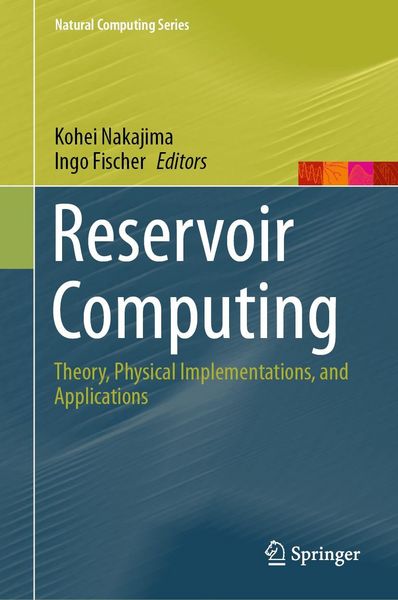
Reservoir Computing Theory, Physical Implementations, and Applications
219,99 €
inkl. gesetzl. MwSt.Beschreibung
Produktdetails
Format
Kopierschutz
Nein
Family Sharing
Nein
Text-to-Speech
Nein
Erscheinungsdatum
05.08.2021
Herausgeber
Kohei Nakajima + weitereVerlag
Springer Nature SingaporeSeitenzahl
458 (Printausgabe)
Dateigröße
21355 KB
Sprache
Englisch
EAN
9789811316876
This book is the first comprehensive book about reservoir computing (RC). RC is a powerful and broadly applicable computational framework based on recurrent neural networks. Its advantages lie in small training data set requirements, fast training, inherent memory and high flexibility for various hardware implementations. It originated from computational neuroscience and machine learning but has, in recent years, spread dramatically, and has been introduced into a wide variety of fields, including complex systems science, physics, material science, biological science, quantum machine learning, optical communication systems, and robotics. Reviewing the current state of the art and providing a concise guide to the field, this book introduces readers to its basic concepts, theory, techniques, physical implementations and applications.
The book is sub-structured into two major parts: theory and physical implementations. Both parts consist of a compilation of chapters, authored byleading experts in their respective fields. The first part is devoted to theoretical developments of RC, extending the framework from the conventional recurrent neural network context to a more general dynamical systems context. With this broadened perspective, RC is not restricted to the area of machine learning but is being connected to a much wider class of systems. The second part of the book focuses on the utilization of physical dynamical systems as reservoirs, a framework referred to as physical reservoir computing. A variety of physical systems and substrates have already been suggested and used for the implementation of reservoir computing. Among these physical systems which cover a wide range of spatial and temporal scales, are mechanical and optical systems, nanomaterials, spintronics, and quantum many body systems.
This book offers a valuable resource for researchers (Ph.D. students and experts alike) and practitioners working in the field of machine learning,artificial intelligence, robotics, neuromorphic computing, complex systems, and physics.
Noch keine Bewertungen vorhanden
Verfassen Sie die erste Bewertung zu diesem Artikel
Helfen Sie anderen Kundinnen und Kunden durch Ihre Meinung.
Kurze Frage zu unserer Seite
Vielen Dank für Ihr Feedback
Wir nutzen Ihr Feedback, um unsere Produktseiten zu verbessern. Bitte haben Sie Verständnis, dass wir Ihnen keine Rückmeldung geben können. Falls Sie Kontakt mit uns aufnehmen möchten, können Sie sich aber gerne an unseren Kund*innenservice wenden.
zum Kundenservice