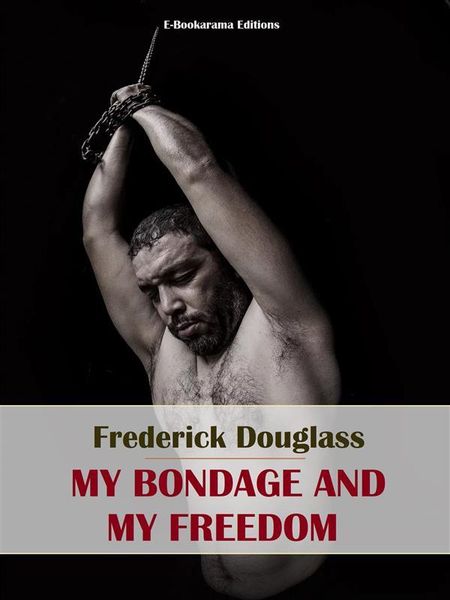
My Bondage and My Freedom
-
- Hardcover
- Taschenbuch
- eBook ausgewählt
- Hörbuch
-
Form:Einzelkauf Download
-
Sprache:Englisch
-
Verlag:E-Bookarama
- MVP 0,49 €
- Zenith Crescent Moon Press 0,99 €
- Zenith Golden Quill 0,99 €
- Merkaba Press 0,91 €
- FrontPage Publishing 0,99 €
- Zenith Evergreen Literary Co. 0,99 €
- Wilder Publications, Inc. 0,50 €
- Madison & Adams Press 0,99 €
- Andura Publishing 0,99 €
- Booklassic 0,88 €
- Pocket Classic 0,99 €
- Jovian Press 0,99 €
- Passerino 0,99 €
- Good Press 0,99 €
- AB Books 0,49 €
- Musaicum Books 0,49 €
- JA 0,49 €
- E-Bookarama ausgewählt
- DigiCat 0,49 €
0,99 €
inkl. gesetzl. MwSt.Beschreibung
Produktdetails
Format
ePUB
Kopierschutz
Nein
Family Sharing
Ja
Text-to-Speech
Ja
Altersempfehlung
ab 13 Jahr(e)
Erscheinungsdatum
09.07.2023
Verlag
E-BookaramaSeitenzahl
(Printausgabe)
Dateigröße
1159 KB
Sprache
Englisch
EAN
9788835386889
Born into slavery in 1818, Frederick Douglass would escape and gain his freedom by his 20th birthday. But rather than be content with his own liberty, he worked to gain attention for the cause of abolition, or the end of slavery. He was particularly gifted in his use of both the written and spoken word, making many doubt that he was ever a slave.
"My Bondage and My Freedom", published in 1855, is an example of a genre of literature known as the slave narrative. This genre flourished from around 1760 and though the first few decades after the abolition of slavery. One of the most famous examples is the interesting "Narrative of the Life of Olaudah Equiano", but the most famous writer of a slave a narrative almost certainly has to be Frederick Douglas. So much did the iconoclastic Douglass have to share about the reality of slavery that "My Bondage and My Freedom" is actually his second publication. The first-and more famous-is his groundbreaking "Narrative of the Life of Frederick Douglass, an American Slave: Written by Himself".
Technically, "My Bondage and My Freedom" is considered a revised and expanded version of that original publication in that it serves to update readers on what has occurred in the decade since the earlier narrative was published. These additions are primarily focused on his encounter with racism in the northern states, his activism in the name of abolition, most significantly, his decision to break away from William Lloyd Garrison and the white abolitionist leaders to establish the primacy of the black voice in the call to end slavery.
Central to this slave narrative if Douglass' fervent expression of his contention that the institutions of slavery corrupts and dehumanises not just the slave, but the slaveowner and non-slaveholder who condones the practice.
"My Bondage and My Freedom", published in 1855, is an example of a genre of literature known as the slave narrative. This genre flourished from around 1760 and though the first few decades after the abolition of slavery. One of the most famous examples is the interesting "Narrative of the Life of Olaudah Equiano", but the most famous writer of a slave a narrative almost certainly has to be Frederick Douglas. So much did the iconoclastic Douglass have to share about the reality of slavery that "My Bondage and My Freedom" is actually his second publication. The first-and more famous-is his groundbreaking "Narrative of the Life of Frederick Douglass, an American Slave: Written by Himself".
Technically, "My Bondage and My Freedom" is considered a revised and expanded version of that original publication in that it serves to update readers on what has occurred in the decade since the earlier narrative was published. These additions are primarily focused on his encounter with racism in the northern states, his activism in the name of abolition, most significantly, his decision to break away from William Lloyd Garrison and the white abolitionist leaders to establish the primacy of the black voice in the call to end slavery.
Central to this slave narrative if Douglass' fervent expression of his contention that the institutions of slavery corrupts and dehumanises not just the slave, but the slaveowner and non-slaveholder who condones the practice.
Noch keine Bewertungen vorhanden
Verfassen Sie die erste Bewertung zu diesem Artikel
Helfen Sie anderen Kundinnen und Kunden durch Ihre Meinung.
Kurze Frage zu unserer Seite
Vielen Dank für Ihr Feedback
Wir nutzen Ihr Feedback, um unsere Produktseiten zu verbessern. Bitte haben Sie Verständnis, dass wir Ihnen keine Rückmeldung geben können. Falls Sie Kontakt mit uns aufnehmen möchten, können Sie sich aber gerne an unseren Kund*innenservice wenden.
zum Kundenservice