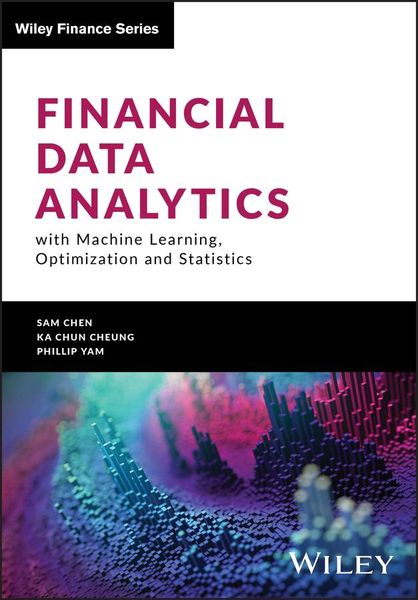
Financial Data Analytics with Machine Learning, Optimization and Statistics
-
- Englisch ausgewählt
59,99 €
inkl. gesetzl. MwSt.,
Beschreibung
Produktdetails
Einband
Gebundene Ausgabe
Erscheinungsdatum
12.11.2024
Verlag
John Wiley & SonsSeitenzahl
816
Maße (L/B/H)
23,6/17,5/4,8 cm
Gewicht
1202 g
Auflage
1. Auflage
Sprache
Englisch
ISBN
978-1-119-86337-3
In Financial Data Analytics with Machine Learning, Optimization and Statistics, a team consisting of a distinguished applied mathematician and statistician, experienced actuarial professionals and working data analysts delivers an expertly balanced combination of traditional financial statistics, effective machine learning tools, and mathematics. The book focuses on contemporary techniques used for data analytics in the financial sector and the insurance industry with an emphasis on mathematical understanding and statistical principles and connects them with common and practical financial problems. Each chapter is equipped with derivations and proofs--especially of key results--and includes several realistic examples which stem from common financial contexts. The computer algorithms in the book are implemented using Python and R, two of the most widely used programming languages for applied science and in academia and industry, so that readers can implement the relevant models and use the programs themselves.
The book begins with a brief introduction to basic sampling theory and the fundamentals of simulation techniques, followed by a comparison between R and Python. It then discusses statistical diagnosis for financial security data and introduces some common tools in financial forensics such as Benford's Law, Zipf's Law, and anomaly detection. The statistical estimation and Expectation-Maximization (EM) & Majorization-Minimization (MM) algorithms are also covered. The book next focuses on univariate and multivariate dynamic volatility and correlation forecasting, and emphasis is placed on the celebrated Kelly's formula, followed by a brief introduction to quantitative risk management and dependence modelling for extremal events. A practical topic on numerical finance for traditional option pricing and Greek computations immediately follows as well as other important topics in financial data-driven aspects, such as Principal Component Analysis (PCA) and recommender systems with their applications, as well as advanced regression learners such as kernel regression and logistic regression, with discussions on model assessment methods such as simple Receiver Operating Characteristic (ROC) curves and Area Under Curve (AUC) for typical classification problems.
The book then moves on to other commonly used machine learning tools like linear classifiers such as perceptrons and their generalization, the multilayered counterpart (MLP), Support Vector Machines (SVM), as well as Classification and Regression Trees (CART) and Random Forests. Subsequent chapters focus on linear Bayesian learning, including well-received credibility theory in actuarial science and functional kernel regression, and non-linear Bayesian learning, such as the Naïve Bayes classifier and the Comonotone-Independence Bayesian Classifier (CIBer) recently independently developed by the authors and used successfully in InsurTech.
After an in-depth discussion on cluster analyses such as K-means clustering and its inversion, the K-nearest neighbor (KNN) method, the book concludes by introducing some useful deep neural networks for FinTech, like the potential use of the Long-Short Term Memory model (LSTM) for stock price prediction.
This book can help readers become well-equipped with the following skills:
* To evaluate financial and insurance data quality, and use the distilled knowledge obtained from the data after applying data analytic tools to make timely financial decisions
* To apply effective data dimension reduction tools to enhance supervised learning
* To describe and select suitable data analytic tools as introduced above for a given dataset depending upon classification or regression prediction purpose
The book covers the competencies tested by several professional examinatio
Noch keine Bewertungen vorhanden
Verfassen Sie die erste Bewertung zu diesem Artikel
Helfen Sie anderen Kundinnen und Kunden durch Ihre Meinung.
Kurze Frage zu unserer Seite
Vielen Dank für Ihr Feedback
Wir nutzen Ihr Feedback, um unsere Produktseiten zu verbessern. Bitte haben Sie Verständnis, dass wir Ihnen keine Rückmeldung geben können. Falls Sie Kontakt mit uns aufnehmen möchten, können Sie sich aber gerne an unseren Kund*innenservice wenden.
zum Kundenservice