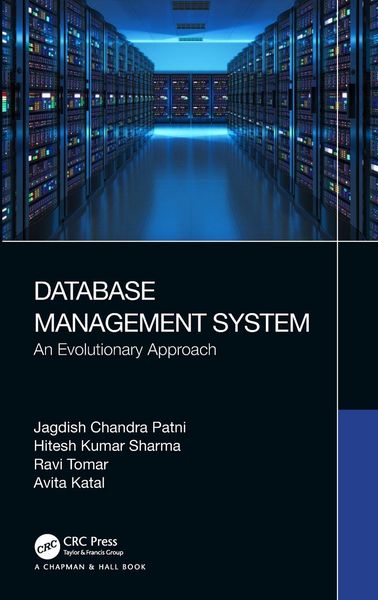
Produktbild: Database Management System

Database Management System An Evolutionary Approach

178,99 €

inkl. gesetzl. MwSt., Versandkostenfrei


Beschreibung

Produktdetails

Einband

Gebundene Ausgabe

Erscheinungsdatum

27.01.2022

Abbildungen

schwarz-weiss Illustrationen, Zeichnungen, schwarz-weiss, Tabellen, schwarz-weiss

Verlag

Taylor & Francis

Seitenzahl

229

Maße (L/B/H)

24/16,1/1,8 cm

Gewicht

520 g

Sprache

Englisch

ISBN

978-0-367-24493-4

Beschreibung

Produktdetails

Einband

Gebundene Ausgabe

Erscheinungsdatum

27.01.2022

Abbildungen

schwarz-weiss Illustrationen, Zeichnungen, schwarz-weiss, Tabellen, schwarz-weiss

Verlag

Taylor & Francis

Seitenzahl

229

Maße (L/B/H)

24/16,1/1,8 cm

Gewicht

520 g

Sprache

Englisch

ISBN

978-0-367-24493-4

Herstelleradresse

Libri GmbH
Europaallee 1
36244 Bad Hersfeld
DE

Email: gpsr@libri.de

Noch keine Bewertungen vorhanden

Verfassen Sie die erste Bewertung zu diesem Artikel

Helfen Sie anderen Kundinnen und Kunden durch Ihre Meinung.

Kundinnen und Kunden meinen

Bewertungen (0)

Die Leseprobe wird geladen.
  • Produktbild: Database Management System
  • 1. Basics of Database. 1.1 Introduction and History of Database. 1.2 Data and Information. 1.3 Database. 1.4 Need for a Database. 1.5 File based database management system. 1.6 Database System. 1.7 Database System components. 1.8 Database Management System Services. 1.9 Database Characteristics. 1.10 Advantages of Database. 1.11 Limitations of Database. Case Studies. Summary. Review Questions. References. 2. Data models and Architecture of DBMS. 2.1 Evolution of Data Model. 2.2 Hierarchical Database Model. 2.3 Network Data Model. 2.4 Relational Database Model. 2.5 Object Oriented Data Model. 2.6 Object Relational Data Model. 2.7 Three Level Architecture of Database. 2.8 Data Independence. 2.9 Database Languages. Summary. Review Questions. References. 3. Relational Database Management System (RDBMS). 3.1 Difference Between RDBMS and DBMS. 3.2 Features of RDBMS. 3.3 Advantages of RDBMS. 3.4 Disadvantages of RDBMS. 3.5 Examples of RDBMS. 3.6 RDBMS Terminologies. 3.7 Keys in Database. 3.8 Integrity Constraints in DBMS. 3.9 Relational Algebra. 3.10 Structured Query Language (SQL). 3.11 CODD's Twelve Rules of Relational Database. 3.12 Database Development Life Cycle. Summary. Case Studies. Review Questions. References. 4. Entity Relationship Model. 4.1 Entity Relationship Diagram. 4.2 Components of a ER Diagram. 4.3 Participation Constraints. 4.4 Strong and Weak Relationship. 4.5 Handling Many to Many Relationship. 4.6 Example of E-R Model. 4.7 Enhanced Entity-Relationship Model. 4.8 Reduction of ER Diagram to Relational model. Summary. Review Questions. References. 5. Normalization. 5.1 Introduction Normalization -A bottom up approach. 5.2 Need for Normalization. 5.3 Types of Dependencies. 5.4 First Normal Form. 5.5 Second Normal Form. 5.6 Third Normal Form. 5.7 Boyce-Codd Normal Form. 5.8 Multi-valued Dependency. 5.9 Join Dependency. 5.10 Lossless and Lossy Decompositions. Summary. Review Questions. References. 6. Managing Data Using Structured Query Language (SQL). 6.1 Introduction to SQL. 6.2 Data Definition Commands. 6.3 Data Manipulation Language (DML). 6.4 Data Control Language. 6.5 Transaction Control Language (TCL). 6.6 Data Query Language (DQL). 6.7 Aggregate Functions. 6.8 Date and Time Functions. 6.9 String Functions. 6.10 Conversion Functions. 6.11 Mathematical Functions. 6.12 Special Operators. 6.13 Types of Constraints. 6.14 Sub Query. Summary. Review Question. References. 7. Introduction to PL/SQL. 7.1 Variable and Constants. 7.2 Data Types. 7.3 PL/SQL Literals. 7.4 Control Statement. 7.5 PL/SQL case statement. 7.6 PL/SQL Loop. 7.7 PL/SQL Continue statement. 7.8 PL/SQL GOTO statement. 7.9 PL/SQL Procedure and Functions. 7.10 PL/SQL cursor. 7.11 PL/SQL Exception. 7.12 PL/SQL Exception Handling. 7.13 PL/SQL Triggers. Summary. Review Questions. References. 8. Transaction Management in Database. 8.1 Definition of Transaction. 8.2 Properties of Transaction. 8.3 States of Transactions. 8.4 Schedule. 8.5 Serializability. 8.6 Recoverable Schedules. 8.7 Concurrency Control. 8.8 Concurrency Control Mechanism. 8.9 Database Back UP and Recovery. 8.10 Security, Integration and Authorization. Summary. Review Questions. References.