Gutscheinbedingungen

**Gültig bis 06.07.2026 auf fremdsprachige Bücher online auf thalia.at, in der Thalia App ab einem Mindestbestellwert von 30€ und in allen Thalia Buchhandlungen in Österreich. In den Buchhandlungen nur gültig auf lagernde Ware. Einzelne Artikel können ausgeschlossen sein. Ausgenommen sind preisgebundene Artikel & eBooks. Pro Einkauf einmal einlösbar. Nur gültig gegen Vorlage oder im Onlineshop hinterlegter Bonuscard. Infos zur Einlösung in der Buchhandlung sind auf der Bonuscard-Vorteilspreisseite zu finden. Click & Collect nur bei Onlinevorabzahlung möglich. Keine Einlösung bei Scan & Go-Bezahlung. Keine Barauszahlung. Nicht kombinierbar mit anderen Aktionen und Gutscheinen. Gutschein wird auf max. 500€ Bestellwert angerechnet. Nicht gültig für Versandkosten und Services.

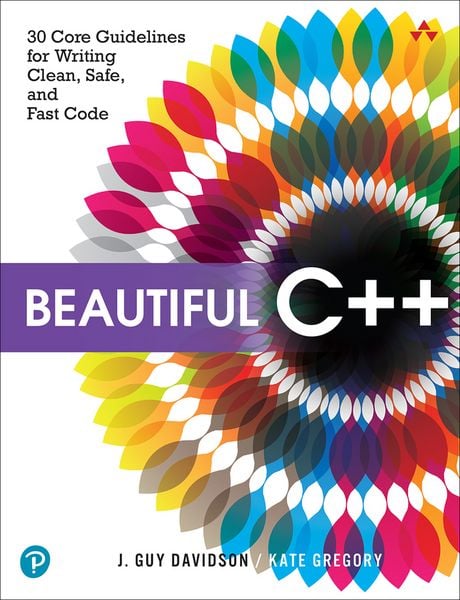
Produktbild: Beautiful C++: 30 Core Guidelines for Writing Clean, Safe, and Fast Code
- 10%

Beautiful C++: 30 Core Guidelines for Writing Clean, Safe, and Fast Code

10% sparen

36,99 € UVP 41,49 €

inkl. gesetzl. MwSt., Versandkostenfrei


Beschreibung

Produktdetails

Einband

Taschenbuch

Erscheinungsdatum

02.04.2022

Verlag

Pearson Studium

Seitenzahl

352

Maße (L/B/H)

23,5/17,8/2 cm

Gewicht

560 g

Auflage

1

Sprache

Englisch

ISBN

978-0-13-764784-2

Beschreibung

Produktdetails

Einband

Taschenbuch

Erscheinungsdatum

02.04.2022

Verlag

Pearson Studium

Seitenzahl

352

Maße (L/B/H)

23,5/17,8/2 cm

Gewicht

560 g

Auflage

1

Sprache

Englisch

ISBN

978-0-13-764784-2

Herstelleradresse


Email: GPSR Kontakt

Noch keine Bewertungen vorhanden

Verfassen Sie die erste Bewertung zu diesem Artikel

Helfen Sie anderen Kundinnen und Kunden durch Ihre Meinung.

Kundinnen und Kunden meinen

Bewertungen (0)

Die Leseprobe wird geladen.
  • Produktbild: Beautiful C++: 30 Core Guidelines for Writing Clean, Safe, and Fast Code
  • List of Selected C++ Core Guidelines xiii

    Foreword xv

    Preface xvii

    Acknowledgments xxi

    About the Authors xxiii

    Section 1: Bikeshedding is bad 1

    Chapter 1.1: P.2: Write in ISO Standard C++ 3

    Chapter 1.2: F.51: Where there is a choice, prefer default arguments over overloading 13

    Chapter 1.3: C.45: Don't define a default constructor that only initializes data members; use in-class member initializers instead 23

    Chapter 1.4: C.131: Avoid trivial getters and setters 31

    Chapter 1.5: ES.10: Declare one name (only) per declaration 41

    Chapter 1.6: NR.2: Don't insist to have only a single return-statement in a function 49

    Section 2: Don't hurt yourself 59

    Chapter 2.1: P.11: Encapsulate messy constructs, rather than spreading through the code 61

    Chapter 2.2: I.23: Keep the number of function arguments low 71

    Chapter 2.3: I.26: If you want a cross-compiler ABI, use a C-style subset 79

    Chapter 2.4: C.47: Define and initialize member variables in the order of member declaration 87

    Chapter 2.5: CP.3: Minimize explicit sharing of writable data 97

    Chapter 2.6: T.120: Use template metaprogramming only when you really need to 107

    Section 3: Stop using that 119

    Chapter 3.1: I.11: Never transfer ownership by a raw pointer (T*) or reference (T&) 121

    Chapter 3.2: I.3: Avoid singletons 129

    Chapter 3.3: C.90: Rely on constructors and assignment operators, not memset and memcpy 139

    Chapter 3.4: ES.50: Don't cast away const 149

    Chapter 3.5: E.28: Avoid error handling based on global state (e.g. errno)159

    Chapter 3.6: SF.7: Don't write using namespace at global scope in a header file 169

    Section 4: Use this new thing properly 179

    Chapter 4.1: F.21: To return multiple "out" values, prefer returning a struct or tuple 181

    Chapter 4.2: Enum.3: Prefer class enums over "plain" enums 193

    Chapter 4.3: ES.5: Keep scopes small 201

    Chapter 4.4: Con.5: Use constexpr for values that can be computed at compile time 213

    Chapter 4.5: T.1: Use templates to raise the level of abstraction of code 225

    Chapter 4.6: T.10: Specify concepts for all template arguments 235

    Section 5: Write code well by default 45

    Chapter 5.1: P.4: Ideally, a program should be statically type safe 247

    Chapter 5.2: P.10: Prefer immutable data to mutable data 259

    Chapter 5.3: I.30: Encapsulate rule violations 267

    Chapter 5.4: ES.22: Don't declare a variable until you have a value to initialize it with 275

    Chapter 5.5: Per.7: Design to enable optimization 285

    Chapter 5.6: E.6: Use RAII to prevent leaks 293

    Envoi 305

    Afterword 307

    Index 309