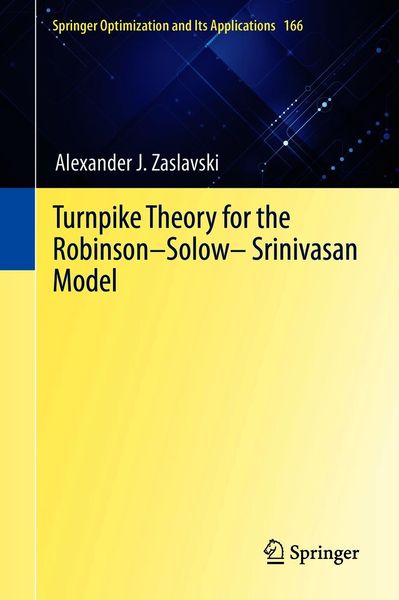
Turnpike Theory for the Robinson-Solow-Srinivasan Model
-
- Hardcover
- Taschenbuch
- eBook ausgewählt
-
Form:Einzelkauf Download
-
Sprache:Englisch
98,99 €
inkl. gesetzl. MwSt.Beschreibung
Produktdetails
Format
Kopierschutz
Nein
Family Sharing
Nein
Text-to-Speech
Nein
Erscheinungsdatum
04.01.2021
Verlag
Springer Nature SwitzerlandSeitenzahl
442 (Printausgabe)
Dateigröße
4505 KB
Sprache
Englisch
EAN
9783030603076
This book is devoted to the study of a class of optimal control problems arising in mathematical economics, related to the Robinson-Solow-Srinivasan (RSS) model. It will be useful for researches interested in the turnpike theory, infinite horizon optimal control and their applications, and mathematical economists. The RSS is a well-known model of economic dynamics that was introduced in the 1960s and as many other models of economic dynamics, the RSS model is determined by an objective function (a utility function) and a set-valued mapping (a technology map). The set-valued map generates a dynamical system whose trajectories are under consideration and the objective function determines an optimality criterion. The goal is to find optimal trajectories of the dynamical system, using the optimality criterion.
Chapter 1 discusses turnpike properties for some classes of discrete time optimal control problems. Chapter 2 present the description of the RSS model and discuss its basic properties. Infinite horizon optimal control problems, related to the RSS model are studied in Chapter 3. Turnpike properties for the RSS model are analyzed in Chapter 4. Chapter 5 studies infinite horizon optimal control problems related to the RSS model with a nonconcave utility function. Chapter 6 focuses on infinite horizon optimal control problems with nonautonomous optimality criterions. Chapter 7 contains turnpike results for a class of discrete-time optimal control problems. Chapter 8 discusses the RSS model and compares different optimality criterions. Chapter 9 is devoted to the study of the turnpike properties for the RSS model. In Chapter 10 the one-dimensional autonomous RSS model is considered and the continuous time RSS model is studied in Chapter 11.Noch keine Bewertungen vorhanden
Verfassen Sie die erste Bewertung zu diesem Artikel
Helfen Sie anderen Kundinnen und Kunden durch Ihre Meinung.
Kurze Frage zu unserer Seite
Vielen Dank für Ihr Feedback
Wir nutzen Ihr Feedback, um unsere Produktseiten zu verbessern. Bitte haben Sie Verständnis, dass wir Ihnen keine Rückmeldung geben können. Falls Sie Kontakt mit uns aufnehmen möchten, können Sie sich aber gerne an unseren Kund*innenservice wenden.
zum Kundenservice