
Gutscheinbedingungen

**Gültig bis 25.06.2026 auf fremdsprachige Bücher online auf thalia.at und in der Thalia App. Einzelne Artikel können ausgeschlossen sein. Ausgenommen sind preisgebundene Artikel & eBooks. Pro Einkauf einmal einlösbar. Click & Collect nur bei Onlinevorabzahlung möglich. Keine Barauszahlung. Nicht kombinierbar mit anderen Aktionen und Gutscheinen. Gutschein wird auf max. 500€ Bestellwert angerechnet. Nicht gültig für Geschenkkarten, Versandkosten und Services.

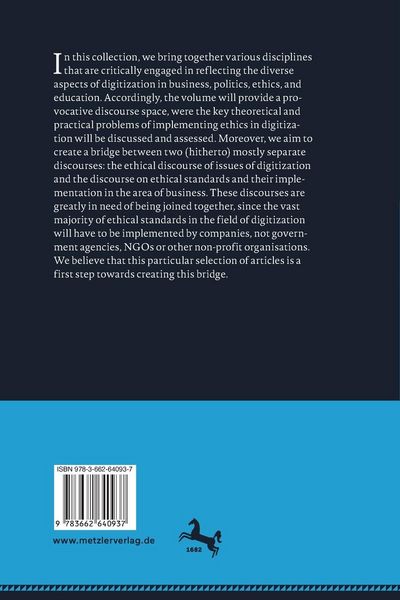
  • Produktbild: Business Ethics and Digitization
  • Produktbild: Business Ethics and Digitization

Business Ethics and Digitization

69,99 €

inkl. gesetzl. MwSt., Versandkostenfrei


Beschreibung

Produktdetails

Einband

Taschenbuch

Erscheinungsdatum

06.08.2022

Herausgeber

Christoph Lütge + weitere

Verlag

Springer Berlin

Seitenzahl

125

Maße (L/B/H)

23,5/15,5/0,8 cm

Gewicht

219 g

Auflage

1st edition 2022

Sprache

Englisch

ISBN

978-3-662-64093-7

Beschreibung

Portrait

Prof. Dr. Christoph Lütge is director of the Institute for Ethics in Artificial Intelligence (IEAI), founded in 2019 at the Technical University of Munich and holds the Peter-Löscher Endowed Chair of Business Ethics. Prof. Dr. Lütge conducts research in the field of business ethics and investigates ethical agency under the conditions of globalization and digitization. In specific, he explores regulatory ethics – ethical behavior in the socio-economic framework of a globalized world.

Prof. Dr. Matthias Uhl is professor for "social implications and ethical aspects of AI" at Technische Hochschule Ingolstadt. Prof. Dr. Uhl's research concentrates on ethics of digitization and business ethics. Further research interests are experimental ethics, experimental economics and behavioral economics as well as the theory of science.

Alexander Kriebitz is a political scientist, who studies the overlap of international law, business ethics and international relations. His current project is a re-examination of literature on Business and Human Rights and the division of labor between states and companies in fulfilling human rights responsibilities. To this end, Alexander Kriebitz published research articles in the Business and Human Rights Journal and in the Human Rights Review.

Raphael Max is an economist with a philosophical background who studies political, economic and social conditions of human behavior in a modern globalized world. A particular focus of his research is the discrepancy between moral judgment and human action. Raphael’s current project is the analysis of the normative perception of economic activities under uncertainty and moral evaluation of investment decisions.


Produktdetails

Einband

Taschenbuch

Erscheinungsdatum

06.08.2022

Herausgeber

Verlag

Springer Berlin

Seitenzahl

125

Maße (L/B/H)

23,5/15,5/0,8 cm

Gewicht

219 g

Auflage

1st edition 2022

Sprache

Englisch

ISBN

978-3-662-64093-7

Herstelleradresse

Springer-Verlag GmbH
Tiergartenstr. 17
69121 Heidelberg
DE

Email: ProductSafety@springernature.com

Kundinnen und Kunden meinen

0 Bewertungen

Informationen zu Bewertungen

Zur Abgabe einer Bewertung ist eine Anmeldung im Konto notwendig. Die Authentizität der Bewertungen wird von uns nicht überprüft. Wir behalten uns vor, Bewertungstexte, die unseren Richtlinien widersprechen, entsprechend zu kürzen oder zu löschen.

Die Bewertungen sind nach Format, Anzahl Sterne und Datum sortiert.

Verfassen Sie die erste Bewertung zu diesem Artikel

Helfen Sie anderen Kund*innen durch Ihre Meinung

Kundinnen und Kunden meinen

0 Bewertungen filtern

  • Produktbild: Business Ethics and Digitization
  • Produktbild: Business Ethics and Digitization
  • Chapter I Business Ethics for the Digital Era.- Chapter II Digitalization and Business Ethics for a Cyber Peace.- Chapter III Artificial General Intelligence in Human Interface – Its Impact on Society and Human Being.- Chapter IV Digital Communication in and beyond Organizations – A Path to Hyperinclusion.- Chapter V Categorization of Risk Management: Clinical Research and Global Justice.- Chapter VI Digitization, Unemployment, and Distributive Justice.- Chapter VII Use of Soviet constructivism experience in urban planning of a contemporary city for digitized society.- Chapter VIII Outline of Ethical Issues Concerning Government, Business and Information Technologies.