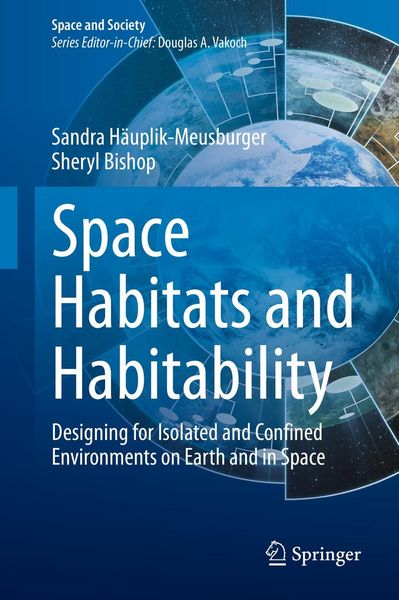
Space Habitats and Habitability Designing for Isolated and Confined Environments on Earth and in Space
-
- Hardcover
- Taschenbuch
- eBook ausgewählt
-
Form:Einzelkauf Download
-
Sprache:Englisch
197,99 €
inkl. gesetzl. MwSt.Beschreibung
Produktdetails
Format
Kopierschutz
Nein
Family Sharing
Nein
Text-to-Speech
Nein
Erscheinungsdatum
31.05.2021
Verlag
SpringerSeitenzahl
250 (Printausgabe)
Dateigröße
12035 KB
Sprache
Englisch
EAN
9783030697402
This book explores creative solutions to the unique challenges inherent in crafting livable spaces in extra-terrestrial environments. The goal is to foster a constructive dialogue between the researchers and planners of future (space) habitats. The authors explore the diverse concepts of the term Habitability from the perspectives of the inhabitants as well as the planners and social sciences.
The book provides an overview of the evolution and advancements of designed living spaces for manned space craft, as well as analogue research and simulation facilities in extreme environments on Earth. It highlights how various current and future concepts of Habitability have been translated into design and which ones are still missing. The main emphasis of this book is to identify the important factors that will provide for well-being in our future space environments and promote creative solutions to achieving living spaces where humans can thrive. Selected aspects are discussed from a socio-spatial professional background and possible applications are illustrated.
Human factors and habitability design are important topics for all working and living spaces. For space exploration, they are vital. While human factors and certain habitability issues have been integrated into the design process of manned spacecraft, there is a crucial need to move from mere survivability to factors that support thriving. As of today, the risk of an incompatible vehicle or habitat design has already been identified by NASA as recognized key risk to human health and performance in space. Habitability and human factors will become even more important determinants for the design of future long-term and commercial space facilities as larger and more diverse groups occupy off-earth habitats.
The book will not only benefit individuals and organizations responsible for manned space missions and mission simulators, but also provides relevant informationto designers of terrestrial austere environments (e.g., remote operational and research facilities, hospitals, prisons, manufacturing). In addition it presents general insights on the socio-spatial relationship which is of interest to researchers of social sciences, engineers and architects.
Noch keine Bewertungen vorhanden
Verfassen Sie die erste Bewertung zu diesem Artikel
Helfen Sie anderen Kundinnen und Kunden durch Ihre Meinung.
Kurze Frage zu unserer Seite
Vielen Dank für Ihr Feedback
Wir nutzen Ihr Feedback, um unsere Produktseiten zu verbessern. Bitte haben Sie Verständnis, dass wir Ihnen keine Rückmeldung geben können. Falls Sie Kontakt mit uns aufnehmen möchten, können Sie sich aber gerne an unseren Kund*innenservice wenden.
zum Kundenservice