KI-Beratung Beta

  • Produktbild: Understanding Artificial Intelligence
  • Produktbild: Understanding Artificial Intelligence

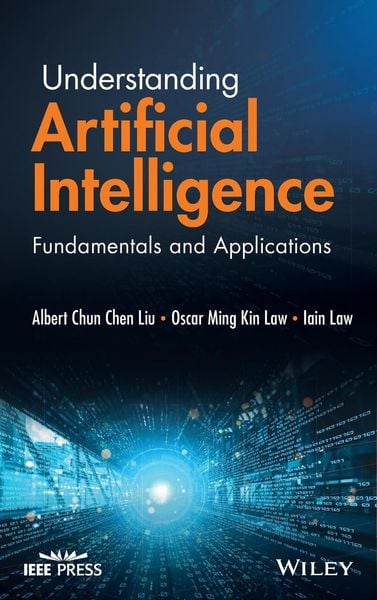
Understanding Artificial Intelligence Fundamentals and Applications

129,99 €

inkl. gesetzl. MwSt., Versandkostenfrei


Beschreibung

Understanding Artificial Intelligence   Provides students across majors with a clear and accessible overview of new artificial intelligence technologies and applications   Artificial intelligence (AI) is broadly defined as computers programmed to simulate the cognitive functions of the human mind. In combination...

Beschreibung

Understanding Artificial Intelligence
 
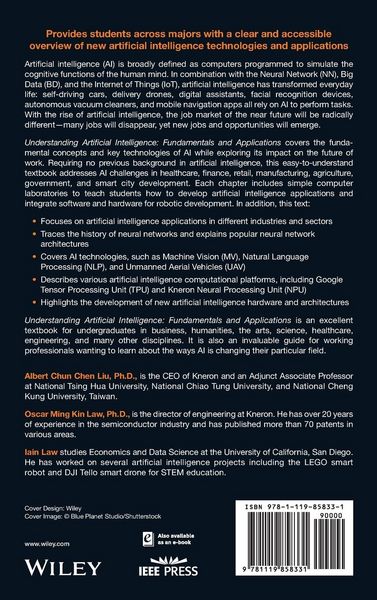
Provides students across majors with a clear and accessible overview of new artificial intelligence technologies and applications
 
Artificial intelligence (AI) is broadly defined as computers programmed to simulate the cognitive functions of the human mind. In combination with the Neural Network (NN), Big Data (BD), and the Internet of Things (IoT), artificial intelligence has transformed everyday life: self-driving cars, delivery drones, digital assistants, facial recognition devices, autonomous vacuum cleaners, and mobile navigation apps all rely on AI to perform tasks. With the rise of artificial intelligence, the job market of the near future will be radically different???many jobs will disappear, yet new jobs and opportunities will emerge.
 
Understanding Artificial Intelligence: Fundamentals and Applications covers the fundamental concepts and key technologies of AI while exploring its impact on the future of work. Requiring no previous background in artificial intelligence, this easy-to-understand textbook addresses AI challenges in healthcare, finance, retail, manufacturing, agriculture, government, and smart city development. Each chapter includes simple computer laboratories to teach students how to develop artificial intelligence applications and integrate software and hardware for robotic development. In addition, this text:
* Focuses on artificial intelligence applications in different industries and sectors
* Traces the history of neural networks and explains popular neural network architectures
* Covers AI technologies, such as Machine Vision (MV), Natural Language Processing (NLP), and Unmanned Aerial Vehicles (UAV)
* Describes various artificial intelligence computational platforms, including Google Tensor Processing Unit (TPU) and Kneron Neural Processing Unit (NPU)
* Highlights the development of new artificial intelligence hardware and architectures
 
Understanding Artificial Intelligence: Fundamentals and Applications is an excellent textbook for undergraduates in business, humanities, the arts, science, healthcare, engineering, and many other disciplines. It is also an invaluable guide for working professionals wanting to learn about the ways AI is changing their particular field.

Produktdetails

Einband

Gebundene Ausgabe

Erscheinungsdatum

21.09.2022

Verlag John Wiley & Sons Inc
Seitenzahl

224

Produktdetails

Einband

Gebundene Ausgabe

Erscheinungsdatum

21.09.2022

Verlag John Wiley & Sons Inc
Seitenzahl

224

Maße (L/B/H)

23,5/15,7/1,7 cm

Gewicht

484 g

Auflage

1. Auflage

Sprache

Englisch

ISBN

978-1-119-85833-1

Herstelleradresse

Libri GmbH
Europaallee 1
36244 Bad Hersfeld
DE

Email: gpsr@libri.de

Noch keine Bewertungen vorhanden

Verfassen Sie die erste Bewertung zu diesem Artikel

Helfen Sie anderen Kundinnen und Kunden durch Ihre Meinung.

Kundinnen und Kunden meinen

Bewertungen (0)

Die Leseprobe wird geladen.
  • Produktbild: Understanding Artificial Intelligence
  • Produktbild: Understanding Artificial Intelligence
  • 1 Introduction 1
     
    1.1 Overview 1
     
    1.2 Development History 3
     
    1.3 Neural Network Model 6
     
    1.4 Popular Neural Network 7
     
    1.4.1 Convolutional Neural Network 7
     
    1.4.2 Recurrent Neural Network 8
     
    1.4.3 Reinforcement Learning 9
     
    1.5 Neural Network Classification 9
     
    1.5.1 Supervised learning 10
     
    1.5.2 Semi-supervised learning 10
     
    1.5.3 Unsupervised learning 11
     
    1.6 Neural Network Operation 11
     
    1.6.1 Training 11
     
    1.6.2 Inference 12
     
    1.7 Application Development 12
     
    1.7.1 Business Planning 14
     
    1.7.2 Network Design 14
     
    1.7.3 Data Engineering 14
     
    1.7.4 System Integration 15
     
    Exercise 16
     
    2 Neural Network 17
     
    2.1 Convolutional Layer 19
     
    2.2 Activation Layer 20
     
    2.3 Pooling Layer 21
     
    2.4 Batch Normalization 22
     
    2.5 Dropout Layer 22
     
    2.6 Fully Connected Layer 23
     
    Exercise 24
     
    3 Machine Vision 25
     
    3.1 Object Recognition 25
     
    3.2 Feature Matching 27
     
    3.3 Facial Recognition 28
     
    3.4 Gesture Recognition 30
     
    3.5 Machine Vision Applications 31
     
    3.5.1 Medical Diagnosis 31
     
    3.5.2 Retail Applications 32
     
    3.5.3 Airport Security 33
     
    Exercise 34
     
    4 Natural Language Processing 35
     
    4.1 Neural Network Model 36
     
    4.1.1 Convolutional Neural Network 36
     
    4.1.2 Recurrent Neural Network 37
     
    4.1.2.1 Long Short-Term Memory Network 38
     
    4.1.3 Recursive Neural Network 39
     
    4.1.4 Reinforcement Learning 40
     
    4.2 Natural Language Processing Applications 41
     
    4.2.1 Virtual Assistant 41
     
    4.2.2 Language Translation 42
     
    4.2.3 Machine Transcription 43
     
    Exercise 45
     
    5 Autonomous Vehicle 46
     
    5.1 Levels of Driving Automation 46
     
    5.2 Autonomous Technology 48
     
    5.2.1 Computer Vision 48
     
    5.2.2 Sensor Fusion 49
     
    5.2.3 Localization 51
     
    5.2.4 Path Planning 52
     
    5.2.5 Drive Control 52
     
    5.3 Communication Strategies 53
     
    5.3.1 Vehicle-to-Vehicle Communication 54
     
    5.3.2 Vehicle-to-Infrastructure Communication 54
     
    5.3.3 Vehicle-to-Pedestrian Communication 55
     
    5.4 Law Legislation 56
     
    5.4.1 Human Behavior 57
     
    5.4.2 Lability 57
     
    5.4.3 Regulation 58
     
    5.5 Future Challenges 58
     
    5.5.1 Road Rules Variation 58
     
    5.5.2 Unified Communication Protocol 58
     
    5.5.3 Safety Standard and Guideline 59
     
    5.5.4 Weather/Disaster 59
     
    Exercise 60
     
    6 Drone 61
     
    6.1 Drone Design 61
     
    6.2 Drone Structure 62
     
    6.2.1 Camera 63
     
    6.2.2 Gyro Stabilization 63
     
    6.2.3 Collision Avoidance 64
     
    6.2.4 Global Positioning System 64
     
    6.2.5 Sensors 64
     
    6.3 Drone Regulation 65
     
    6.3.1 Recreational Rules 65
     
    6.3.2 Commercial Rules 66
     
    6.4 Applications 66
     
    6.4.1 Infrastructure Inspection 66
     
    6.4.2 Civil Construction 67
     
    6.4.3 Agriculture 68
     
    6.4.4 Emergency Rescue 69
     
    Exercise 70
     
    7 Healthcare 71
     
    7.1 Telemedicine 71
     
    7.2 Medical Diagnosis 72
     
    7.3 Medical Imaging 73
     
    7.4 Smart Medical Device 74
     
    7.5 Electronic Health Record 76
     
    7.6 Medical Billing 77
     
    7.7 Drug Development 78
     
    7.8 Clinical Trial 79
     
    7.9 Medical Robotics 80
     
    7.10 Elderly Care 81
     
    7.11 Future Chal