KI-Beratung Beta

Gutscheinbedingungen

**Gültig bis 30.11.2026 auf Spielzeug, Schreibwaren, Filme, Geschenke & Trends, Musik, tolino eReader & Zubehör, Hörbücher und Hörbuch-Downloads, nicht preisgebundene Bücher und Kalender online auf thalia.at und in der Thalia App. Einzelne Artikel können ausgeschlossen sein. Aufgrund der Buchpreisbindung sind deutschsprachige Bücher und eBooks ausgenommen. Zusätzlich ausgenommen sind Abos & Flatrates, Games, Geschenkkarten/-boxen, Shelfies, Software, Zeitschriften sowie einzelne Artikel von tonies®. Pro Einkauf einmal einlösbar. Nur gültig mit im Onlineshop hinterlegter Bonuscard. Click & Collect nur bei Onlinevorabzahlung möglich. Keine Barauszahlung. Nicht kombinierbar mit anderen Aktionen und Gutscheinen. Gutschein wird auf max. 500€ Bestellwert angerechnet. Nicht gültig für Versandkosten und Services.

  • Produktbild: Sentimental Analysis and Deep Learning
  • Produktbild: Sentimental Analysis and Deep Learning
Band 1408

Sentimental Analysis and Deep Learning Proceedings of ICSADL 2021

231,99 €

inkl. gesetzl. MwSt., Versandkostenfrei


Beschreibung

This book gathers selected papers presented at the International Conference on Sentimental Analysis and Deep Learning (ICSADL 2021), jointly organized by Tribhuvan University, Nepal; Prince of Songkla University, Thailand; and Ejesra during June, 18–19, 2021. The volume discusses state-of-the-art research...

Beschreibung

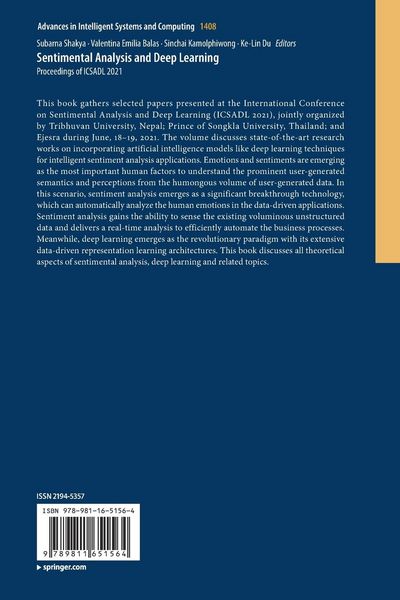
This book gathers selected papers presented at the International Conference on Sentimental Analysis and Deep Learning (ICSADL 2021), jointly organized by Tribhuvan University, Nepal; Prince of Songkla University, Thailand; and Ejesra during June, 18–19, 2021. The volume discusses state-of-the-art research works on incorporating artificial intelligence models like deep learning techniques for intelligent sentiment analysis applications. Emotions and sentiments are emerging as the most important human factors to understand the prominent user-generated semantics and perceptions from the humongous volume of user-generated data. In this scenario, sentiment analysis emerges as a significant breakthrough technology, which can automatically analyze the human emotions in the data-driven applications. Sentiment analysis gains the ability to sense the existing voluminous unstructured data and delivers a real-time analysis to efficiently automate the business processes. Meanwhile, deep learning emerges as the revolutionary paradigm with its extensive data-driven representation learning architectures. This book discusses all theoretical aspects of sentimental analysis, deep learning and related topics.

Portrait


Dr. Prof. Subarna Shakya
is currently Professor of Computer Engineering, Department of Electronics and Computer Engineering, Central Campus, Institute of Engineering, Pulchowk, Tribhuvan University, Coordinator (IOE), LEADER Project (Links in Europe and Asia for engineering, eDucation, Enterprise and Research exchanges), ERASMUS MUNDUS. He received M.Sc. and Ph.D. degrees in Computer Engineering from the Lviv Polytechnic National University, Ukraine, 1996 and 2000, respectively. His research area includes e-government systems, computer systems and simulation, distributed  and cloud computing,  software engineering and information systems, computer architecture, information security for e-government, multimedia systems.
Dr. Valentina E. Balas
is currently Full Professor at “Aurel Vlaicu” University of Arad, Romania. She is Author of more than 300 research papers. Her research interests are in intelligent systems, fuzzy control, soft computing. She is Editor-in Chief to International Journal of Advanced Intelligence Paradigms (IJAIP) and to IJCSE. He is Member of EUSFLAT, ACM and a SM IEEE, Member in TC–EC and TC-FS (IEEE CIS), TC–SC (IEEE SMCS), Joint Secretary FIM. 
Dr. Sinchai Kamolphiwong
is Director of CNR (Centre for Network Research), Prince of Songkla University, Department of Computer Engineering, Songkhla, Thailand. He had completed his Ph.D. in the University of New South Wales, Australia. He has secured awards and research grants in reputed organization. His research interest includes computer networks, tele-medicine and real-time communications. 
Dr. Ke-Lin Du
is Research scientist at Center for Signal Processing and Communications, Department of Electrical and Computer Engineering, Concordia University, since 2001, where he became Affiliate Associate Professor in 2011. His research area includes signal processing, wireless communications and soft computing.

Produktdetails

Einband

Taschenbuch

Erscheinungsdatum

26.10.2021

Abbildungen

XXXIII, 1030 p. 557 illus., 428 illus. in color.

Herausgeber Subarna Shakya + weitere

Produktdetails

Einband

Taschenbuch

Erscheinungsdatum

26.10.2021

Abbildungen

XXXIII, 1030 p. 557 illus., 428 illus. in color.

Herausgeber
Verlag Springer Singapore
Seitenzahl

1030

Maße (L/B/H)

23,5/15,5/5,7 cm

Gewicht

1574 g

Auflage

1. Auflage

Sprache

Englisch

ISBN

978-981-16-5156-4

Herstelleradresse

Springer-Verlag KG
Sachsenplatz 4-6
1201 Wien
AT

Email: ProductSafety@springernature.com

Noch keine Bewertungen vorhanden

Verfassen Sie die erste Bewertung zu diesem Artikel

Helfen Sie anderen Kundinnen und Kunden durch Ihre Meinung.

Kundinnen und Kunden meinen

Bewertungen (0)

  • Produktbild: Sentimental Analysis and Deep Learning
  • Produktbild: Sentimental Analysis and Deep Learning
  • Analysis of Healthcare Industry Using Machine Learning Approach: A Case Study in Bengaluru Region.- Dynamic Document Localization for Ecient Mining.- SentiSeries: A Trilogy of Customer Reviews, Sentiment Analysis and Time Series.- Video Summarization using Fully Convolutional Residual Dense Network.- An Efficient Deep Learning Approach for Detecting Pneumonia Using the Convolutional Neural Network.- QMCDS: Quantum Memory for Cloud Data Storage.- A Study towards Bangla Fake News Detection using Machine Learning and Deep Learning.- A Deep Learning Approach to Analyze the Propagation of Pandemic in America.- Graph Convolution Based Joint Learning of Rumour with Content, User Credibility, Propagation Context and Cognitive as well as Emotion Signals.- Deep Learning based Real Time Object Classification and Recognition using Supervised Learning Approach.