Gutscheinbedingungen

**Gültig bis 04.08.2026 ab einem Mindestbestellwert von 30€ auf Spielzeug, Schreibwaren, Filme, Geschenke & Trends, Musik, tolino eReader & Zubehör, Hörbücher und Hörbuch-Downloads (außer Abo), nicht preisgebundene Bücher und Kalender online auf thalia.at und in der Thalia App. Einzelne Artikel können ausgeschlossen sein. Aufgrund der Buchpreisbindung sind deutschsprachige Bücher und eBooks ausgenommen. Zusätzlich ausgenommen sind preisgebundene Artikel, Abos & Flatrates, eBooks, Games, Geschenkkarten/-boxen, Shelfies, Software, Zeitschriften sowie einzelne Artikel von tonies®. Pro Einkauf einmal einlösbar. Click & Collect nur bei Onlinevorabzahlung möglich. Keine Barauszahlung. Nicht kombinierbar mit anderen Aktionen und Gutscheinen. Gutschein wird auf max. 500€ Bestellwert angerechnet. Nicht gültig für Versandkosten und Services. Preisgebundene Artikel sind vom Mindestbestellwert ausgeschlossen.

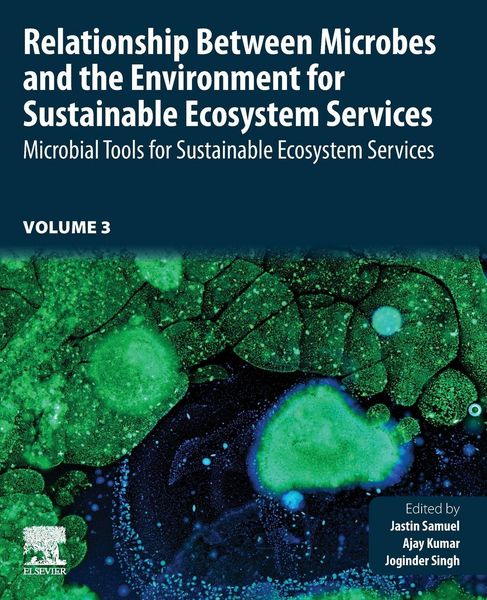
  • Produktbild: Relationship Between Microbes and the Environment for Sustainable Ecosystem Services, Volume 3
  • Produktbild: Relationship Between Microbes and the Environment for Sustainable Ecosystem Services, Volume 3
- 13%

Relationship Between Microbes and the Environment for Sustainable Ecosystem Services, Volume 3 Microbial Tools for Sustainable Ecosystem Services

13% sparen

142,99 € UVP 164,50 €

inkl. gesetzl. MwSt., Versandkostenfrei


Beschreibung

Produktdetails

Einband

Taschenbuch

Erscheinungsdatum

09.12.2022

Abbildungen

30 illustrations (15 in full color)

Herausgeber

Jastin Samuel + weitere

Verlag

Elsevier Science & Technology

Seitenzahl

342

Maße (L/B/H)

23,5/19,1/1,8 cm

Gewicht

590 g

Sprache

Englisch

ISBN

978-0-323-89936-9

Beschreibung

Portrait

Dr. Jastin Samuel (PhD) is working as Assistant Professor leading waste valorization research lab at Lovely Professional University, Phagwara, Punjab, India. He has more than a decade experience in R&D. He has been an active part of DST, EU-DBT, and CSIR-funded projects. He was awarded the prestigious CSIR-SRF fellowship in Engineering (ENG42) in 2013. Along with his team, he has developed lab-scale mine wastewater treatment system for opencast mines at Orissa, India; established ETP tertiary treatment facility for two industries (sugar industry and distillery industry) with reuse and business proposition in Andhra Pradesh, India, that is, approved by CPCB; established a water treatment facility at Pondicherry in PPP mode with the State Government. He is presently working on pathway assessment and mitigation of Micro and Nano-plastics. He has been a member of review boards of various journals and conferences in India and abroad.
Ajay Kumar is currently an Assistant Professor at the Amity Institute of Biotechnology, Amity University, Noida, India. He previously served as a Visiting Scientist at the Agricultural Research Organization, Volcani Center, Israel (2018-2022), and completed his doctoral research at the Department of Botany, Institute of Science, Banaras Hindu University, Varanasi, India, focusing on plant-microbe interactions. Dr. Kumar's research expertise spans plant-microbe interactions, microbial biocontrol, postharvest fruit disease management, microbial endophytes of medicinal plants, and cyanobacteria-pesticide interactions. He is a prolific author in leading international journals and is also actively engaged in academic editing with major publishers such as Elsevier, Springer, CRC Press, and Wiley. Dr. Kumar currently serves as an Associate Editor for Frontiers in Microbiology and BMC Microbiology, a Guest Editor for Microorganisms and Plants (MDPI), and a Series Editor for Plant and Soil Microbiome (Elsevier).

Dr. Joginder Singh is a Professor in the Department of Botany at Nagaland University, Lumami, India. His previous positions include a professorship at Lovely Professional University's School of Bioengineering and Biosciences and a Young Scientist role at Jai Narain Vyas University's Microbial Biotechnology and Biofertilizer Laboratory (funded by the Department of Science and Technology, Government of India). He is a member of several scientific societies, including the Association of Microbiologists of India and the European Federation of Biotechnology. Dr. Singh has an extensive publication record, with over 250 research and review articles, 35 edited books (with publishers like Elsevier and Springer), and 125 book chapters. He is a reviewer for numerous prestigious journals. He has actively participated in and presented at numerous national and international scientific events.

Produktdetails

Einband

Taschenbuch

Erscheinungsdatum

09.12.2022

Abbildungen

30 illustrations (15 in full color)

Herausgeber

Verlag

Elsevier Science & Technology

Seitenzahl

342

Maße (L/B/H)

23,5/19,1/1,8 cm

Gewicht

590 g

Sprache

Englisch

ISBN

978-0-323-89936-9

Herstelleradresse

Libri GmbH
Europaallee 1
36244 Bad Hersfeld
DE

Email: GPSR Kontakt

Noch keine Bewertungen vorhanden

Verfassen Sie die erste Bewertung zu diesem Artikel

Helfen Sie anderen Kundinnen und Kunden durch Ihre Meinung.

Kundinnen und Kunden meinen

Bewertungen (0)

Die Leseprobe wird geladen.
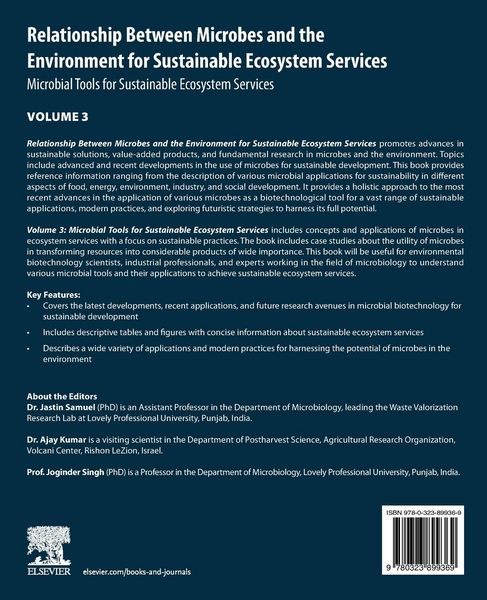
  • Produktbild: Relationship Between Microbes and the Environment for Sustainable Ecosystem Services, Volume 3
  • Produktbild: Relationship Between Microbes and the Environment for Sustainable Ecosystem Services, Volume 3
  • 1. Clean energy production by microorganisms: A sustainable approach
    2. Prospects of clean energy from bacteria, fungus and algae
    3. Microbiology of biofuels: cultivating the future
    4. Role of Microbial Xylanases in bio-refinery platform and it's impact on ecosystem services
    5. Microbial filters for Air Treatment: A Sustainable Approach
    6. Cyanobacteria: A Pro-pollution Indicator For Environmental Hazards
    7. Microorganism in waste valorization and its impact on the environment and economy.
    8. Eco-friendly biopolymers and bioadsorbants from algae to combat pollution
    9. Role of Algae in controlling and biomonitoring pollutants in aquatic ecosystem
    10. Bioremediation of chlorophenols for the production of biogas: a green alternative
    11. Microbial surfactants: approaches in environmental contamination management
    12. Role of beneficial microbes in biotic and abiotic stress
    13. Application of microbial antagonists for the preservation of fruits from postharvest diseases of fruits
    14. Microbial Fuel Cell: A State-of-the-Art Technology for Bioelectricity Generation
    15. Lactococcus lactis: A Potent Metabolite to design Natural Health Promoting Biofunctional Foods
    16. Microbial enzymes: a new approach for contamination management
    17. Effect of Bio-Additives and Kinetic Studies of Saccharomyces cerevisiae on High Purity Alcohol Production Suitable for Medicinal Use
    18. Second-generation biofuels: Facts and future