KI-Beratung Beta

  • Produktbild: Pesticides in the Natural Environment
  • Produktbild: Pesticides in the Natural Environment

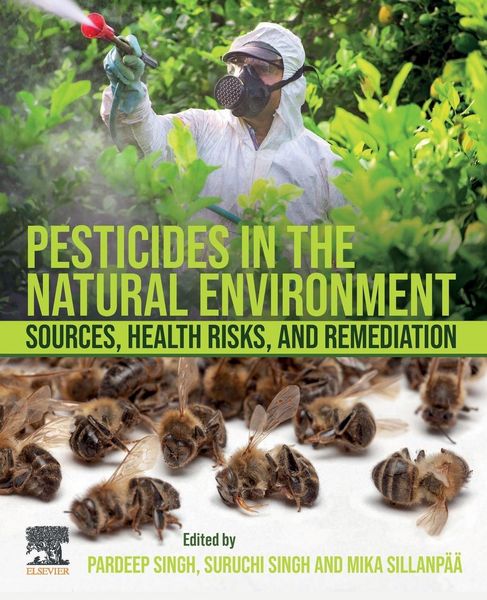
Pesticides in the Natural Environment Sources, Health Risks, and Remediation

143,99 €

inkl. gesetzl. MwSt., Versandkostenfrei


Beschreibung

Pesticides in the Natural Environment: Sources, Health Risks, and Remediation presents the direct and indirect impacts of the use of pesticides on the environment, human health, and agriculture. The book explores sustainable alternatives to pesticide use, along with policies for regulations and remediation...

Beschreibung

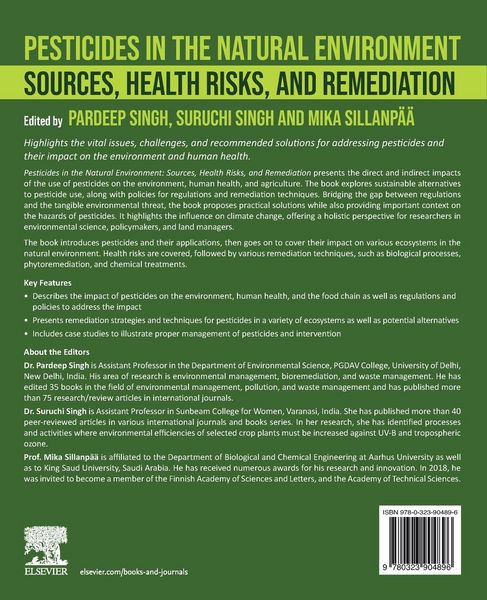
Pesticides in the Natural Environment: Sources, Health Risks, and Remediation presents the direct and indirect impacts of the use of pesticides on the environment, human health, and agriculture. The book explores sustainable alternatives to pesticide use, along with policies for regulations and remediation techniques. Bridging the gap between regulations and the tangible environmental threat, the book proposes practical solutions while also providing important context on the hazards of pesticides. It highlights the influence on climate change, offering a holistic perspective for researchers in environmental science, policymakers, and land managers.
The book introduces pesticides and their applications, then goes on to cover their impact on various ecosystems in the natural environment. Health risks are covered, followed by various remediation techniques, such as biological processes, phytoremediation, and chemical treatments.

Portrait

Dr Pardeep Singh is presently working as an Assistant Professor at the Department of Environmental Science, PGDAV College, University of Delhi, India. He obtained his master's degree from the Department of Environmental Science at Banaras Hindu University, Varanasi India in 2011. He obtained his doctorate from the Indian Institute of Technology (Banaras Hindu University) Varanasi in the year 2017. The area of his doctoral research is the degradation of organic pollutants through various indigenous isolated microbes and by using various types of photocatalytic. He has published more than 35 papers in international journals in the field of waste management.

Dr. Suruchi Singh is presently working as Faculty in the Department of Botany, Sunbeam College for Women, India. She obtained her PhD from Banaras Hindu University, India in Botany with Environmental Science as major field. Dr Singh received her postdoctoral experiences in Department of Botany, Banaras Hindu University under Council of Scientific and Industrial Research and Department of Science and Technology. She has published articles in various international journals and books series (>40 peer reviewed articles). In her research, she has identified processes and activities where environmental efficiencies of selected crop plants must be increased against UV-B and tropospheric Ozone.

Mika Sillanpää is a professor at the University of Johannesburg, South Africa. His research centers on chemical treatment in environmental engineering, environmental monitoring, and resource recovery from waste streams.

Sillanpää received his M.Sc. (Eng.) and D.Sc. (Eng.) degrees from the Aalto University where he also completed an MBA degree in 2013. Since 2000, he has been a full professor/adjunct professor at the University of Oulu, the University of Eastern Finland, the LUT University, the University of Eastern Finland and the University of Johannesburg.

He has received numerous awards for research and innovation. He is the first Laureate of Scientific Committee on the Problems of the Environment (SCOPE)'s Young Investigator Award, which was delivered at the UNESCO Conference in Shanghai 2010 for his "significant contributions, outstanding achievements and research leadership in Environmental Technological Innovations to address present water pollution problems worldwide, especially with regard to wastewater treatment and reuse”. In 2011, he was invited to act as a Principal Scientific Reviewer in the GEO-5 report of the United Nations Environmental Programme (UNEP). In 2012, he received Tapani Järvinen Environmental Technology Award and Publication Award of the Lappeenranta University of Technology. In 2014, he received the Science Award of the Lappeenranta University of Technology and Pro Mikkeli Award. In 2018, he was invited as a Member of the Finnish Academy of Sciences and Letters and Technology Academy of Finland. He also received Literature award from the Water Association of Finland in 2018.
Produktdetails

Einband

Taschenbuch

Erscheinungsdatum

20.05.2022

Herausgeber Pardeep Singh + weitere
Verlag Elsevier Science & Technology

Produktdetails

Einband

Taschenbuch

Erscheinungsdatum

20.05.2022

Herausgeber
Verlag Elsevier Science & Technology
Seitenzahl

618

Maße (L/B/H)

23,5/19,1/3,2 cm

Gewicht

1048 g

Sprache

Englisch

ISBN

978-0-323-90489-6

Noch keine Bewertungen vorhanden

Verfassen Sie die erste Bewertung zu diesem Artikel

Helfen Sie anderen Kundinnen und Kunden durch Ihre Meinung.

Kundinnen und Kunden meinen

Bewertungen (0)

Die Leseprobe wird geladen.
  • Produktbild: Pesticides in the Natural Environment
  • Produktbild: Pesticides in the Natural Environment
  • Chapter 1: Classification of pesticides and loss of crops due to creepy crawlers
    Chapter 2: Ecological impacts of pesticides on soil and water ecosystems and its natural degradation process
    Chapter 3: Fate and assessment of pesticide in aquatic ecosystem
    Chapter 4: Fate and adverse effects of pesticides in the environment
    Chapter 5: Towards understanding the impact of pesticides on freshwater ecosystem
    Chapter 6: Persistence of pesticides and their impacts on human health and environment
    Chapter 7: Complex approaches to assessing the pesticides risk on human health and environment
    Chapter 8: Neurodevelopmental and reproductive impacts of pesticides on pregnant women
    Chapter 9: Pesticides and human health: The noxious impact on maternal system and fetal development
    Chapter 10: ¿ytogenetical bioindication of pesticidal contamination
    Chapter 11: Modulation of soil microbiome and related alterations in response to pesticides
    Chapter 12: Botanical pesticides as alternatives for more sustainable crops and healthy foods
    Chapter 13: The potential use of essential oils as natural biocides against plant pathogens
    Chapter 14: Sustainable and eco-friendly alternatives to reduce the use of pesticides
    Chapter 15: Strategies for sustainable and ecofriendly pest management in Agroecosystem
    Chapter 16: Pesticides removal from aqueous streams through anaerobic and aerobic biological treatment processes
    Chapter 17: Metal organic frameworks for the removal of pesticides
    Chapter 18: Removal pesticides by advanced techniques based on nanomaterials
    Chapter 19: Pesticides removal techniques from the aquatic environment
    Chapter 20: Perspective of sustainable and intensified developments in treatment of pesticides from aqueous streams
    Chapter 21: Biomonitoring and biomarkers of pesticide exposure and human health risk assessment