KI-Beratung Beta

  • Produktbild: Entangled
  • Produktbild: Entangled

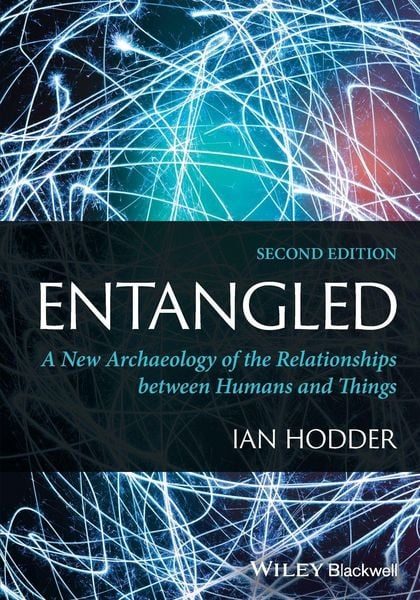
Entangled A New Archaeology of the Relationships between Humans and Things

49,99 €

inkl. gesetzl. MwSt., Versandkostenfrei


Beschreibung

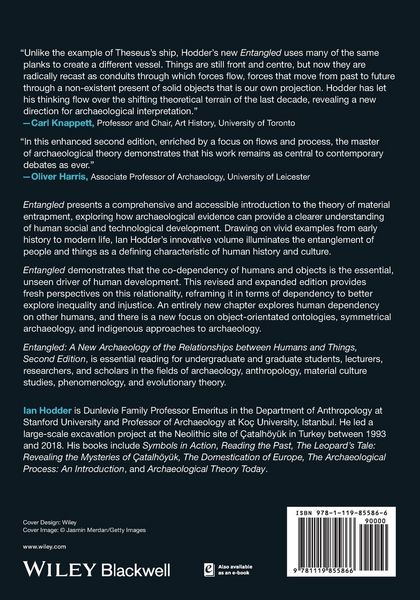
Offers a comprehensive and accessible introduction to the theory of material entanglement and entrapment, enriched with vivid examples from everyday life

Entangled explores how archaeological evidence can help provide a better understanding of the direction of human social and technological change,...

Beschreibung

Offers a comprehensive and accessible introduction to the theory of material entanglement and entrapment, enriched with vivid examples from everyday life

Entangled explores how archaeological evidence can help provide a better understanding of the direction of human social and technological change, demonstrating how the interrelationship of humans and things is a defining characteristic of human history and culture. Using examples drawn from both the early farming settlements of the Middle East and daily life in the modern world, Ian Hodder highlights the complex co-dependencies of humans and things-arguing that the maintenance and sustaining of material worlds are the unseen drivers of human development.

Updated and expanded, Entangled offers new perspectives on the study of the relationality between things and humans. In this edition, the author reframes relationality in terms of various forms of dependence to better explore inequality, injustice, and the ways people get entrapped in detrimental social and economic situations. An entirely new chapter focuses on human dependence on other humans, such as between colonial powers and colonized people. Increased focus is placed on object-oriented ontologies and assemblages, symmetrical archaeology, and indigenous and radical approaches in archaeology that critique relationality and posthumanism. A wide range of new examples, references, and literature are presented throughout the book.

  • Argues that dependence on things forces humans down particular evolutionary pathways and social trends
  • Demonstrates how long-standing entanglements can be irreversible and increase in scale and complexity over time
  • Integrates archaeology, natural and biological sciences, and the social sciences
  • Presents a critical review of key contemporary perspectives, including material culture studies, phenomenology, evolutionary theory, cognitive archaeology, human ecology, and complexity theory

Entangled: A New Archaeology of the Relationships between Humans and Things, Second Edition is essential reading for undergraduate and graduate students, lecturers, researchers, and scholars in the fields of archeology, anthropology, material culture studies, and related fields across the social sciences and humanities.

Produktdetails

Verkaufsrang

17325

Einband

Taschenbuch

Erscheinungsdatum

02.11.2023

Verlag John Wiley & Sons Inc

Produktdetails

Verkaufsrang

17325

Einband

Taschenbuch

Erscheinungsdatum

02.11.2023

Verlag John Wiley & Sons Inc
Seitenzahl

240

Maße (L/B/H)

25,1/17,6/1,5 cm

Gewicht

484 g

Auflage

2. Auflage

Sprache

Englisch

ISBN

978-1-119-85586-6

Herstelleradresse

Libri GmbH
Europaallee 1
36244 Bad Hersfeld
DE

Email: gpsr@libri.de

Noch keine Bewertungen vorhanden

Verfassen Sie die erste Bewertung zu diesem Artikel

Helfen Sie anderen Kundinnen und Kunden durch Ihre Meinung.

Kundinnen und Kunden meinen

Bewertungen (0)

Die Leseprobe wird geladen.
  • Produktbild: Entangled
  • Produktbild: Entangled
  • Contents

    Epigraph viii

    List of Figures ix

    Preface and Acknowledgements for First Edition xii

    Preface and Acknowledgements for Second Edition xiii

    1Thinking About Things Differently (from Things to Flows) 1

    What Is a Thing? 1

    Things-in-Themselves? 3

    Changing Definitions of Entanglement 8

    From Things to Strings 12

    Weaker and Stronger Entanglements 14

    Conclusion - (a) Why Process Matters 15

    Conclusion - (b) Are We at One with Things? 16

    2 Humans Depend on Things 19

    Dependence: Some Introductory Concepts 20

    Forms of Dependence 21

    Reflective and Non-reflective Relationships with Things 22

    Going Toward and Away from Things 24

    Identification and Ownership 26

    Some Previous Accounts of the Human Dependence on Things 29

    Being There with Things 29

    Material Culture and Materiality 32

    Cognition and the Extended Mind 36

    Conclusion: Things R Us 39

    3 Things Depend on Other Things 41

    Forms of Connection Between Things 43

    Production and Reproduction 43

    Exchange 43

    Use 44

    Consumption 44

    Discard 44

    Post-deposition 44

    Affordances 49

    From Affordance to Dependence 51

    The French School - Operational Chains 52

    Behavioral Chains 54

    Things Depend on Past Things and on Future Things 58

    Entangled Ideas 58

    Conclusion 59

    4 Things Depend on Humans 65

    Things Fall Apart 68

    Behavioral Archaeology and Material Behavior 70

    Behavioral Ecology 74

    Human Behavioral Ecology 79

    The Temporalities of Things 83

    Conclusion: The Unruliness of Things 84

    5 Human-Human Entanglement 86

    Inequality, Power and Entanglement 87

    Poverty Traps 90

    Emotional Bonds 92

    Conclusion 93

    6 Exploring Entanglement 95

    The Physical Processes of Things 95

    Temporalities 98

    Forgetness 101

    The Tautness of Entanglements and Path Dependency 103

    Types and Degrees of Entanglement 105

    Cores and Peripheries of Entanglements 108

    Contingency 109

    Conclusion 111

    7 Entangled Abstractions and Bodily Engagements 113

    Abstraction, Metaphor and Mimesis 114

    From Granola to Beethoven 117

    Abstract Entanglements at Çatalhöyük 123

    Conclusion 126

    8 Two Examples Regarding the Onset of Domestication and Sedentary Village Life: China and the Middle East 128

    China 128

    Middle East 130

    Conclusion 138

    9 Method 139

    Tanglegrams 140

    Formal Network Approaches 144

    Sequencing Entanglements 147

    Diachronic Entanglements 152

    Interpretation 156

    Conclusion 159

    10 Toward an Entangled String Theory and Comparison with Other Approaches 160

    Things Do Not Have Agency 161

    There Is No Present, Only a Flow from Past to Future 163

    Toward an Entangled String Theory 164

    Other Contemporary Approaches 171

    Latour and Actor Network Theory 172

    Assemblage Theory 175

    Containment and Enchainment 176

    Ontologies 177

    Material Engagement Theory 178

    Agential Realism 179

    Conclusion 180

    11 Conclusion: From Things to Flows 182

    Aquatic Culture? 182

    Some Final Examples 183

    Some Loose Ends 186

    Bibliography 189

    Index 209