KI-Beratung Beta

  • Produktbild: Scaling Up of Microbial Electrochemical Systems
  • Produktbild: Scaling Up of Microbial Electrochemical Systems

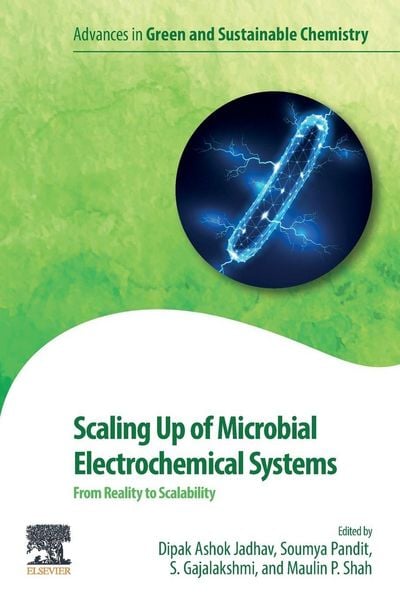
Scaling Up of Microbial Electrochemical Systems From Reality to Scalability

205,99 €

inkl. gesetzl. MwSt., Versandkostenfrei


Beschreibung

Scaling Up of Microbial Electrochemical Systems: From Reality to Scalability is the first book of its kind to focus on scaling up of microbial electrochemical systems (MES) and the unique challenges faced when moving towards practical applications using this technology. This book emphasizes an understanding...

Beschreibung

Scaling Up of Microbial Electrochemical Systems: From Reality to Scalability is the first book of its kind to focus on scaling up of microbial electrochemical systems (MES) and the unique challenges faced when moving towards practical applications using this technology. This book emphasizes an understanding of the current limitations of MES technology and suggests a way forward towards onsite applications of MES for practical use. It includes the basics of MES as well as success stories and case studies of MES in the direction of practical applications.

This book will give a new direction to energy researchers, scientists and policymakers working on field applications of microbial electrochemical systems-microbial fuel cells, microbial electrolysis cells, microbial electrosynthesis cells, and more.

Portrait

Dipak Ashok Jadhav is a research professor at the Korea Maritime and Ocean University, Busan, South Korea. His research interests lie in microbial fuel cells, bioelectrochemical systems, sanitation, bioenergy research, water management, and waste-to-energy. He has received several prestigious awards and fellowship including Young Technological Innovation Award (GYTI), Young Engineers Award, Promising Engineers Award, Swachthon Award from Ministry, DAAD fellowship, Silver medal for post graduate studies at IIT Kharagpur, etc. His research area is microbial fuel cell, Bioelectrochemical system, Sanitation, Bioenergy research, Water management, Waste to Energy recovery. To his credits, there are over 33 papers in various peer-reviewed SCI journals including Renewable and Sustainable energy reviews, Bioresource Technology, Energy, Applied Biochemistry and Biotechnology, etc. and also authored 19 book chapters. He has presented the work at national and international conferences in the area of bioelectrochemical system and bioenergy. He is also serving as editorial board member /reviewers for International Journals and member for several scientific societies in the field of microbial fuel cell and bioenergy research. He is also editor for book on microbial electrochemical system.

Dr. Soumya Pandit is a senior assistant professor at Sharda University, Greater Noida, Delhi NCR, India. He pursued his doctoral studies from Indian Institute of Technology, Kharagpur and completed his postdoctoral research work (PBC fellow) at the Department of Desalination and Water Treatment, The Zuckerberg Institute for Water Research (ZIWR), Ben-Gurion University of the Negev. He is a recipient of North West University, South Arica Post-doctoral fellowship. He has authored 21 research papers in peer-reviewed journals and has authored 22 book chapters and published 3 Indian patents. He holds a BTech and MTech in Biotechnology. His current research focuses on microbial electrochemical systems for bioenergy harvesting, biohythane, bacterial biofilm and biofouling study, etc. He serves as a reviewer for Frontiers in Environmental Microbiology, editorial board member in SCIREA Journal of Biology, and the Journal of Korean Society of Environmental Engineers (JKSEE).Dr. S. Gajalakshmi is an Assistant Professor and Head (i/c) at Centre for Pollution Control and Environmental Engineering, Pondicherry University, Puducherry, India, with more than 15 years of experience in teaching and research. She is a Gold Medallist in BSc and MSc and has an MPhil and PhD in Environmental Science and Engineering from Pondicherry University. She was awarded 'Best Teacher Award', Pondicherry University for the years 2014, 2015, 2016, 2018. Her research interests are solid waste management, nutrient dynamics of soil, domestic and industrial wastewater treatment, energy, and microbial fuel cells. She has published over 50 publications in peer reviewed prestigious journals, has authored one book and contributed more than 10 chapters in other books. She is granted one patent on a unique wastewater treatment process and one patent published on novel process for ligninous waste treatment.Maulin P. Shah is a distinguished environmental scientist, academician, and globally recognized expert in the fields of environmental biotechnology and sustainable
wastewater treatment. He has made significant contributions to advancing eco-friendly
technologies for pollution control, particularly through innovative biological treatment processes. He holds extensive academic and research experience, with a strong focus on industrial wastewater treatment, bioremediation, and microalgae-based technologies. His work emphasizes the integration of sustainability principles with practical engineering solutions, helping industries reduce their environmental footprint.
His books cover a wide spectrum of cutting-edge domains, including industrial wastewater microbiology, bioremediation, biodegradation, algal biotechnology, biofuel, bioenergy, circular economy, metagenomics related to wastewater treatment, and enzyme engineering.
Produktdetails

Einband

Taschenbuch

Erscheinungsdatum

08.02.2022

Abbildungen

Approx. 100 illustrations

Herausgeber Dipak Ashok Jadhav + weitere

Produktdetails

Einband

Taschenbuch

Erscheinungsdatum

08.02.2022

Abbildungen

Approx. 100 illustrations

Herausgeber
Verlag Elsevier Science & Technology
Seitenzahl

514

Maße (L/B/H)

22,9/15,2/2,6 cm

Gewicht

682 g

Sprache

Englisch

ISBN

978-0-323-90765-1

EU-Ansprechpartner

Elsevier B.V.
Radarweg 29
1043 NX Amsterdam
NL
productsafety@elsevier.com

Herstelleradresse

Elsevier Science & Technology
London Wall 125
EC2Y 5AS London
GB
tradeorders@elsevier.com

Noch keine Bewertungen vorhanden

Verfassen Sie die erste Bewertung zu diesem Artikel

Helfen Sie anderen Kundinnen und Kunden durch Ihre Meinung.

Kundinnen und Kunden meinen

Bewertungen (0)

Die Leseprobe wird geladen.
  • Produktbild: Scaling Up of Microbial Electrochemical Systems
  • Produktbild: Scaling Up of Microbial Electrochemical Systems
  • Section 1: Basics of microbial electrochemical systems
    1. Introduction to microbial electrochemical systems
    2. Electroactive biofilm and electron transfer in microbial electrochemical systems
    3. Advancement in Anode materials for microbial electrochemical system applications
    4. Advancement in antifouling cathode materials and ORR cathodic catalysts for MES applications
    5. Modifications in ion exchange separators and Membranes for scaling up applications of MES
    6. Evaluation of performance of microbial electrochemical system and role of operating conditions

    Section 2: Scaling up of microbial electrochemical systems
    7. Recent progress in scaling up of microbial electrochemical systems
    8. Pilot scale application of microbial electrolysis cells
    9. Scaling-up applications of microbial fuel cell
    10. Stacking of microbial fuel cells and electrochemical perspective for scaling up
    11. Microbial electrosynthesis applications for onsite applications
    12. Application of bioelectrochemical system for sanitation and wastewater treatment
    13. Coupling of microbial electrochemical systems with conventional wastewater treatment systems: Possibility and Reality
    14. Septic tank microbial fuel cells: Utilization of human waste and urine for in situ bioelectricity generation
    15. Power management for stacking of microbial fuel cells and maximum power point tracking technology

    Section 3: Scaling up challenges and perspectives
    16. Present Scaling up challenges and perspectives for microbial electrochemical systems
    17. Microbial electrochemical systems: challenges for commercialization and how it can be addressed
    18. Numerical and simulation approach for scaling up of microbial electrochemical systems
    19. Energy and cost economic analysis for microbial electrochemical systems
    20. Life cycle analysis of microbial electrochemical systems