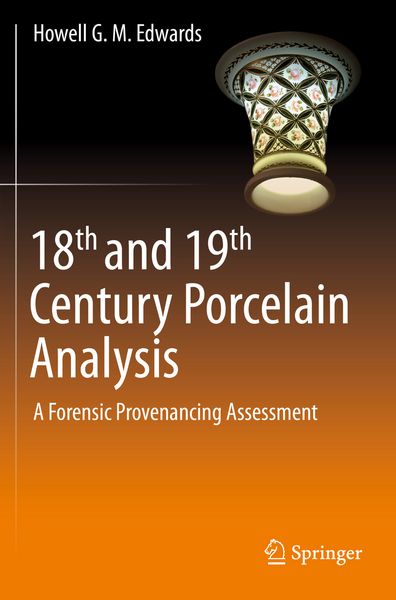
18th and 19th Century Porcelain Analysis A Forensic Provenancing Assessment
-
- Hardcover
- Taschenbuch ausgewählt
- eBook
-
Sprache:Englisch
151,99 €
inkl. gesetzl. MwSt.,
Beschreibung
Produktdetails
Einband
Taschenbuch
Erscheinungsdatum
14.07.2021
Abbildungen
XXVII, 324 p. 58 illus., 52 illus. in color.
Verlag
SpringerSeitenzahl
324
Maße (L/B/H)
23,5/15,5/1,8 cm
Gewicht
608 g
Auflage
1st edition 2020
Sprache
Englisch
ISBN
978-3-030-42194-6
This book addresses the contributions made by analytical chemistry to the characterisation of 18
th
and early 19
th
Century English and Welsh porcelains commencing with the earliest reports of Sir Arthur Church and of Herbert Eccles and Bernard Rackham using chemical digestion techniques and concluding with the most recent instrumental experiments, which together span more than a hundred years of study. From the earliest experiments which required necessarily the sacrifice of significant portions of each specimen, which may already have been damaged , to the latest experiments which needed only microsampling or the non-destructive interrogation of valuable perfect specimens a comprehensive survey is undertaken of more than twenty manufactories of quality porcelains. The correlation is made between the quantitative elemental oxide determinations of the scanning electron microscopic diffraction and Xray fluorescence data and the qualitative molecular spectroscopic Raman data to demonstrate their complementarity and use in the holistic forensic assessment of the origin of the fired procelains ; this will form the groundwork for the adoption of analytical techniques for the attribution of unknown or questionable procelains to their potential source factories . The book will also examine the perception of what constitutes a porcelain and its definitions and examines the assignment of porcelains to types which currently employs the definitions of hard paste , soft paste , hybrid , magnesian and bone china from the conclusions derived from the analytical data and a consideration of the raw materials employed in their manufacturing processes. During the discussion of this analytical evidence several themes and protocols have been established for its utilisation in the potential identification of porcelains and several case studies undertaken for this purpose are cited. The book will be of interest toanalytical scientists , to museum ceramics curators and to ceramics historians.
Noch keine Bewertungen vorhanden
Verfassen Sie die erste Bewertung zu diesem Artikel
Helfen Sie anderen Kundinnen und Kunden durch Ihre Meinung.
Kurze Frage zu unserer Seite
Vielen Dank für Ihr Feedback
Wir nutzen Ihr Feedback, um unsere Produktseiten zu verbessern. Bitte haben Sie Verständnis, dass wir Ihnen keine Rückmeldung geben können. Falls Sie Kontakt mit uns aufnehmen möchten, können Sie sich aber gerne an unseren Kund*innenservice wenden.
zum Kundenservice