Gutscheinbedingungen

**Gültig bis 14.09.2026 auf Spielzeug, Schreibwaren, Filme, Geschenke & Trends, Musik, tolino eReader & Zubehör, Hörbücher, nicht preisgebundene Bücher und Kalender in der Thalia App. Einzelne Artikel können ausgeschlossen sein. Aufgrund der Buchpreisbindung sind deutschsprachige Bücher und eBooks ausgenommen. Zusätzlich ausgenommen sind Abos & Flatrates, Games, Geschenkkarten/-boxen, Shelfies, Software, Zeitschriften sowie einzelne Artikel von tonies®. Pro Einkauf einmal einlösbar. Nur gültig mit im Onlineshop hinterlegter Bonuscard. Click & Collect nur bei Onlinevorabzahlung möglich. Keine Barauszahlung. Nicht kombinierbar mit anderen Aktionen und Gutscheinen. Gutschein wird auf max. 500€ Bestellwert angerechnet. Nicht gültig für Versandkosten und Services.

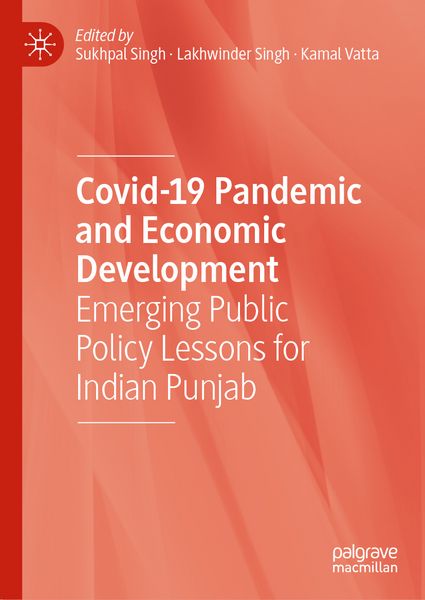
  • Produktbild: Covid-19 Pandemic and Economic Development
  • Produktbild: Covid-19 Pandemic and Economic Development

Covid-19 Pandemic and Economic Development Emerging Public Policy Lessons for Indian Punjab

129,99 €

inkl. gesetzl. MwSt., Versandkostenfrei


Beschreibung

Produktdetails

Einband

Gebundene Ausgabe

Erscheinungsdatum

28.09.2021

Abbildungen

XXVI, 309 p. 10 illus., 2 illus. in color.

Herausgeber

Sukhpal Singh + weitere

Verlag

Springer Singapore

Seitenzahl

309

Maße (L/B/H)

21,6/15,3/2,3 cm

Gewicht

548 g

Auflage

1st ed. 2021

Sprache

Englisch

ISBN

978-981-16-4441-2

Beschreibung

Portrait

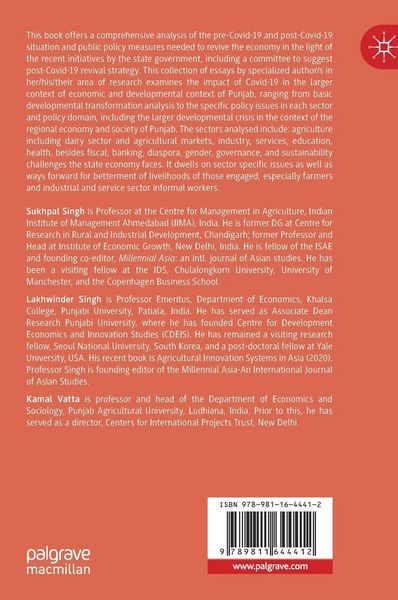
Sukhpal Singh is Professor at the Centre for Management in Agriculture, Indian Institute of Management Ahmedabad (IIMA), India. He is former DG at Centre for Research in Rural and Industrial Development, Chandigarh; former Professor and Head at Institute of Economic Growth, New Delhi, India. He is fellow of the ISAE and founding co-editor, Millennial Asia : an intl. journal of Asian studies. He has been a visiting fellow at the IDS, Chulalongkorn University, University of Manchester, and the Copenhagen Business School.

Lakhwinder Singh is Professor Emeritus, Department of Economics, Khalsa College, Punjabi University, Patiala, India. He has served as Associate Dean Research Punjabi University, where he has founded Centre for Development Economics and Innovation Studies (CDEIS). He has remained a visiting research fellow, Seoul National University, South Korea, and a post-doctoral fellow at Yale University, USA. His recent book is Agricultural Innovation Systems in Asia (2020). Professor Singh is founding editor of the Millennial Asia-An International Journal of Asian Studies.

Kamal Vatta is professor and head of the Department of Economics and Sociology, Punjab Agricultural University, Ludhiana, India. Prior to this, he has served as a director, Centers for International Projects Trust, New Delhi.


Produktdetails

Einband

Gebundene Ausgabe

Erscheinungsdatum

28.09.2021

Abbildungen

XXVI, 309 p. 10 illus., 2 illus. in color.

Herausgeber

Verlag

Springer Singapore

Seitenzahl

309

Maße (L/B/H)

21,6/15,3/2,3 cm

Gewicht

548 g

Auflage

1st ed. 2021

Sprache

Englisch

ISBN

978-981-16-4441-2

Herstelleradresse

Springer-Verlag GmbH
Tiergartenstr. 17
69121 Heidelberg
DE

Email: ProductSafety@springernature.com

Noch keine Bewertungen vorhanden

Verfassen Sie die erste Bewertung zu diesem Artikel

Helfen Sie anderen Kundinnen und Kunden durch Ihre Meinung.

Kundinnen und Kunden meinen

Bewertungen (0)

  • Produktbild: Covid-19 Pandemic and Economic Development
  • Produktbild: Covid-19 Pandemic and Economic Development
  • Chapter 1 Covid-19 Pandemic and Sustainability of Punjab Economy.- Chapter 2 Agriculture Sustainability in Punjab: A Way Forward.- Chapter 3 Impact of Covid-19 Lockdown on Punjab Agriculture.- Chapter 4 Need for Innovations in Crop Residue Management in Punjab: Lessons from the Covid-19 Pandemic.- Chapter 5 Farm Gardens: A Promising Approach to Enhance Food Security and Sustainability.- Chapter 6 Reforming Agricultural Markets in Punjab in the Context of Union Farm Acts for the Post-Covid-19 Recovery.- Chapter 7 Impact of Covid-19 Pandemic on Dairy Industry in Punjab: Major Concerns and Policy Options.- Chapter 8 Making Punjab’s Urban Informal Sector More Resilient While Securing Livelihoods during Post-Covid-19 Times.- Chapter 9 Covid-19 and MSMEs in Punjab: Challenges Ahead.- Chapter 10 Implementation of Emergency Credit Line Guarantee Scheme (ECLGS) in Punjab: An Assessment of Performance of Scheduled Commercial Banks.- Chapter 11 Employment Participation of Rural Women in Punjab: A Need for Policy Retrospect.- Chapter 12 Covid-19 Pandemic and the Scheduled Caste Workers in Rural Punjab: A Need for Structural Transformation.- Chapter 13 Livelihood of Agricultural Labourers in Punjab: Emerging Policy Issues.- Chapter 14 Covid-19 and Health Care Services in Punjab: Consequences and Challenges.- Chapter 15 Making Quality Education Accessible to All: Policy Perspective on School Education in Punjab.- Chapter 16 Covid-19 Pandemic and the Service Sector of Punjab: An Assessment of Impact and Policies for Revival.- Chapter 17 Basic Human Needs and Non-State Actors in Punjab: Understanding the Lives of Poor Amidst the Covid-19 Pandemic.- Chapter 18 Punjab’s Migration Crisis under Lockdown and Beyond: Some Suggestions for Public Policy.- Chapter 19 Diaspora Well-Being and the Covid-19 Pandemic: Some Reflections on Public Discourses on Impacts in the USA and UK.- Chapter 20 Governance Structure and Punjab Economy Under and Post-Covid-19 Lockdown.- Chapter 21 Punjab’s Post-Covid-19 Economic Policy under Indian Federalism.- Chapter 22 Implications of Covid-19 on the Revenue of Punjab under GST Regime.- Chapter 23 Public Policy and Governance Reforms for Post-Covid-19 Recovery and Sustainable Growth and Development in Punjab.- Index.