Gutscheinbedingungen

**Gültig bis 14.09.2026 auf Spielzeug, Schreibwaren, Filme, Geschenke & Trends, Musik, tolino eReader & Zubehör, Hörbücher, nicht preisgebundene Bücher und Kalender in der Thalia App. Einzelne Artikel können ausgeschlossen sein. Aufgrund der Buchpreisbindung sind deutschsprachige Bücher und eBooks ausgenommen. Zusätzlich ausgenommen sind Abos & Flatrates, Games, Geschenkkarten/-boxen, Shelfies, Software, Zeitschriften sowie einzelne Artikel von tonies®. Pro Einkauf einmal einlösbar. Nur gültig mit im Onlineshop hinterlegter Bonuscard. Click & Collect nur bei Onlinevorabzahlung möglich. Keine Barauszahlung. Nicht kombinierbar mit anderen Aktionen und Gutscheinen. Gutschein wird auf max. 500€ Bestellwert angerechnet. Nicht gültig für Versandkosten und Services.

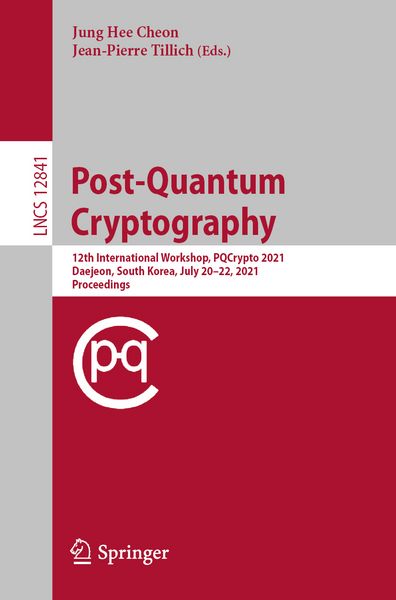
  • Produktbild: Post-Quantum Cryptography
  • Produktbild: Post-Quantum Cryptography
Band 12841

Post-Quantum Cryptography 12th International Workshop, PQCrypto 2021, Daejeon, South Korea, July 20–22, 2021, Proceedings

Aus der Reihe Security and Cryptology

89,99 €

inkl. gesetzl. MwSt., Versandkostenfrei


Beschreibung

Produktdetails

Einband

Taschenbuch

Erscheinungsdatum

15.07.2021

Abbildungen

XIII, 500 p. 73 illus., 20 illus. in color.

Herausgeber

Jung Hee Cheon + weitere

Verlag

Springer

Seitenzahl

500

Maße (L/B/H)

23,5/15,5/2,8 cm

Gewicht

774 g

Auflage

1st ed. 2021

Sprache

Englisch

ISBN

978-3-030-81292-8

Beschreibung

Produktdetails

Einband

Taschenbuch

Erscheinungsdatum

15.07.2021

Abbildungen

XIII, 500 p. 73 illus., 20 illus. in color.

Herausgeber

Verlag

Springer

Seitenzahl

500

Maße (L/B/H)

23,5/15,5/2,8 cm

Gewicht

774 g

Auflage

1st ed. 2021

Sprache

Englisch

ISBN

978-3-030-81292-8

Herstelleradresse

Springer-Verlag GmbH
Tiergartenstr. 17
69121 Heidelberg
DE

Email: ProductSafety@springernature.com

Noch keine Bewertungen vorhanden

Verfassen Sie die erste Bewertung zu diesem Artikel

Helfen Sie anderen Kundinnen und Kunden durch Ihre Meinung.

Kundinnen und Kunden meinen

Bewertungen (0)

  • Produktbild: Post-Quantum Cryptography
  • Produktbild: Post-Quantum Cryptography

  • Code-Based Cryptography.-
    Decoding supercodes of Gabidulin codes and applications to cryptanalysis.- LESS-FM: Fine-tuning Signatures from a Code-based Cryptographic Group Action.- Classical and Quantum algorithms for generic Syndrome Decoding problems and applications to the Lee metric.- 
    Multivariate Cryptography
    .- Improving Thomae-Wolf Algorithm for Solving Underdetermined.- Multivariate Quadratic Polynomial Problem.- New Practical Multivariate Signatures from a Nonlinear Modifier.- On the Effect of Projection on Rank Attacks in Multivariate Cryptography.-
    Quantum Algorithms.-
    Quantum Key Search for Ternary LWE.- A fusion algorithm for solving the hidden shift problem in finite abelian groups.- The “quantum annoying” property of password-authenticated key exchange protocols.-
    Implementation and Side channel attack.-
    Differential Power Analysis of the Picnic Signature Scheme.- Implementation of Lattice Trapdoors on Modules and Applications.- Verifying Post-Quantum Signatures in 8 KiB of RAM.- Fast NEON-based multiplication for lattice-based NIST Post-Quantum Cryptography finalists.-
    Isogeny
    .- CSI-RAShi: Distributed key generation for CSIDH.- SimS: a Simplification of SiGamal.- Memory Optimization Techniques for Computing Discrete Logarithms in Compressed SIKE.-
    Lattice-Based Cryptography
    .- Generating cryptographically-strong random lattice bases and recognizing rotations of Z.- Zero-Knowledge Proofs for Committed Symmetric Boolean Functions.- Short Identity-Based Signatures with Tight Security from Lattices.- On Removing Rejection Conditions in Practical Lattice-Based Signatures.- Secure Hybrid Encryption In the Standard Model from Hard Learning Problems.-
    Cryptanalysis.-
    Attack on Beyond-Birthday-Bound MACs in Quantum Setting.- An algebraic approach to the Rank Support Learning problem.- Quantum Indistinguishability for Public Key Encryption.- A Practical Adaptive Key Recovery Attack on the LGM (GSW-like) Cryptosystem.