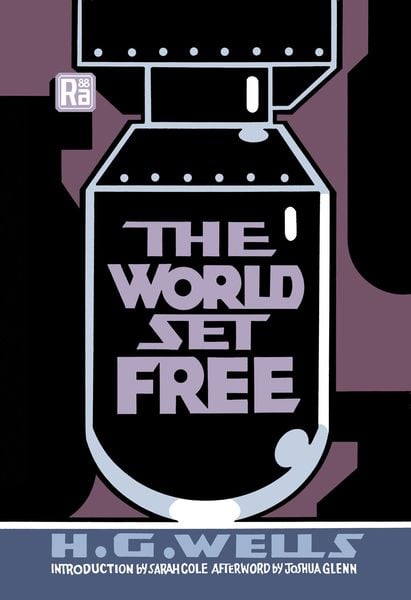
The World Set Free
-
- Hardcover
- Taschenbuch ausgewählt
- eBook
-
Sprache:Englisch
-
Verlag:The MIT Press
- Hawthorne Classics 15,99 €
- The MIT Press 10,49 € ausgewählt
- 1st World Library 19,99 €
- Fantastica 17,99 €
- True Sign Publishing House Private Limited 19,99 €
- E-Kitap Projesi & Cheapest Books 23,70 €
- Bibliotech Pr 19,99 €
- Book Jungle 26,99 €
- Culturea 18,99 €
- Creative Media Partners, LLC 24,99 €
- H. G. Wells Library 26,99 €
- Bottom of the Hill Publishing 22,99 €
- Lits 17,99 €
- Antiquum Novum Verlag 26,99 €
- Avarang Books 23,99 €
- Indoeuropeanpublishing.Com 19,99 €
- Double 9 Books 17,99 €
- Book tree 15,99 €
10,49 €
UVP
16,90 €
inkl. gesetzl. MwSt.,
- Kostenlose Lieferung ab 30 € Einkaufswert
- Versandkostenfrei für Bonuscard-Kund*innen
Beschreibung
Produktdetails
Einband
Taschenbuch
Erscheinungsdatum
03.05.2022
Verlag
The MIT PressSeitenzahl
282
Maße (L/B/H)
19,9/13/2,1 cm
Gewicht
270 g
Farbe
Schwarz / Ozeanblau
Sprache
Englisch
ISBN
978-0-262-54336-1
Writing in 1913, on the eve of World War I s mass slaughter and long before World War II s mushroom cloud finale, H. G. Wells imagined a war that begins in atomic apocalypse but ends in a utopia of enlightened world government. Set in the 1950s, Wells s neglected novel The World Set Free describes a conflict so horrific that it actually is the war that ends war.
Wells the first to imagine a uranium-based bomb offers a prescient description of atomic warfare that renders cities unlivable for years: Whole blocks of buildings were alight and burning fiercely, the trembling, ragged flames looking pale and ghastly and attenuated in comparison with the full-bodied crimson glare beyond. Drawing on discoveries by physicists and chemists of the time, Wells foresees both a world powered by clean, plentiful atomic energy and the destructive force of the neutron chain reaction.
With a cast of characters including Marcus Karenin, the moral center of the narrative; Firmin, a proto-Brexiteer; and Egbert, the visionary young British monarch, Wells dramatizes a world struggling for sanity. Wells s supposedly happy ending a planetary government presided over by European men may not appeal to contemporary readers, but his anguish at the world s self-destructive tendencies will strike a chord.
Sarah Cole is the author of Inventing Tomorrow: H.G. Wells and The Twentieth Century (2019). The Parr Professor of English and Comparative Literature and Dean of Humanities at Columbia University, she is the cofounder of the NYNJ Modernism Seminar and founder of the Humanities War and Peace Initiative at Columbia. She is also the author of Modernism, Male Friendship, and the First World War (2003) and At the Violet Hour: Modernism and Violence in England and Ireland (2012).
Joshua Glenn, who was the first to describe the years 1900 1935 as science fiction s Radium Age, has helped popularize stories from the era for over a decade now. A former Boston Globe staffer and publisher of the indie intellectual journal Hermenaut, he is coauthor of The Idler s Glossary (2008), Significant Objects (2012), and the family activities guide UNBORED (2012). He is also cofounder of the brand consultancy Semiovox; and he publishes the blogHiLobrow.
Noch keine Bewertungen vorhanden
Verfassen Sie die erste Bewertung zu diesem Artikel
Helfen Sie anderen Kundinnen und Kunden durch Ihre Meinung.
Kurze Frage zu unserer Seite
Vielen Dank für Ihr Feedback
Wir nutzen Ihr Feedback, um unsere Produktseiten zu verbessern. Bitte haben Sie Verständnis, dass wir Ihnen keine Rückmeldung geben können. Falls Sie Kontakt mit uns aufnehmen möchten, können Sie sich aber gerne an unseren Kund*innenservice wenden.
zum Kundenservice