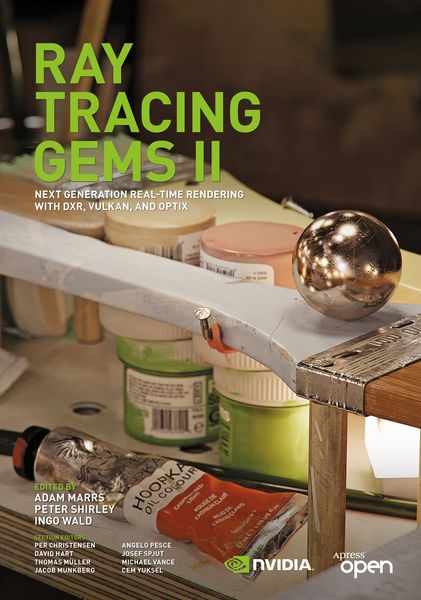
Ray Tracing Gems II Next Generation Real-Time Rendering with DXR, Vulkan, and OptiX
-
- Englisch ausgewählt
47,99 €
inkl. gesetzl. MwSt.,
Beschreibung
Produktdetails
Einband
Taschenbuch
Erscheinungsdatum
23.08.2021
Herausgeber
Adam Marrs + weitereVerlag
ApressSeitenzahl
858
Maße (L/B/H)
25,4/17,8/4,5 cm
Gewicht
1835 g
Auflage
1st ed.
Sprache
Englisch
ISBN
978-1-4842-7187-2
Ray Tracing Gems II is written by industry experts with a particular focus on ray tracing, and it offers a practical means to master the new capabilities of current and future GPUs with the latest graphics APIs.
What You'll Learn:
- The latest ray tracing techniques for developing real-time applications in multiple domains
- Case studies from developers and studios who have shipped products that use real-time ray tracing.
- Guidance, advice and best practices for renderingapplications with various GPU-based ray tracing APIs (DirectX Raytracing, Vulkan Ray Tracing)
- High performance graphics for 3D graphics, virtual reality, animation, and more
Who This Book Is For: Game and graphics developers who are looking to leverage the latest hardware and software tools for real-time rendering and ray tracing to enhance their applications across a variety of disciplines.
Noch keine Bewertungen vorhanden
Verfassen Sie die erste Bewertung zu diesem Artikel
Helfen Sie anderen Kundinnen und Kunden durch Ihre Meinung.
Kurze Frage zu unserer Seite
Vielen Dank für Ihr Feedback
Wir nutzen Ihr Feedback, um unsere Produktseiten zu verbessern. Bitte haben Sie Verständnis, dass wir Ihnen keine Rückmeldung geben können. Falls Sie Kontakt mit uns aufnehmen möchten, können Sie sich aber gerne an unseren Kund*innenservice wenden.
zum Kundenservice