
• Produktbild: Teaching Gradually
  • Produktbild: Teaching Gradually

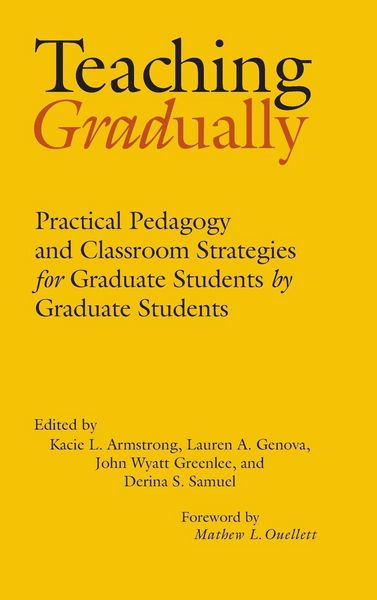
Teaching Gradually Practical Pedagogy for Graduate Students, by Graduate Students

236,99 €

inkl. gesetzl. MwSt., Versandkostenfrei


Beschreibung

Produktdetails

Einband

Gebundene Ausgabe

Erscheinungsdatum

27.09.2021

Herausgeber

Kacie L. Armstrong + weitere

Verlag

Taylor and Francis

Seitenzahl

330

Maße (L/B/H)

23,5/15,7/2,2 cm

Gewicht

539 g

Sprache

Englisch

ISBN

978-1-64267-160-5

Beschreibung

Produktdetails

Einband

Gebundene Ausgabe

Erscheinungsdatum

27.09.2021

Herausgeber

Verlag

Taylor and Francis

Seitenzahl

330

Maße (L/B/H)

23,5/15,7/2,2 cm

Gewicht

539 g

Sprache

Englisch

ISBN

978-1-64267-160-5

Herstelleradresse

Libri GmbH
Europaallee 1
36244 Bad Hersfeld
DE

Email: gpsr@libri.de

Kundinnen und Kunden meinen

0 Bewertungen

Informationen zu Bewertungen

Zur Abgabe einer Bewertung ist eine Anmeldung im Konto notwendig. Die Authentizität der Bewertungen wird von uns nicht überprüft. Wir behalten uns vor, Bewertungstexte, die unseren Richtlinien widersprechen, entsprechend zu kürzen oder zu löschen.

Die Bewertungen sind nach Format, Anzahl Sterne und Datum sortiert.

Verfassen Sie die erste Bewertung zu diesem Artikel

Helfen Sie anderen Kund*innen durch Ihre Meinung

Kundinnen und Kunden meinen

0 Bewertungen filtern

Die Leseprobe wird geladen.
  • Produktbild: Teaching Gradually
  • Produktbild: Teaching Gradually
  • Foreword—Mathew Ouellett Preface Introduction Part One. The Science Behind Learning 1. Opportunities and Precarities of Active Learning Approaches for Graduate Student Instructors — Diana Rose Newby 2. Introducing Metacognition (or Thinking About Your Thinking. in the Classroom — Stephany Santos 3. Teaching Students How to Effectively Take Notes — Julia Nolte and Hamid B. Turker 4. What Do They Already Know? Tackling Differences in Students' Prior Knowledge—Aditya Anupam Part Two. The Instructional Role of Graduate Student Instructors Developing a Teaching Identity 5. The Not-So-Smooth Transition From Teaching Assistant to Instructor of Record — Becky Tang 6. Teaching Practices Advocating Against Gender Bias and Combatting Impostor Syndrome — Sarah Klanderman and Reshma Menon Leading Discussions and Holding Office Hours 7. Using Deliberate Practice to Help Students Learn From Discussion — Cory Davia 8. Standing-Room-Only Office Hour Strategies — Rachel Bristol Conducting Lab Sessions 9. Supporting Inquiry and Inclusion in Science Labs —Danny Doucette 10. An Innovative, Interactive Class Design for an Engineering Laboratory — Amir Saeidi Navigating Studio-Based Pedagogy 11. Teaching History for the Studio. Engaging Studio-Based Students — Athanasiou Geolas 12. Teaching Interdisciplinary Travel Studio Courses. Practical Experiences From the Urban Humanities —Jonathan Banfill Serving as an Instructor of Record 13. Creating New Courses Using Backward Design — Jessica Kansky and Jessica Taggart 14. Teaching in the Moment. Lessons From Improv — Alexander Bower 15. The Power of Productive Struggle — Arielle Grim-McNally 16. Using Mastery Objective to Foster Inclusive Teaching — Sean Colonna 17. Making Groupwork Work — Valentin B. Küchle and Jihye Hwang 18. Is This Above My Pay Grade? Turning a Cheating Scandal Into a Teaching Moment — Dean Jordan 19. Difficult Conversations in Class. How Not to Panic — Kirsten Darby Smith Incorporating Technology in the Classroom 20. Tackling the Challenges of the Online Classroom. Student Motivation and Active Learning — Dana Simionescu 21. Facilitating Meaningful Interactions in Synchronous Online Courses — Jack Ryan Sturm 22. Setting Digital Projects in Undergraduate Courses — Krithika Vachali and John Wyatt Greenlee Part Three. The Inclusive Classroom Empowering All Learners 23. Building Rapport. How Active Learning Strategies Create Inclusivity in the First-Year Classroom — Stephen Reaugh 24. Transparent and Flexibile Teaching for the Inclusive Classroom — Dana Mirsalis 25. UDL Practices. Contextual Difference and the Difference It Makes — Maya Hey 26. Beyond Group Discussions. Differentiated Instruction in the College Writing Classroom —Sara Lovett Utilizing the Strength of a Diverse Classroom 27. Increasing Diversity, Decreasing Alienation. Teaching Liberal Arts Courses to Diverse Student Bodies — Lindsey Peterson 28. Embracing the Value of Cultural Wealth From Underrepresented Groups — Edgar Virguez Overcoming Instructor Challenges 29. Renegotiating Power in Teaching and Learning. Feminist Pedagogical Practices for an Inclusive Composition Classroom — Alex Brostoff and Marlena Gittleman 30. Making My Classroom Accessible for Me. Digital Practice as Inclusive Pedagogy — Andrew Jenks 31. Positions in Communication. Creating Space for International Graduate Students and Teachers — William Kingsland Part Four. Assessment of Teaching and Learning 32. Engaging and Assessing Gen Z — Alisha Nypaver 33. Reframing Learning Goals Through Assessment — Rachana Bhave 34. Accretive Method. Feedback for Student Writing Growth — Kailana Durnan and Ariel Martino 35. What Is a Participation Grade? Inclusive Strategies for Engaging Students and Assessing Participation — Valeria Bondura Part Five. Research Skills for Students 26. Teaching Your Students How to Critically Read the Primary Literature — Lauren A. Genova and Kacie L. Armstrong 37. Multiple Modes of Learning, Multiple Means of Belonging. Special Collections and the Undergraduate Classroom — Gina Marie Hurley 38. Course-Based Undergraduate Research Experiences (CUREs). Scaffolding Research and Writing — Lindsey Hendricks-Franco Part Six. Professional Development and Reflection 39. Learning by Observing. The Art of an Effective Teaching Observation — Zachary Domach 40. Mentoring Undergraduate Students — Eugene Law 41. Queer Graduate Pedagogies. Destabilizing Power Binaries and Negotiating Authority — Ruth Book and Alex Gatten 42. Feedback. Why You Need It, How to Get It, and What to Do With It —Emily Kerr Index Editor and Contributors