Gutscheinbedingungen

**Gültig bis 02.09.2026 auf fremdsprachige Bücher in der Thalia App. Einzelne Artikel können ausgeschlossen sein. Ausgenommen sind preisgebundene Artikel & eBooks. Pro Einkauf einmal einlösbar. Click & Collect nur bei Onlinevorabzahlung möglich. Keine Barauszahlung. Nicht kombinierbar mit anderen Aktionen und Gutscheinen. Gutschein wird auf max. 500€ Bestellwert angerechnet. Nicht gültig für Geschenkkarten, Versandkosten und Services.

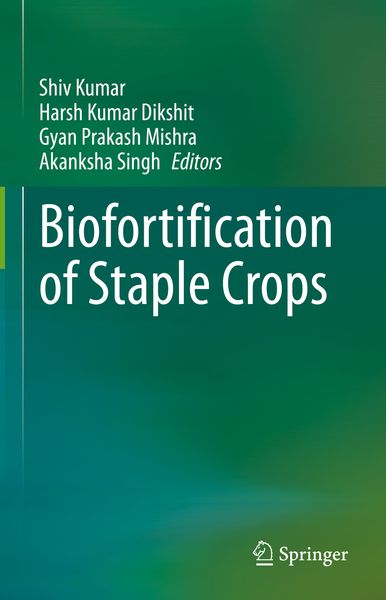
Produktbild: Biofortification of Staple Crops

Biofortification of Staple Crops

149,99 €

inkl. gesetzl. MwSt., Versandkostenfrei


Beschreibung

Produktdetails

Einband

Gebundene Ausgabe

Erscheinungsdatum

10.03.2022

Abbildungen

XVI, 549 p. 1 illus.

Herausgeber

Shiv Kumar + weitere

Verlag

Springer Singapore

Seitenzahl

549

Maße (L/B/H)

24,1/16/3,6 cm

Gewicht

1010 g

Auflage

22001 Auflage 1st edition 2022

Sprache

Englisch

ISBN

978-981-16-3279-2

Beschreibung

Portrait


Dr. Shiv Kumar leads ICARDA’s Food Legumes Program delivering improved germplasm of lentil, kabuli chickpea, faba bean, and grass pea to national partners in South Asia, Sub-Saharan Africa, West Asia, and North Africa. He works on developing short- duration, climate-smart varieties of lentil and grass pea, with high iron and zinc content for the sustainable intensification of cereal-based cropping systems. During his three-decade career he has worked with national and international partners to develop 39 lentil, five mungbean, two urdbean, one rice, and three grass pea varieties. He has published 196 peer-reviewed journal articles, 77 book chapters, ten books, seven technical bulletins, and two training manuals. He also supervises teaching and training of national partners. He has done his master’s and PhD in Plant Breeding from G.B.P.U.A. & T. Pantnagar (India). 

Dr. Harsh Kumar Dikshit is serving as Principal Scientist at ICAR-Indian Agricultural Research Institute, New Delhi (India). He is working on genetic improvement of grain legumes through conventional and molecular approaches. He has developed fifteen varieties of different grain legumes (lentil, mungbean and dry beans) for cultivation in India. His present focus is on basic and applied research on Biofortification and biotic stresses of lentil and mungbean. He is faculty of Division of Genetics and is involved in teaching of different courses and thesis research guidance to post graduate students. He has done his master’s and PhD in Plant Breeding from G.B.P.U.A. & T. Pantnagar (India). 

Dr. Gyan Prakash Mishra is currently working as Principal Scientist at ICAR-Indian Agricultural Research Institute, New Delhi (India). Before that he has worked at DRDO-Defence Institute of High Altitude Research, Leh (India) as Scientist ‘C’, ICAR-Directorate of Groundnut Research, Junagadh (India) and ICAR-Indian Institute of Vegetable Research, Varanasi (India) as Senior Scientist. His major research interest includes crop improvement through conventional, molecular and transgenics approaches. He has done his master’s and PhD in Genetics from Indian Agricultural Research Institute, New Delhi (India) and postdoc from University of California, Riverside and Purdue University, USA as BOYSCAST-Fellow.  

Dr. Akanksha Singh is working as Assistant Professor at Amity Institute of Organic Agriculture, Amity University, Noida (India). Her research areas include characterization of Lens species for grain Fe and Zn and association mapping and development of genetic and genomic resources. She has published around 23 research papers in reputed journals. She has contributed in development of lentil varieties for central India and registration of biofortified lentil germplasm L 4704 (Fe and Zn rich). She received Babu Jag Jivan Ram Memorial Gold Medal and Chancellor’s Silver Medal from Bundelkhand University, Jhansi for her master’s degree. She has done PhD in Biotechnology from Banasthali University, Banasthali (India). 

Produktdetails

Einband

Gebundene Ausgabe

Erscheinungsdatum

10.03.2022

Abbildungen

XVI, 549 p. 1 illus.

Herausgeber

Verlag

Springer Singapore

Seitenzahl

549

Maße (L/B/H)

24,1/16/3,6 cm

Gewicht

1010 g

Auflage

22001 Auflage 1st edition 2022

Sprache

Englisch

ISBN

978-981-16-3279-2

Herstelleradresse

Springer-Verlag KG
Sachsenplatz 4-6
1201 Wien
AT

Email: ProductSafety@springernature.com

Noch keine Bewertungen vorhanden

Verfassen Sie die erste Bewertung zu diesem Artikel

Helfen Sie anderen Kundinnen und Kunden durch Ihre Meinung.

Kundinnen und Kunden meinen

Bewertungen (0)

  • Produktbild: Biofortification of Staple Crops
  • Chapter 1. Biofortification of staple crops: Present status and future strategies.- Chapter 2. Historical overview of biofortification in crop plants and its implications.- Chapter 3. Genetic fortification of rice to address hidden hunger: progress and prospects.- Chapter 4. Advances in Wheat biofortification and Mainstreaming Grain Zinc in CIMMYT Wheat.- Chapter 5. Biofortification of maize for nutritional security.- Chapter 6. Pearl millet: bio-fortification approaches in a micronutrient dense, climate-resilient nutri-cereal.- Chapter 7. Barley Biofortification.- Chapter 8. Prospects of Biofortification in Groundnut using Modern Breeding Approaches.- Chapter 9. Dry Bean Biofortification With Iron and Zinc.- Chapter 10. Lentil biofortification.- Chapter 11. Biofortification of Mungbean.- Chapter 12. Biofortification of Cassava: Recent Progress and Challenges Facing the Future.- Chapter 13. Vegetable biofortification: An underexploited silver lining for malnutrition management.- Chapter 14. Transgenics for Biofortification with special reference to Rice.- Chapter 15. Agronomic and transgenic approaches for rice Zn biofortification.- Chapter 16. Agronomic approaches for biofortification of staple food crops.- Chapter 17. Micronutrients: Soil to seed.- Chapter 18. Pulse crop biofortification towards human health, targeting prebiotic carbohydrates, protein, and minerals.- Chapter 19. Biofortification of chickpea.- Chapter 20. Bifortifying sorghum for delivering grain micronutrients in high yielding cultivars with market preferred traits.