• Produktbild: Formal Linguistics and Language Education
  • Produktbild: Formal Linguistics and Language Education
Band 43

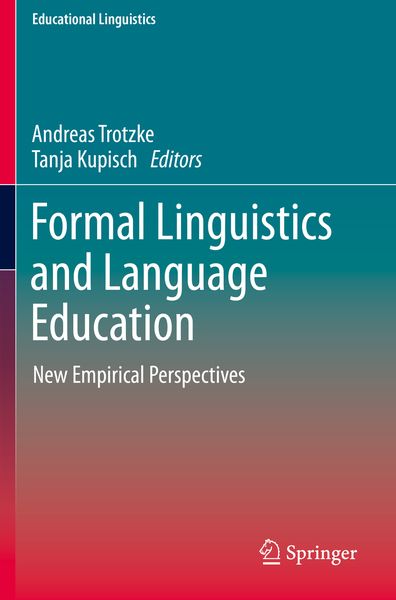
Formal Linguistics and Language Education New Empirical Perspectives

Aus der Reihe Educational Linguistics

138,99 €

inkl. gesetzl. MwSt., Versandkostenfrei


Beschreibung

Produktdetails

Einband

Taschenbuch

Erscheinungsdatum

11.06.2021

Herausgeber

Andreas Trotzke + weitere

Verlag

Springer

Seitenzahl

221

Maße (L/B/H)

23,5/15,5/1,3 cm

Gewicht

359 g

Auflage

1st ed. 2020

Sprache

Englisch

ISBN

978-3-030-39259-8

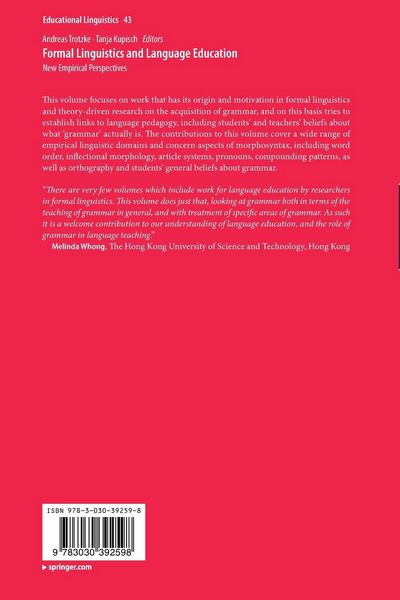
Beschreibung

Portrait

Andreas Trotzke  is Außerplanmäßiger Professor in the Department of Linguistics, University of Konstanz and Research Fellow at the Autonomous University of Barcelona. Trotzke is General Editor of the journal Pedagogical Linguistics. He got his PhD from the University of Freiburg in 2010 and has been a lecturer at the University of Potsdam and a postdoctoral fellow/visiting professor at MIT (2015), UC San Diego (2015), Stanford University (2016-2017), and UPF Barcelona (2018). He has recently been awarded the prestigious International Chair 2017 Empirical Foundations of Linguistics at Université Sorbonne Paris Cité/CNRS. His areas of expertise include the syntax-pragmatics interface, psycholinguistics, and language education.


Tanja Kupisch is Full Professor at the Department of Linguistics, University of Konstanz and Professor II at UiT The Arctic University of Norway. She got her PhD from the University of Hamburg in 2006, specializing in bilingual first language acquisition. She has worked as a researcher and teacher at the universities of Calgary, McGill, Hamburg, Lund, Konstanz, and Tromsø, specializing in first, second, and third language acquisition, heritage bilingualism, bilectal acquisition, and language attrition, including child and adult learners. Her work focuses on phenomena such as nominal syntax and foreign accent, including the languages French, Italian, English, German, Turkish, and Russian.

Produktdetails

Einband

Taschenbuch

Erscheinungsdatum

11.06.2021

Herausgeber

Verlag

Springer

Seitenzahl

221

Maße (L/B/H)

23,5/15,5/1,3 cm

Gewicht

359 g

Auflage

1st ed. 2020

Sprache

Englisch

ISBN

978-3-030-39259-8

Herstelleradresse

Springer-Verlag GmbH
Tiergartenstr. 17
69121 Heidelberg
DE

Email: ProductSafety@springernature.com

Kundinnen und Kunden meinen

0 Bewertungen

Informationen zu Bewertungen

Zur Abgabe einer Bewertung ist eine Anmeldung im Konto notwendig. Die Authentizität der Bewertungen wird von uns nicht überprüft. Wir behalten uns vor, Bewertungstexte, die unseren Richtlinien widersprechen, entsprechend zu kürzen oder zu löschen.

Die Bewertungen sind nach Format, Anzahl Sterne und Datum sortiert.

Verfassen Sie die erste Bewertung zu diesem Artikel

Helfen Sie anderen Kund*innen durch Ihre Meinung

Kundinnen und Kunden meinen

0 Bewertungen filtern

Weitere Artikel finden Sie in

  • Produktbild: Formal Linguistics and Language Education
  • Produktbild: Formal Linguistics and Language Education
  • Formal linguistics and language education: Bridging the gap; Andreas Trotzke & Tanja Kupisch.- Part I: Conceptual Foundations.- Formal linguistics and language education: A view from bilingualism research; Fatih Bayram & Jason Rothman.- Grammatical concepts for pedagogical grammar; Tom Rankin & Melinda Whong.- Part II: Native Language Settings.- Teaching word order variation with a constraint-based view on grammar; Daniel Gutzmann & Katharina Turgay.- Grammar is irrelevant: The role of epistemological beliefs in students’ learning success; Daniela Elsner.- Shaking students’ beliefs about grammar: Some thoughts on the academic education of future language teachers; Sandra Döring.- Do linguistic landscapes influence the spelling competence of orthographic beginners? Two case studies; Björn Rothstein.- Part III: Second/Third Language Settings.- The present tense in English, again; Amber Dudley & Roumyana Slabakova.- Explicit and implicit knowledge of article semantics in Belarusian learners of English: Implications for teaching; Anders Agebjörn.- Post-instruction processing of generics in English by Japanese L2 learners; Neal Snape.- L2 influence in L3 acquisition: The role of the L3; Rosalinde Stadt, Aafke Hulk & Petra Sleeman.