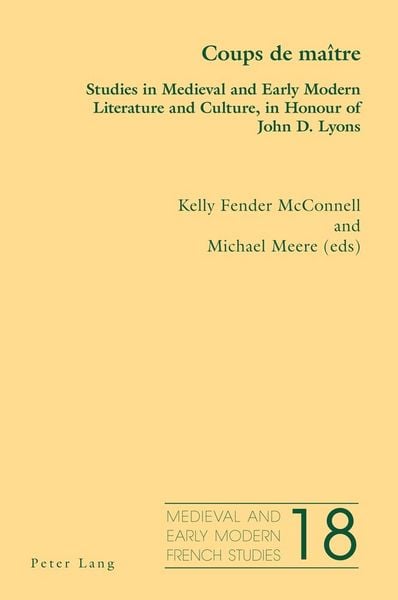
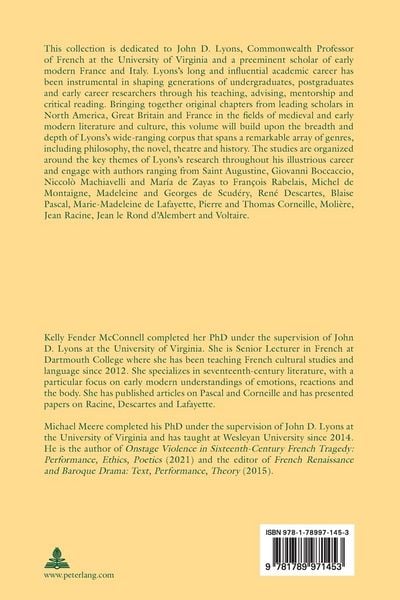
CONTENTS: Corneille, Racine, Molière – Hélène Merlin-Kajman: Lire John Lyons : une chance – Églantine Morvant: La temporalité de la clémence d’Auguste : vers un pouvoir absolu à visage humain – Ellen R. Welch: Noises Off: Tragic Acousmatics in Corneille and Racine – Michael Hawcroft: Racine’s Assistants: Non-speaking Roles in
Andromaque
and Its English Translations – John Campbell: Taste, Distaste and Criticism: Voltaire on Corneille’s
Polyeucte
and Racine’s
Athalie
– Georges Forestier: Des confidences de Molière mourant? Amorce d’une réflexion sur la « vérité » des textes – Noël Peacock: Molière’s Parody of Tragedy – Scudéry, Lafayette and the Salons – Kathleen Wine: Chance, Astrology and Authorship in Scudéry’s
Ibrahim ou l’illustre bassa
– Hélène Bilis: Reading Lafayette from the Outside: Character Interactions in the «Anti-imaginative Novel» – Harriet Stone: At Home with Nicolaes Maes’s Eavesdropper and
La Princesse de Clèves
– Faith E. Beasley: Recovering Lost Conversations: The Case of François Bernier – Montaigne, Descartes, Pascal – George Hoffmann: The Devil in Descartes – Hall Bjørnstad: Of Angels and Beasts: The Exemplarity of Failure in Montaigne and Pascal – Erec R. Koch: Intertextuality and Citation: Montaigne in Pascal – Nicholas Hammond: The Ordinary Conversations of Life: Example and Education in Another
Entretien avec M. de Sacy
– Richard E. Goodkin: Temporality and the Birth of Calculus in Blaise Pascal’s and Pierre de Fermat’s Problem of Points and d’Alembert’s Concept of Limits: A Humanistic Perspective – Renaissance, Baroque,
Classicisme
– Virginia Krause: « Composé par M. François Rabelais »: Author, Title, Page – Christopher Braider: Painting as Experiment in Rubens’s
Four Philosophers
– Michael Moriarty: Love and Friendship: Jean-Pierre Camus and the Moralists – Michael Meere: Poliarque-Théocrine, or Pierre Du Ryer’s Cross-Dressed King – Thomas Pavel: Marvellous Forgotten Works: The Story of Alcamène and Ménalippe by La Calprenède and
Timocrate
by Thomas Corneille – Emma Gilby: The Genre of the « Bouts Rimés » and Seventeenth-Century Satire – Anne Régent-Susini: Funeral Sermons in Seventeenth-Century French Letters and Diaries: The Building of a Genre – Guy Spielmann: The «French Baroque» from Self-Evidence to Oxymoron – and Back – Example, History, Imagination – Stephen G. Nichols: Castration as Exemplum: The Making of a Medieval Trope – Kevin Brownlee: Ekphrasis in Jean de Meun’s Rose and Boccaccio’s
Teseida
: The Erotic Statue and the Illustrated Building – Timothy Chesters: Face-Off: Communication and Countenance in Blaise de Monluc’s
Commentaires
– Éric Méchoulan:
Lettre envoyee au Philosophe eloquent
: exemplarité d’une situation et construction du public dans la querelle de l’éloquence en 1627 – Malina Stefanovska: A Seventeenth-Century View of History: The Cardinal de Retz and the Example of Machiavelli – Marina S. Brownlee: Zayas’s Diabolical Magic – Katherine Ibbett: A Clearing in the Woods: The Example of the Early Modern Beaver.