KI-Beratung Beta

Gutscheinbedingungen

**Gültig bis 30.11.2026 auf Spielzeug, Schreibwaren, Filme, Geschenke & Trends, Musik, tolino eReader & Zubehör, Hörbücher und Hörbuch-Downloads, nicht preisgebundene Bücher und Kalender online auf thalia.at und in der Thalia App. Einzelne Artikel können ausgeschlossen sein. Aufgrund der Buchpreisbindung sind deutschsprachige Bücher und eBooks ausgenommen. Zusätzlich ausgenommen sind Abos & Flatrates, Games, Geschenkkarten/-boxen, Shelfies, Software, Zeitschriften sowie einzelne Artikel von tonies®. Pro Einkauf einmal einlösbar. Nur gültig mit im Onlineshop hinterlegter Bonuscard. Click & Collect nur bei Onlinevorabzahlung möglich. Keine Barauszahlung. Nicht kombinierbar mit anderen Aktionen und Gutscheinen. Gutschein wird auf max. 500€ Bestellwert angerechnet. Nicht gültig für Versandkosten und Services.

  • Produktbild: Muslim Piety as Economy
  • Produktbild: Muslim Piety as Economy

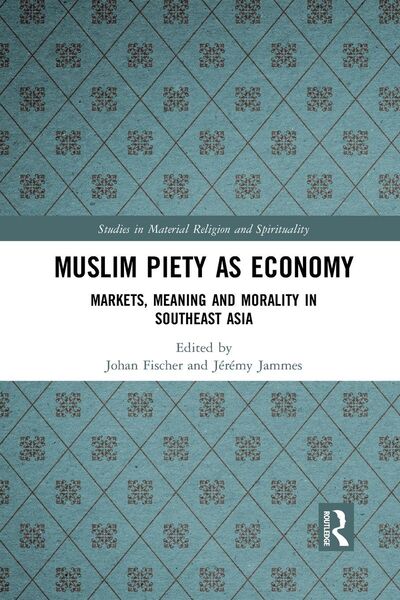
Muslim Piety as Economy Markets, Meaning and Morality in Southeast Asia

62,99 €

inkl. gesetzl. MwSt., Versandkostenfrei


Beschreibung

The first volume to explore Muslim piety as a form of economy, this book examines specific forms of production, trade, regulation, consumption, entrepreneurship and science that condition - and are themselves conditioned by - Islamic values, logics and politics. With a focus on Southeast Asia as a site...

Beschreibung

The first volume to explore Muslim piety as a form of economy, this book examines specific forms of production, trade, regulation, consumption, entrepreneurship and science that condition - and are themselves conditioned by - Islamic values, logics and politics. With a focus on Southeast Asia as a site of significant and diverse integration of Islam and the economy - as well as the incompatibilities that can occur between the two - it reveals the production of a Muslim piety as an economy in its own right. Interdisciplinary in nature and based on in-depth empirical studies, the book considers issues such as the Qur'anic prohibition of corruption and anti-corruption reforms; the emergence of the Islamic economy under colonialism; 'halal' or 'lawful' production, trade, regulation and consumption; modesty in Islamic fashion marketing communications; and financialisation, consumerism and housing. As such, it will appeal to scholars of sociology, anthropology and religious studies with interests in Islam and Southeast Asia.

Rezension

'This new volume substantially expands current conversations beyond dominant discourses of Islamic economy and its technical focus on financial instruments, to broader critical engagements with market regulation, public policy, and symbolic communication through examinations of contemporary halal discourses that transcend formalistic understandings of 'shari'a compliance' to more complex dynamics across the interlinked spheres of governance, finance, fashion and family life.' - R. Michael Feener, Oxford Centre for Islamic Studies, University of Oxford, UK

'This superb volume brings together experienced scholars in sciences, social sciences, and Islamic studies to examine contemporary developments around halal standards in Southeast Asia. Few treatments of this topic succeed as this one does in both ranging broadly-from economics to colonial history to fiction-and plunging in depth-especially into biology and genetics.' - John R. Bowen, Dunbar-Van Cleve Professor, Washington University in St. Louis, author of On British Islam, and A New Anthropology of Islam

'Over the past generation, many Muslim-majority societies have experienced a revival in religious observance at the same time as they have witnessed unprecedented levels of market growth. The changes have been no where more transformative than in the Muslim-majority societies of Southeast Asia. This meticulously researched and highly original book brings together some of the finest scholarship on Islam and economic change in Muslim Southeast Asia, and offers rich insight into one of the most distinctive but little studied features of Muslim modernity.' - Robert W. Hefner, Pardee School of Global Affairs, Boston University, USA

'An unrivalled and thoroughly documented investigation of Muslim Southeast Asia, indispensable to the understanding of one of the most remarkable and comprehensive transformations of Islam in recent decades: the emergence of Muslim piety as an economic system unto itself.' - Rémy Madinier, Centre National de la Recherche Scientifique, France

'A more informed analysis and understanding of Islam and Muslims in Southeast Asia and their contemporary articulations must be embedded in the historical reality of plurality, plural society and diversity templates that become the mould of social life in the region. In equal measure, any attempt to explain and analyse recent major developments of Islamic economy in the region must be embedded not only in its historical reality but also in the reality of its pluralistic capitalist economy, in which formal and substantive economies are enmeshed. The book, Muslim Piety as Economy: Markets, Meaning and Morality in Southeast, arguably is the first that has successfully captured both of the 'embedization processes' grounded in impressive empirical evidence. It is a must read for anyone interested in contemporary articulation of Islamic economy in the vast maritime-riverine complex, called the Malay world, that constitutes the major component of Southeast Asia.' - Shamsul A.B., Distinguished Professor and UNESCO Chair (Communications & Social Cohesion) at The National University of Malaysia

' ... the relationship, between the growing piety and economy, remains relatively underexplored. This book fills an important gap by exploring, among other things, the economic impact of growing piety in Southeast Asia. Islam in many contexts is often presented as a total way of life ... The book brings home the important and irrefutable point: Halal as a trope has connected local with global, and tradition with modernity.' - Habibul Haque Khondker, Asian Journal of Social Science

Produktdetails

Einband

Taschenbuch

Erscheinungsdatum

30.06.2021

Abbildungen

12 SW-Abb.

Herausgeber Johan Fischer + weitere

Produktdetails

Einband

Taschenbuch

Erscheinungsdatum

30.06.2021

Abbildungen

12 SW-Abb.

Herausgeber
Verlag Taylor & Francis
Seitenzahl

258

Maße (L/B/H)

23,4/15,6/1,4 cm

Gewicht

398 g

Sprache

Englisch

ISBN

978-1-03-208720-7

Herstelleradresse

Produktsicherheitsverantwortliche/r
Europaallee 1
36244 Bad Hersfeld
DE

Email: gpsr@libri.de

Noch keine Bewertungen vorhanden

Verfassen Sie die erste Bewertung zu diesem Artikel

Helfen Sie anderen Kundinnen und Kunden durch Ihre Meinung.

Kundinnen und Kunden meinen

Bewertungen (0)

Die Leseprobe wird geladen.
  • Produktbild: Muslim Piety as Economy
  • Produktbild: Muslim Piety as Economy
  • 1. Introduction 2. Social Trust, the Qur'anic Prohibition of Corruption, and Anti-Corruption Reforms in Indonesia 3. Muhammadiyah, Membership Dues and the Islamic Economy in Colonial Aceh 4. Brunei Halal Certification: A Review and Way Forward 5. Consumer Goods and the Role of Science in the Halal Industry in Southeast Asia 6. Contamination of Halal Food Products: Insights on Theological Rulings 7. Middle-Class Projects in Modern Malaysia and Beyond 8. Modesty in Islamic Fashion Marketing Communications in ASEAN 9. Packaging MIB: Representations of Islam in Anglophone Bruneian Fiction 10. Tales from Two Cities: Financialisation, Consumerism and Affordable Housing in Kuala Lumpur and Jakarta 11. Afterword: Contemporary Halal Tropism, or Islam and Economy between the Global and the Traditional Era