
KI-Beratung Beta

Gutscheinbedingungen

**Gültig bis 30.11.2026 auf Spielzeug, Schreibwaren, Filme, Geschenke & Trends, Musik, tolino eReader & Zubehör, Hörbücher und Hörbuch-Downloads, nicht preisgebundene Bücher und Kalender online auf thalia.at und in der Thalia App. Einzelne Artikel können ausgeschlossen sein. Aufgrund der Buchpreisbindung sind deutschsprachige Bücher und eBooks ausgenommen. Zusätzlich ausgenommen sind Abos & Flatrates, Games, Geschenkkarten/-boxen, Shelfies, Software, Zeitschriften sowie einzelne Artikel von tonies®. Pro Einkauf einmal einlösbar. Nur gültig mit im Onlineshop hinterlegter Bonuscard. Click & Collect nur bei Onlinevorabzahlung möglich. Keine Barauszahlung. Nicht kombinierbar mit anderen Aktionen und Gutscheinen. Gutschein wird auf max. 500€ Bestellwert angerechnet. Nicht gültig für Versandkosten und Services.

  • Produktbild: Social Inequalities and Discontent in Yugoslav Socialism
  • Produktbild: Social Inequalities and Discontent in Yugoslav Socialism

Social Inequalities and Discontent in Yugoslav Socialism

62,99 €

inkl. gesetzl. MwSt., Versandkostenfrei


Beschreibung

Socialist countries like Yugoslavia garnered legitimacy through appealing to social equality. Yet social stratification was characteristic of Yugoslav society and increased over the course of the state's existence. By the 1980s the country was divided on socio-economic as well as national lines. Through...

Beschreibung

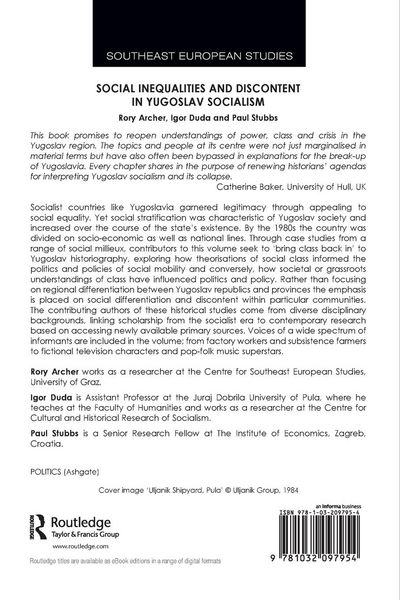
Socialist countries like Yugoslavia garnered legitimacy through appealing to social equality. Yet social stratification was characteristic of Yugoslav society and increased over the course of the state's existence. By the 1980s the country was divided on socio-economic as well as national lines. Through case studies from a range of social millieux, contributors to this volume seek to 'bring class back in' to Yugoslav historiography, exploring how theorisations of social class informed the politics and policies of social mobility and conversely, how societal or grassroots understandings of class have influenced politics and policy. Rather than focusing on regional differentiation between Yugoslav republics and provinces the emphasis is placed on social differentiation and discontent within particular communities. The contributing authors of these historical studies come from diverse disciplinary backgrounds, linking scholarship from the socialist era to contemporary research based on accessing newly available primary sources. Voices of a wide spectrum of informants are included in the volume; from factory workers and subsistence farmers to fictional television characters and pop-folk music superstars.

Rezension

'...the volume presents valuable new insights and manages to make a forceful argument for a new research agenda: we need to take the social more seriously when explaining how Yugoslavia worked (and how it failed).'

Ulf Brunnbauer
Leibniz Institute for East and Southeast European Studies, Regensburg, Germany
Southeastern Europe 42 (2018)

Produktdetails

Einband

Taschenbuch

Erscheinungsdatum

30.06.2021

Herausgeber Rory Archer + weitere
Verlag Taylor & Francis

Produktdetails

Einband

Taschenbuch

Erscheinungsdatum

30.06.2021

Herausgeber
Verlag Taylor & Francis
Seitenzahl

212

Maße (L/B/H)

23,4/15,6/1,2 cm

Gewicht

330 g

Sprache

Englisch

ISBN

978-1-03-209795-4

Herstelleradresse

Libri GmbH
Europaallee 1
36244 Bad Hersfeld
DE

Email: gpsr@libri.de

Noch keine Bewertungen vorhanden

Verfassen Sie die erste Bewertung zu diesem Artikel

Helfen Sie anderen Kundinnen und Kunden durch Ihre Meinung.

Kundinnen und Kunden meinen

Bewertungen (0)

Weitere Artikel finden Sie in

Die Leseprobe wird geladen.
  • Produktbild: Social Inequalities and Discontent in Yugoslav Socialism
  • Produktbild: Social Inequalities and Discontent in Yugoslav Socialism
  • Contents: Bringing class back in: an introduction, Rory Archer, Igor Duda and Paul Stubbs; What nationalism has buried: Yugoslav social scientists on the crisis, grassroots powerlessness and Yugoslavism, Ana Devic; The gastarbajteri as a transnational Yugoslav working class, Brigitte Le Normand; 'Paid for by the workers, occupied by the bureaucrats': housing inequalities in 1980s Belgrade, Rory Archer; Education, conflict, and class reproduction in socialist Yugoslavia, Jana Bacevic; Roma between ethnic group and an 'underclass' as portrayed through newspaper discourses in socialist Slovenia, Julija Sardelic; Of social inequalities in a socialist society. the creation of a rural underclass in Yugoslav Kosovo, Isabel Ströhle; 'They came as workers and left as Serbs': the role of Rakovica's blue-collar workers in Serbian social mobilizations of the late 1980s, Goran Music; 'Buy me a silk skirt mile!' Celebrity culture, gender and social positioning in socialist Yugoslavia, Ana Hofman and Polona Sitar; When capitalism and socialism get along best. Tourism, consumer culture and the idea of progress in Malo Misto, Igor Duda. Index.