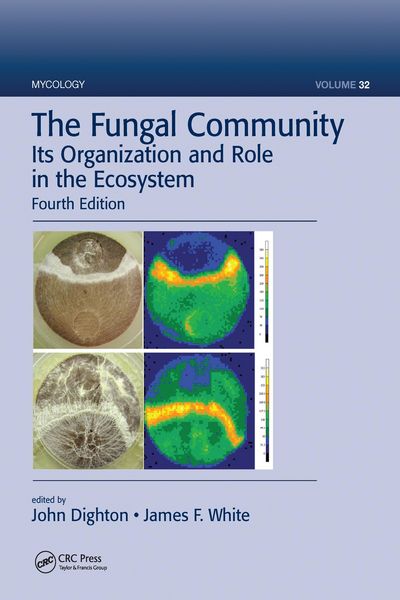
The Fungal Community Its Organization and Role in the Ecosystem, Fourth Edition
-
- Hardcover
- Taschenbuch ausgewählt
- eBook
-
Sprache:Englisch
71,99 €
inkl. gesetzl. MwSt.,
Beschreibung
Produktdetails
Einband
Taschenbuch
Erscheinungsdatum
30.06.2021
Abbildungen
60 SW-Abb., 72 Farbabb.
Herausgeber
John Dighton + weitereVerlag
Taylor & FrancisSeitenzahl
652
Maße (L/B/H)
27,7/20,9/3,8 cm
Gewicht
1210 g
Auflage
4th edition
Sprache
Englisch
ISBN
978-1-03-209717-6
"...a number of chapters provide excellent summaries of the modern methods available for studying fungal ecology, along with those more traditional methods that are still extremely valuable...overall it is a hugely valuable compendium of fungal ecology research. It is a must for the library shelf."
-Lynne Boddy, Cardiff University, UK, Mycological Research, 2006
"These 44 chapters are an excellent starting point for anyone interested in fungal communities, in the broadest sense of the term. It is a book for dipping into...may be the last comprehensive treatment of fungal communities before the molecular revolution."
-Meriel Jones, University of Liverpool, UK, Microbiology Today
"... the scope of the work is tremendous. ... Excellent chapters providing overviews of methods ... provide a snap shot of the current approaches used to understand fungal communities at several levels of organization. This book should probably be on the shelf of every student of mycology, and many ecologists too. For all students, this book should be a valuable resource and source of inspiration."
-Daniel Henk, Imperial College Faculty of Medicine, London, in Inoculum, Vol. 59, No. 3, May 2008
"Thorough taxonomic and subject indices further aid the reader in navigating through multiple authors' treatments of subjects of interest."
- Anthony Amend, Department of Botany, University of Hawaii at Manoa in Economic Botany, V. 61
In all subjects in science, new findings and the use of new technologies allow us to develop an ever-greater understanding of our world. Expanded and updated coverage in the fourth edition includes:
- Adds new sections on Integrating Genomics and Metagenomics into Community Analysis, Recent Advances in Fungal Endophyte Research, Fungi in the Built Environment, and Fungal Signaling and Communication
- Includes a broader treatment of fungal communities in natural ecosystems with in-depth coverage of fungal adaptations to stress and conservation
- Expands coverage of the influence of climate change on fungi and the role of fungi in organically polluted ecosystems
Includes contributions from scientists from 20 nations to illustrate a true global approach for bridging gaps between ecological concepts and mycology
Noch keine Bewertungen vorhanden
Verfassen Sie die erste Bewertung zu diesem Artikel
Helfen Sie anderen Kundinnen und Kunden durch Ihre Meinung.
Kurze Frage zu unserer Seite
Vielen Dank für Ihr Feedback
Wir nutzen Ihr Feedback, um unsere Produktseiten zu verbessern. Bitte haben Sie Verständnis, dass wir Ihnen keine Rückmeldung geben können. Falls Sie Kontakt mit uns aufnehmen möchten, können Sie sich aber gerne an unseren Kund*innenservice wenden.
zum Kundenservice