KI-Beratung Beta

Gutscheinbedingungen

**Gültig am 20.11.2026 ab einem Mindestbestellwert von 30€ auf Spielzeug, Schreibwaren, Filme, Geschenke & Trends, Musik, tolino eReader & Zubehör, Hörbücher und Hörbuch-Downloads, nicht preisgebundene Bücher und Kalender online auf thalia.at und in der Thalia App. Einzelne Artikel können ausgeschlossen sein. Aufgrund der Buchpreisbindung sind deutschsprachige Bücher und eBooks ausgenommen. Zusätzlich ausgenommen sind Abos & Flatrates, Games, Geschenkkarten/-boxen, Shelfies, Software, Zeitschriften sowie einzelne Artikel von tonies®. Pro Einkauf einmal einlösbar. Click & Collect nur bei Onlinevorabzahlung möglich. Keine Barauszahlung. Nicht kombinierbar mit anderen Aktionen und Gutscheinen. Gutschein wird auf max. 500€ Bestellwert angerechnet. Nicht gültig für Versandkosten und Services. Preisgebundene Artikel sind vom Mindestbestellwert ausgeschlossen.

Produktbild: Social Simulation for a Crisis

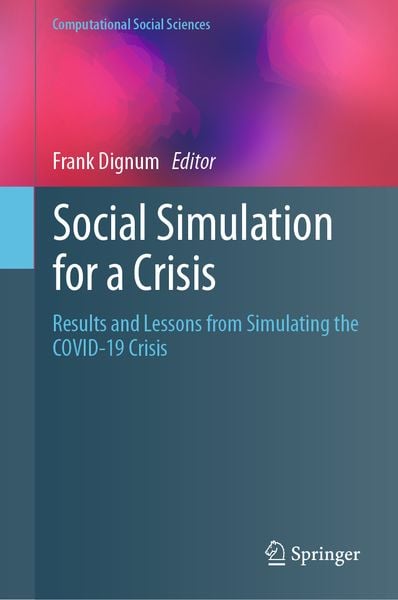
Social Simulation for a Crisis Results and Lessons from Simulating the COVID-19 Crisis

169,99 €

inkl. gesetzl. MwSt., Versandkostenfrei


Beschreibung

Simulating for a crisis is far more than creating a simulation of a crisis situation. In order for a simulation to be useful during a crisis, it should be created within the space of a few days to allow decision makers to use it as quickly as possible. Furthermore, during a crisis the aim is not to...

Beschreibung

Simulating
for
a crisis is far more than creating a simulation
of
a crisis situation. In order for a simulation to be useful during a crisis, it should be created within the space of a few days to allow decision makers to use it as quickly as possible. Furthermore, during a crisis the aim is not to optimize just one factor, but to balance various, interdependent aspects of life. In the COVID-19 crisis, decisions had to be made concerning e.g. whether to close schools and restaurants, and the (economic) consequences of a 3 or 4-week lock-down had to be considered. As such, rather than one simulation focusing on a very limited aspect, a framework allowing the simulation of several different scenarios focusing on different aspects of the crisis was required. Moreover, the results of the simulations needed to be easily understandable and explainable: if a simulation indicates that closing schools has no effect, this can only be used if the decision makers can explain why this is the case. This book describes how a simulation framework was created for the COVID-19 crisis, and demonstrates how it was used to simulate a wide range of scenarios that were relevant for decision makers at the time. It also discusses the usefulness of the approach, and explains the decisions that had to be made along the way as well as the trade-offs. Lastly, the book examines the lessons learned and the directions for the further development of social simulation frameworks to make them better suited to crisis situations, and to foster a more resilient society.

Portrait


Frank Dignum is a Dutch computer scientist. Since February 2019 he is a Professor of Socially-Aware AI at Umeå University and a part-time associate professor at the Department of Information and Computing Sciences of the Utrecht University. He also is a honorary principle research fellow in the Department of Computing and Information Systems at the University of Melbourne. Dignum is best known from his work on software agents, multi-agent systems and fundamental aspects of social agents including norms, social rules and communication. This work is performed in the context of social simulations, games and dialogue management systems.
Dignum received his PhD in 1989 from the VU University Amsterdam. He started his academic career as assistant professor and chair of the department of Computer Science at the University of Swaziland in 1990. In 1992 he moved back to Portugal and became assistant professor at the Instituto Superior Técnico in Lisbon. After coming back in the Netherlands in 1993 as assistant professor at Eindhoven University of Technology, in 2000 he was appointed Associate professor at the Department of Information and Computing Sciences of the Utrecht University. 

Produktdetails

Einband

Gebundene Ausgabe

Erscheinungsdatum

09.06.2021

Abbildungen

XIV, 453 p. 170 illus., 155 illus. in color.

Herausgeber Frank Dignum

Produktdetails

Einband

Gebundene Ausgabe

Erscheinungsdatum

09.06.2021

Abbildungen

XIV, 453 p. 170 illus., 155 illus. in color.

Herausgeber Frank Dignum
Verlag Springer
Seitenzahl

453

Maße (L/B/H)

24,1/16/3,1 cm

Gewicht

812 g

Auflage

21001 Auflage 1st edition 2021

Sprache

Englisch

ISBN

978-3-030-76396-1

Herstelleradresse

Springer-Verlag GmbH
Europaplatz 3
69115 Heidelberg
DE

Email: ProductSafety@springernature.com

Noch keine Bewertungen vorhanden

Verfassen Sie die erste Bewertung zu diesem Artikel

Helfen Sie anderen Kundinnen und Kunden durch Ihre Meinung.

Kundinnen und Kunden meinen

Bewertungen (0)

  • Produktbild: Social Simulation for a Crisis

  • Part 1. ASOCC Theory and Platform.- Chapter 1. Introduction.- Chapter 2. Foundations.- Chapter 3. From Theories to Implementation.- Chapter 4. Simulation Use.- Part II. Scenario's and Submodels.- Chapter 5. Closing of Schools.- Chapter 6. Testing & Smart Testing.- Chapter 7. Deployment and Effects of an App for Tracking and Tracing Contacts.- Chapter 8. How Culture Influences the Management of a Pandemic: Simulating the Effect of Culture on the Effective Management of the COVID-19 crisis,- Chapter 9. Economics.- Chapter 10. Exit Strategies.- Part III. Results and Lessons Learned.- Chapter 11. Extensible Model-Building in Crises.- Chapter 12. Comparative Validation of Simulation Models for the COVID-19 Pandemic.- Chapter 13. Supporting Policy Makers in a Crisis.- Chapter 14. From Crisis to Resilience Support.- Chapter 15. Challenges and Issues.- Chapter 16. Conclusions.