Gutscheinbedingungen

**Gültig bis 14.09.2026 auf Spielzeug, Schreibwaren, Filme, Geschenke & Trends, Musik, tolino eReader & Zubehör, Hörbücher, nicht preisgebundene Bücher und Kalender in der Thalia App. Einzelne Artikel können ausgeschlossen sein. Aufgrund der Buchpreisbindung sind deutschsprachige Bücher und eBooks ausgenommen. Zusätzlich ausgenommen sind Abos & Flatrates, Games, Geschenkkarten/-boxen, Shelfies, Software, Zeitschriften sowie einzelne Artikel von tonies®. Pro Einkauf einmal einlösbar. Nur gültig mit im Onlineshop hinterlegter Bonuscard. Click & Collect nur bei Onlinevorabzahlung möglich. Keine Barauszahlung. Nicht kombinierbar mit anderen Aktionen und Gutscheinen. Gutschein wird auf max. 500€ Bestellwert angerechnet. Nicht gültig für Versandkosten und Services.

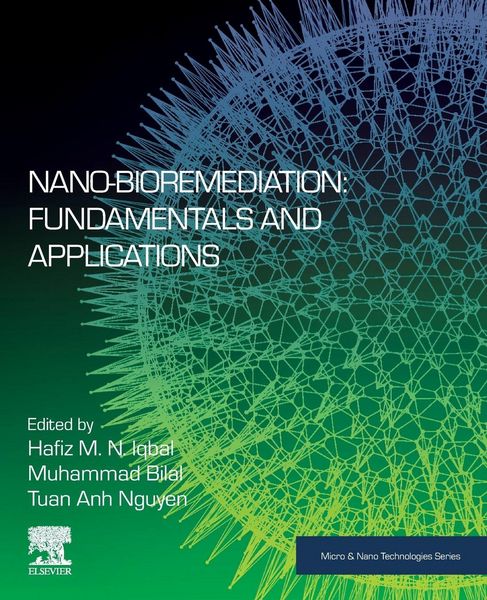
  • Produktbild: Nano-Bioremediation
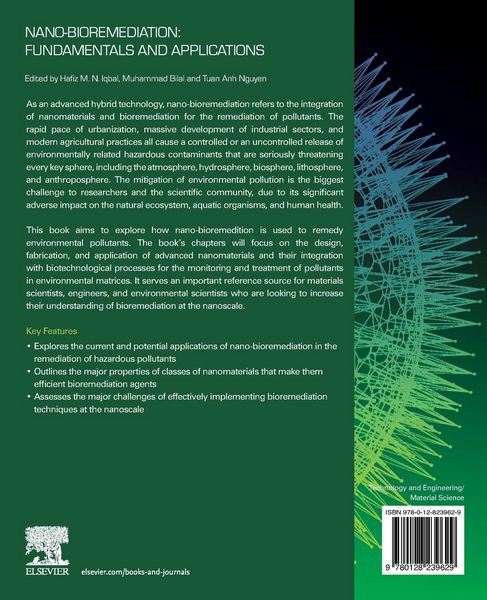
  • Produktbild: Nano-Bioremediation

Nano-Bioremediation Fundamentals and Applications

207,99 €

inkl. gesetzl. MwSt., Versandkostenfrei


Beschreibung

Produktdetails

Einband

Taschenbuch

Erscheinungsdatum

10.11.2021

Abbildungen

50 illustrations (50 in full color)

Herausgeber

Hafiz M. N. Iqbal + weitere

Verlag

Elsevier Science & Technology

Seitenzahl

620

Maße (L/B/H)

23,5/19,1/3,2 cm

Gewicht

1051 g

Sprache

Englisch

ISBN

978-0-12-823962-9

Beschreibung

Portrait

Hafiz M.N. Iqbal is a Research Professor in the School of Engineering and Sciences at the Tecnológico de Monterrey, Mexico. His areas of research are biomaterials, bioengineering, biomedical engineering, environmental engineering, bioremediation, bio-catalysis, enzymes, immobilization, chemical engineering, green chemistry, algal biotechnology, and bioenergy.
Muhammad Bilal is working as an Associate Professor at the Faculty of Civil and Environmental Engineering, Gdansk University of Technology, Poland. Previously, he served as an assistant/associate Professor at Poznan University of Technology, Poland, and the School of Life Science and Food Engineering, Huaiyin Institute of Technology, Huaian, China. He earned his Ph.D. from Shanghai Jiao Tong University, specializing in bioengineering and applied biotechnology. His main research activities are oriented to Environmental biotechnology, nanotechnology, enzyme engineering, immobilization, chemical modifications, and industrial applications of microbial enzymes, liquid, and solid waste management. He has authored over 700 peer-reviewed articles, 150 book chapters, 25 edited books. Dr. Bilal is the associate editor of Frontiers in Chemical Engineering and Frontiers in Environmental Science (Frontiers), and an editorial board member for several journals. He was listed as a highly cited researcher (Clarivate) in 2021 and holds several "highly cited papers" in WOS.
Tuan Anh Nguyen is a Senior Principal Research Scientist at the Institute for Tropical Technology, Vietnam Academy of Science and Technology, Hanoi, Vietnam. He received a BS in physics from Hanoi University in 1992, a BS in economics from Hanoi National Economics University in 1997, and a PhD in chemistry from the Paris Diderot University, France, in 2003. He was a Visiting Scientist at Seoul National University, South Korea, in 2004, and the University of Wollongong, Australia, in 2005. He then worked as a Postdoctoral Research Associate and Research Scientist at Montana State University, United States in 2006-09. In 2012 he was appointed as the Head of the Microanalysis Department at the Institute for Tropical Technology. His research areas of interest include smart sensors, smart networks, smart hospitals, smart cities, complexiverse, and digital twins. He has edited more than 74 books for Elsevier, 12 books for CRC Press, 1 book for Springer, 1 book for RSC, and 2 books for IGI Global. He is the Editor-in-Chief of Kenkyu Journal of Nanotechnology & Nanoscience.

Produktdetails

Einband

Taschenbuch

Erscheinungsdatum

10.11.2021

Abbildungen

50 illustrations (50 in full color)

Herausgeber

Verlag

Elsevier Science & Technology

Seitenzahl

620

Maße (L/B/H)

23,5/19,1/3,2 cm

Gewicht

1051 g

Sprache

Englisch

ISBN

978-0-12-823962-9

Herstelleradresse

Libri GmbH
Europaallee 1
36244 Bad Hersfeld
DE

Email: gpsr@libri.de

Noch keine Bewertungen vorhanden

Verfassen Sie die erste Bewertung zu diesem Artikel

Helfen Sie anderen Kundinnen und Kunden durch Ihre Meinung.

Kundinnen und Kunden meinen

Bewertungen (0)

Die Leseprobe wird geladen.
  • Produktbild: Nano-Bioremediation
  • Produktbild: Nano-Bioremediation
  • PART 1: BASIC PRINCIPLES
    1. Nano-bioremediation: an introduction
    2. Classification, potential routes, and risks of emerging pollutants
    3. Characterization of nanomaterials used in nano-bioremediation
    4. Nanotoxicity and antibacterial properties of nanomaterials, when used in nano-bioremediation
    5. Interactions of nanomaterials with microbes

    PART 2: NANOMATERIALS-BASED BIOTECHNOLOGY FOR AIR REMEDIATION 
    6. Nano-bioremediation for air remediation: an introduction
    7. Bionanosensors to detect (and quantify) air pollutants (nanobiosensors for virus detection in the air)
    8. Nanomaterials for biological membrane in filtration processes (immobilization of nanoparticles in the filtration of bio-membrane structures)
    9. Bioremediation of air using microorganisms encapsulated within a nanoshell (nanocontainer/nanocapsule)
    10. Nanomaterials in bioadsorbents for airborne particulate matter
    11. Nano-bioremediation for indoor air treatment
    12. Toxicity/risk assessment of nanomaterials when used in air remediation
    13. Nanomaterials for biological- and physicochemical-combination processes

    PART 3: NANOMATERIALS-BASED BIOTECHNOLOGY FOR WATER REMEDIATION
    14. Nano-bioremediation for water remediation: an introduction
    15. Nanostructured catalytic biomembranes for water filtration
    16. Nano-biocatalysts for wastewater remediation and redefining of pollutants
    17. Nano-biosorbents to remove contaminants from water matrices
    18. Enzyme-linked nanomaterials to mitigate emerging contaminants
    19. Toxicity/risk assessment of nanomaterials when used in water remediation

    PART 4: NANOMATERIALS-BASED BIOTECHNOLOGY FOR SOIL REMEDIATION
    20. Nano-bioremediation for soil remediation: an introduction
    21. Soil contamination, risk assessment, and nano-bioremediation
    22. Nanobiosensors for soil quality monitoring
    23. Bioremediation of organic pesticides using nanomaterials
    24. Nano-sorbents to remove heavy metal pollutants
    25. Nano-bioremediation of insecticides and herbicides
    26. Toxic risks of nanomaterials used in soil remediation

    PART 5: CURRENT PILOT/INDUSTRIAL APPLICATIONS AND FUTURE SCOPE
    27. Pilot scale treatment of environment using nano-bioremediation
    28. Current challenges, research gaps, and measures
    29. Enforcement and legislation
    30. Future perspectives