
Violence, Victimisation and Young People Education and Safe Learning Environments
-
- Hardcover ausgewählt
- Taschenbuch
- eBook
-
Sprache:Englisch
119,99 €
inkl. gesetzl. MwSt.,
Beschreibung
Produktdetails
Einband
Gebundene Ausgabe
Erscheinungsdatum
09.07.2021
Abbildungen
VI, 239 p. 9 illus.
Herausgeber
Ylva Odenbring + weitereVerlag
SpringerSeitenzahl
239
Maße (L/B/H)
24,1/16/2 cm
Gewicht
541 g
Sprache
Englisch
ISBN
978-3-030-75318-4
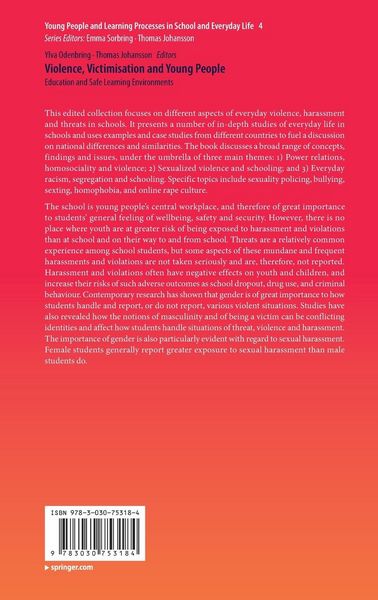
This edited collection focuses on different aspects of everyday violence, harassment and threats in schools. It presents a number of in-depth studies of everyday life in schools and uses examples and case studies from different countries to fuel a discussion on national differences and similarities. The book discusses a broad range of concepts, findings and issues, under the umbrella of three main themes: 1) Power relations, homosociality and violence; 2) Sexualized violence and schooling; and 3) Everyday racism, segregation and schooling. Specific topics include sexuality policing, bullying, sexting, homophobia, and online rape culture.
The school is young people’s central workplace, and therefore of great importance to students’ general feeling of wellbeing, safety and security. However, there is no place where youth are at greater risk of being exposed to harassment and violations than at school and on their way to and from school. Threats are a relatively common experience among school students, but some aspects of these mundane and frequent harassments and violations are not taken seriously and are, therefore, not reported. Harassment and violations often have negative effects on youth and children, and increase their risks of such adverse outcomes as school dropout, drug use, and criminal behaviour. Contemporary research has shown that gender is of great importance to how students handle and report, or do not report, various violent situations. Studies have also revealed how the notions of masculinity and of being a victim can be conflicting identities and affect how students handle situations of threat, violence and harassment. The importance of gender is also particularly evident with regard to sexual harassment. Female students generally report greater exposure to sexual harassment than male students do.
Noch keine Bewertungen vorhanden
Verfassen Sie die erste Bewertung zu diesem Artikel
Helfen Sie anderen Kundinnen und Kunden durch Ihre Meinung.
Kurze Frage zu unserer Seite
Vielen Dank für Ihr Feedback
Wir nutzen Ihr Feedback, um unsere Produktseiten zu verbessern. Bitte haben Sie Verständnis, dass wir Ihnen keine Rückmeldung geben können. Falls Sie Kontakt mit uns aufnehmen möchten, können Sie sich aber gerne an unseren Kund*innenservice wenden.
zum Kundenservice