• Produktbild: Contaminants in Agriculture
  • Produktbild: Contaminants in Agriculture

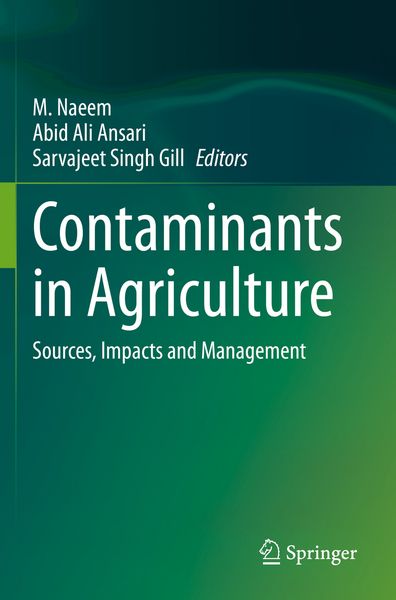
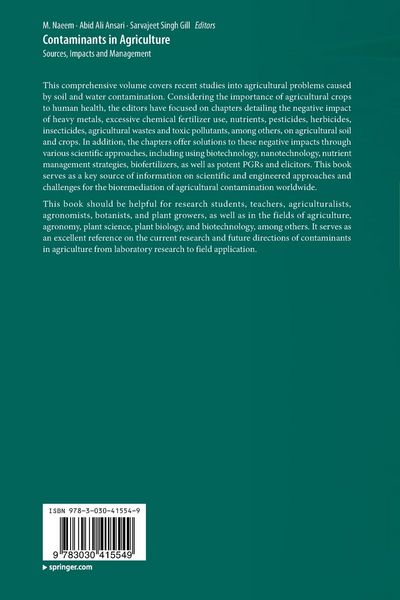
Contaminants in Agriculture Sources, Impacts and Management

148,99 €

inkl. gesetzl. MwSt., Versandkostenfrei


Beschreibung

Produktdetails

Einband

Taschenbuch

Erscheinungsdatum

26.04.2021

Herausgeber

M. Naeem + weitere

Verlag

Springer

Seitenzahl

446

Maße (L/B/H)

23,5/15,5/2,5 cm

Gewicht

692 g

Auflage

1st ed. 2020

Sprache

Englisch

ISBN

978-3-030-41554-9

Beschreibung

Portrait

Dr. M. Naeem is an Assistant Professor in the Department of Botany at Aligarh Muslim University, India. For more than a decade, he has devoted his research to improving the yield and quality of commercially important medicinal and aromatic plants (MAPs). His research focuses on escalating the production of MAPs and their active principles using a novel and safe technique involving depolymerized polysaccharides as well as the application of potent PGRs. His research also focuses on abiotic stress tolerance in medicinal plants. To date, Dr. Naeem has successfully run three major research projects as the Principal Investigator sponsored by national funding agencies like Department of Science & Technology, New Delhi and Council of Science & Technology UP, Lucknow. Dr. Naeem has published more than 80 research papers in reputable national and international journals as well as seven books. He has also participated in various national and international conferences and acquired life memberships to various scientific bodies in India and abroad. Based on his research contributions, Dr. Naeem has been awarded a Research Associateship from the Council of Scientific & Industrial Research, New Delhi; a Yuva Vaigyanic Samman  (2011) from the State Government of Uttar Pradesh; a Fast Track Young Scientist Award from the Department of Science & Technology, India; a Rashtriya Gaurav Award (2016) from the International Friendship Society, New Delhi, a Young Scientist of the Year Award (2015), a Distinguished Young Scientist of the Year  Award (2017) & a Best Scientist of the Year Award (2018) from the Scientific and Environmental Research Institute, Kolkata; and UGC-BSR Research Start-up Grant (2018) by  UGC, New Delhi

Dr. Abid A. Ansari is an Assistant Professor in the Department of Biology, Faculty of Science, University of Tabuk, Saudi Arabia. Dr. Ansari’s research work is concerned with phytoremediation and eutrophication. He has a number of research articles of national and international repute to his credit. He has written 10 edited books and a number of book chapters on varied aspects of his research. He has been awarded Environmentalist of the Year - 2011’ & ‘Scientist of the Year-2014’ by the National Environmental Science Academy, India and ‘Research Excellence 2016 Award’ by University of Tabuk. He has also participated in various national and international conferences and acquired memberships to various scientific bodies (Saudi Biological Society, International Phytotechnology Society, and Society for Ecological Restoration).

Sarvajeet Singh Gill, serving as an Assistant Professor at Centre for Biotechnology, MD University, Rohtak, India, has made significant contributions towards abiotic stress tolerance in crop plants. His research includes abiotic stress tolerance in crop plants, reactive oxygen species signaling and antioxidant machinery, gene expression, helicases, crop improvement, transgenics, nitrogen & sulfur metabolism and plant fungal symbiotic interactions. Together with Dr. Narendra Tuteja at International Centre for Genetic Engineering and Biotechnology (ICGEB), New Delhi, he worked on plant helicases and discovered a novel function of plant MCM6, PDH45 and p68 in salinity stress tolerance that will help improve crop production at sub-optimal conditions. A recipient of the Junior Scientist of the Year Award 2008 from the National Environmental Science Academy, Dr. Gill has edited several books and has a number of research papers, review articles, and book chapters to his name.

Produktdetails

Einband

Taschenbuch

Erscheinungsdatum

26.04.2021

Herausgeber

Verlag

Springer

Seitenzahl

446

Maße (L/B/H)

23,5/15,5/2,5 cm

Gewicht

692 g

Auflage

1st ed. 2020

Sprache

Englisch

ISBN

978-3-030-41554-9

Herstelleradresse

Springer-Verlag KG
Sachsenplatz 4-6
1201 Wien
AT

Email: GPSR Kontakt

Noch keine Bewertungen vorhanden

Verfassen Sie die erste Bewertung zu diesem Artikel

Helfen Sie anderen Kundinnen und Kunden durch Ihre Meinung.

Kundinnen und Kunden meinen

Bewertungen (0)

  • Produktbild: Contaminants in Agriculture
  • Produktbild: Contaminants in Agriculture
  • Preface.- Organic and Inorganic Fertilizer Contaminants in Agriculture.- Role of Nutrients in Plant Growth and Development.- Practice and Impact of Pesticides in Agricultural Crops.- Response of Organic and Inorganic Fertilizers on Soil Microbial Population and Yield of Plants.- An Overview of the Effect of Heavy Metals on Soil and Plant Growth.- Effect of Acid Rain on Crop Plants and its Mitigation Approaches.- Heavy Metals.- Heavy Metal Induced Gene Expression in Plants.- Nano-contaminants.- Heavy Metal Toxicity and Tolerance in Crop Plants.- Planning and Engineering Applications of Agricultural Wastes and their Remediation Strategies.- The Use of Constructed Wetlands to Mitigate Pollution from Agricultural Runoff.- Role of Nitrogen and Agricultural Management in Changing Environment.- Efficient Biotransformation of Agricultural Waste in India.- Impact of Bio-fertilizers/ Mineral Fertilizers on Crop Productionunder Contaminated Soils.- Nutrient Management for Medicinal Plants grown in Calcareous Soils.- Intimidating Effects of Heavy Metals on Mentha Species   and Its Mitigation Using Scientific Approaches.- Impact of Heavy Metals on  Catharanthus roseus  and Its Amelioration through Conceivable Approaches.- Role of Cobalt in Plants.- Phytoremediation of Contaminated Soils of Mining Areas.- Bioremediation of Toxic Pollutants.- Ecological Implications of Atmospheric Nutrient Deposition in Low-Nutrient Ecosystems.- Utilization of Sericulture Waste by Employing Possible Approaches.- Inimical Effects of Arsenic on the Plant Physiology and Possible Biotechnological Solutions to Mitigate Arsenic Induced Toxicity.- The Use of Vermicompost Leachate for Irrigation in Two South American Plant Species.- Index.