KI-Beratung Beta

Produktbild: Cash Crops

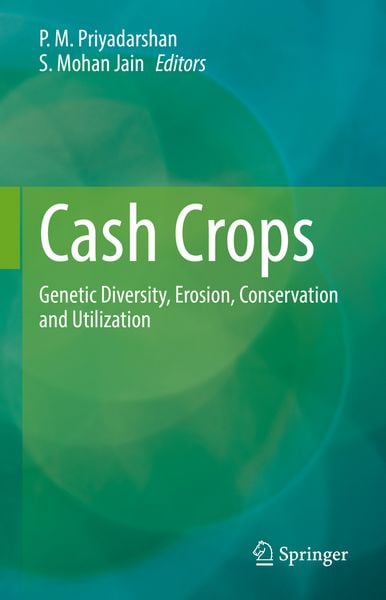
Cash Crops Genetic Diversity, Erosion, Conservation and Utilization

179,99 €

inkl. gesetzl. MwSt., Versandkostenfrei


Beschreibung

Cash crops are grown and sold for monetary gain and not necessarily for sustenance. They include coffee, tea, coconut, cotton, jute, groundnut, castor, linseed, cocoa, rubber, cassava, soybean, sweet potato, potato, wheat, corn and teff.  While some of these crops have been improved for realizing yield...

Beschreibung

Cash crops are grown and sold for monetary gain and not necessarily for sustenance. They include coffee, tea, coconut, cotton, jute, groundnut, castor, linseed, cocoa, rubber, cassava, soybean, sweet potato, potato, wheat, corn and teff.  While some of these crops have been improved for realizing yield potential, breeding of many of them is still in infancy. Crops that underwent    rigorous breeding have eventually lost much of the diversity due to extensive cultivation with a few improved varieties and the diversity in less bred species is to be conserved. Over the past years, scholars and policy makers have become increasingly aware of the short and long-run impact of climatic factors on economic, food security, social and political outcomes . Genetic diversity, natural and induced, is much needed for the future generations to sustain food production with more climate resilient crops.  In contrast, crop uniformity produced across the farm fields in the form ofimproved varieties is genetically vulnerable to biotic and abiotic stresses. Thus, it is essential and challenging to address the issue of compromising between maximizing crop yield under a given set of conditions and minimizing the risk of crop failure when conditions change. Cash crops are grown in an array of climatic conditions. Many of the world’s poor still live in rural areas.  Many are subsistence farmers, operating very small farms using very little agricultural inputs for achieving marketable outputs.  Conserving the diversity of these crops and addressing all issues of crop culture through modern tools of biotechnology and genomics is a real challenge. We believe the focus of this book is to fill an unmet need of this and other grower communities by providing the necessary knowledge, albeit indirectly via the academics, to manage the risks of cash crops breeding through managing genetic diversity.


Portrait


P. M. Priyadarshan


He is a prominent 
Hevea 
rubber breeder. He began his research career by breeding triticale and wheat while doing M.Phil and PhD degrees at the Chaudhary Charan Singh University, Meerut under the guidance of Prof. P.K. Gupta..  During the 1980s he focused on the 
in vitro
 culture of spices. He joined the Rubber Research Institute of India (Rubber Board, Ministry of Commerce, Govt. of India) as a Plant Breeder in 1990 and specialized in breeding 
Hevea
 rubber for sub-optimal environments. He was a visiting scientist at the Hardwood Tree Improvement and Regeneration Centre, Purdue University, U.S.A. In 2009, he became the Institute’s Deputy Director, and managed its Central Experiment Station until 2016.  He has been involved in breeding cereals, spices and 
Hevea
 rubber for 32 years. He is a reviewer of several international journals like Industrial Crops & Products, Tree Genetics and Genomes etc. He has published several research papers and chapters in journals and books of international repute like Advances in Agronomy, Advances in Genetics, and Plant Breeding Reviews. He has edited books on Breeding Plantation Tree Crops (Springer), Breeding Major Food Staples (Blackwell-Wiley), and the Genomics of Tree Crops (Springer). He also authored books on the Biology of 
Hevea
 Rubber (Springer) and on Plant Breeding: Classical to Modern (Springer).  

Shri Mohan Jain 

 He received M. Phil, 1973 and Ph.D., 1978, Jawaharlal Nehru University, New Delhi, India;. postdoctoral fellow in Israel, USA, and visiting scientist/Professor in Japan, Malaysia, Germany, and Italy. He worked in both academia and industry, and served as a Technical Officer, Plant Breeding and Genetics, International Atomic Energy Agency (IAEA), Vienna, Austria, 1999-2005. Dr. Jain is on the editorial Board of Euphytica, In Vitro, Propagation of Ornamental Plants; reviewer in Plant cell and organ culture, Plant cell reports, and few others. His publications are more than 165 in peer reviewed journals, book chapters, and conference proceedings, and edited 65 books; invited speaker and acted as a Chairperson in several international conferences worldwide.
 
He was awarded Nobel Peace Prize, 2005 in commemoration the awarding to IAEA of the Nobel Peace Prize for 2005, also former consultant to IAEA, the European Union, The Government of Grenada, Iranian date palm Company and the Egyptian Government.  

Produktdetails

Einband

Gebundene Ausgabe

Erscheinungsdatum

19.10.2021

Abbildungen

X, 626 p. 110 illus., 101 illus. in color.

Herausgeber P.M. Priyadarshan + weitere

Produktdetails

Einband

Gebundene Ausgabe

Erscheinungsdatum

19.10.2021

Abbildungen

X, 626 p. 110 illus., 101 illus. in color.

Herausgeber
Verlag Springer
Seitenzahl

626

Maße (L/B/H)

24,1/16/4 cm

Gewicht

1058 g

Auflage

21001 Auflage 1st edition 2022

Sprache

Englisch

ISBN

978-3-030-74925-5

Herstelleradresse

Springer-Verlag GmbH
Europaplatz 3
69115 Heidelberg
DE

Email: ProductSafety@springernature.com

Noch keine Bewertungen vorhanden

Verfassen Sie die erste Bewertung zu diesem Artikel

Helfen Sie anderen Kundinnen und Kunden durch Ihre Meinung.

Kundinnen und Kunden meinen

Bewertungen (0)

  • Produktbild: Cash Crops

  • Chapter 1: Cash crops: An introduction.- 
    Part I: Beverages.- 
    Chapter 2: Cocoa.- Chapter 3: Coffee.- 
    Part II: Industrial crops.- 
    Chapter 4: Sugarcane.- Chapter 5: Rubber.- Chapter 6: Jute.- 
    Part III: Oil seeds.- 
    Chapter 7: Coconut.- Chapter 8: Oil Palm.- Chapter 9: Mustard.- 
    Part IV: Pulses.- 
    Chapter 10: Groundnut.- Chapter 11: Lentil.- 
    Part V: Fruits and nuts.- 
    Chapter 12: Date palm.- Chapter 13: Tomato.- Chapter 14: Cashewnut.- 
    Part VI: Spices.- 
    Chapter 15: Cardamom.