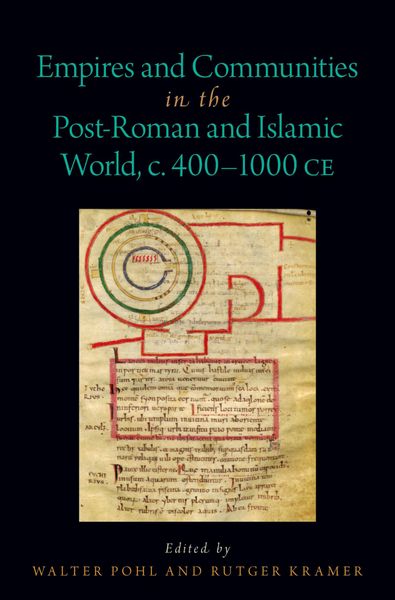
Empires and Communities in the Post-Roman and Islamic World, C. 400-1000 CE
-
Form:Einzelkauf Download
-
Sprache:Englisch
-
eBook Format:ePUB
- PDF 0,00 €
- ePUB 59,10 € ausgewählt
59,10 €
inkl. gesetzl. MwSt.Beschreibung
Produktdetails
Format
ePUB
Kopierschutz
Ja
Family Sharing
Nein
Text-to-Speech
Ja
Erscheinungsdatum
03.05.2021
Herausgeber
Rutger Kramer + weitereVerlag
OUP eBookSeitenzahl
288 (Printausgabe)
Dateigröße
2779 KB
Sprache
Englisch
EAN
9780190067960
This is an open access title available under the terms of a CC BY-NC 4.0 International licence. It is free to read at Oxford Scholarship Online and offered as a free PDF download from OUP and selected open access locations.
This book deals with the ways empires affect smaller communities like ethnic groups, religious communities and local or peripheral populations. It raises the question how these different types of community were integrated into larger imperial edifices, and in which contexts the dialectic between empires and particular communities caused disruption. How did religious discourses or practices reinforce (or subvert) imperial pretenses? How were constructions of identity affected in the process? How were Egyptians accommodated under Islamic rule, Yemenis included in an Arab identity, Aquitanians integrated in the Carolingian empire, Jews in the Fatimid Caliphate? Why did the dissolution of Western Rome and the Abbasid Caliphate lead to different types of polities in their wake? How was the Byzantine Empire preserved in the 7th century; how did the Franks construct theirs in the 9th? How did single events in early medieval Rome and Constantinople promote social integration in both a local and a broader framework?
Focusing on the post-Roman Mediterranean, this book deals with these questions from a comparative perspective. It takes into account political structures in the Latin West, in Byzantium and in the early Islamic world, and does so in a period that is exceptionally well suited to study the various expansive and erosive dynamics of empires, as well as their interaction with smaller communities. By never adhering to a single overall model, and avoiding Western notions of empire, this volume combines individual approaches with collaborative perspectives. Taken together, these chapters constitute a major contribution to the advancement of comparative studies on pre-modern empires.
This book deals with the ways empires affect smaller communities like ethnic groups, religious communities and local or peripheral populations. It raises the question how these different types of community were integrated into larger imperial edifices, and in which contexts the dialectic between empires and particular communities caused disruption. How did religious discourses or practices reinforce (or subvert) imperial pretenses? How were constructions of identity affected in the process? How were Egyptians accommodated under Islamic rule, Yemenis included in an Arab identity, Aquitanians integrated in the Carolingian empire, Jews in the Fatimid Caliphate? Why did the dissolution of Western Rome and the Abbasid Caliphate lead to different types of polities in their wake? How was the Byzantine Empire preserved in the 7th century; how did the Franks construct theirs in the 9th? How did single events in early medieval Rome and Constantinople promote social integration in both a local and a broader framework?
Focusing on the post-Roman Mediterranean, this book deals with these questions from a comparative perspective. It takes into account political structures in the Latin West, in Byzantium and in the early Islamic world, and does so in a period that is exceptionally well suited to study the various expansive and erosive dynamics of empires, as well as their interaction with smaller communities. By never adhering to a single overall model, and avoiding Western notions of empire, this volume combines individual approaches with collaborative perspectives. Taken together, these chapters constitute a major contribution to the advancement of comparative studies on pre-modern empires.
Noch keine Bewertungen vorhanden
Verfassen Sie die erste Bewertung zu diesem Artikel
Helfen Sie anderen Kundinnen und Kunden durch Ihre Meinung.
Kurze Frage zu unserer Seite
Vielen Dank für Ihr Feedback
Wir nutzen Ihr Feedback, um unsere Produktseiten zu verbessern. Bitte haben Sie Verständnis, dass wir Ihnen keine Rückmeldung geben können. Falls Sie Kontakt mit uns aufnehmen möchten, können Sie sich aber gerne an unseren Kund*innenservice wenden.
zum Kundenservice