Gutscheinbedingungen

**Gültig bis 15.06.2026 auf Spiele & Spielzeug online auf thalia.at, in der Thalia App ab einem Mindestbestellwert von 30€ und in allen Thalia Buchhandlungen in Österreich. In den Buchhandlungen nur gültig auf lagernde Ware. Einzelne Artikel können ausgeschlossen sein. Ausgenommen sind preisgebundene Artikel sowie online auf thalia.at und in der Thalia App einzelne Artikel von tonies®. Pro Einkauf einmal einlösbar. Nur gültig gegen Vorlage oder im Onlineshop hinterlegter Bonuscard. Infos zur Einlösung in der Buchhandlung sind auf der Bonuscard-Vorteilspreisseite zu finden. Click & Collect nur bei Onlinevorabzahlung möglich. Keine Einlösung bei Scan & Go-Bezahlung. Keine Barauszahlung. Nicht kombinierbar mit anderen Aktionen und Gutscheinen. Gutschein wird auf max. 500€ Bestellwert angerechnet. Nicht gültig für Geschenkkarten, Versandkosten und Services.

Produktbild: Rechargeable Ion Batteries
- 12%

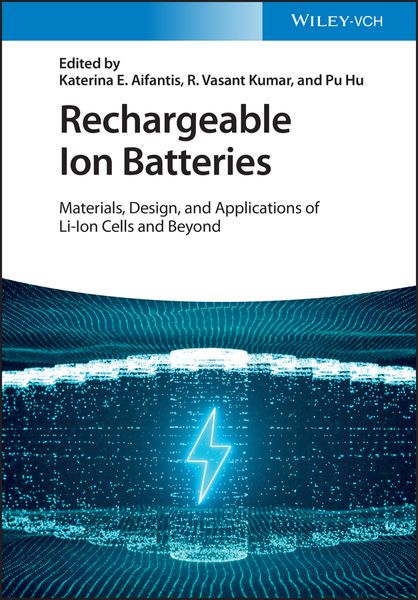
Rechargeable Ion Batteries Materials, Design and Applications of Li-Ion Cells and Beyond

12% sparen

144,99 € UVP 166,60 €

inkl. gesetzl. MwSt., Versandkostenfrei


Beschreibung

Produktdetails

Einband

Gebundene Ausgabe

Erscheinungsdatum

14.12.2022

Abbildungen

farbige Illustrationen

Herausgeber

Katerina E. Aifantis + weitere

Verlag

Wiley-VCH

Seitenzahl

400

Maße (L/B/H)

24,6/17,3/2,6 cm

Gewicht

916 g

Auflage

1. Auflage

Sprache

Englisch

ISBN

978-3-527-35018-6

Beschreibung

Portrait

Katerina Aifantis an associate professor at the University of Florida, Gainesville, USA. She focuses on understanding the mechanical behavior of materials, particularly at the micron and nano scales, with applications in energy storage and biology. In 2019 her work on silicon anodes resulted in her receiving the Foteinou Award, the highest honor in electrochemistry bestowed by the Academy of Athens. She has published more than 85 articles, and co-edited the book High Energy Density Li Batteries, Materials, Engineering and Applications, Wiley-VCH 2010, which was also translated in Chinese in 2013.


R. Vasant Kumar is the Head of Materials Chemistry Group and a Fellow of Trinity Hall in University of Cambridge, UK, and a Fellow of the Institute of Materials, Mining and Metallurgy; and the Energy Institute. He has published more than 350 papers, 20 patents, 11 chapters in handbooks and edited one book. His research has helped advance new knowledge in materials chemistry with innovations in sensors, batteries, fuel cells, electrolytic cells and photocatalytic reactors.


Pu Hu is currently a professor at Wuhan institute of technology, Hubei, China. He has more than ten years of research experience in cathode/anode materials of Li-ion and Na-ion batteries, including three years of industrial experience of R&D engineering in Beijing Central Press Union Tech. Co. Ltd. He has published more than twenty peer-reviewed articles and holds one patent.

Produktdetails

Einband

Gebundene Ausgabe

Erscheinungsdatum

14.12.2022

Abbildungen

farbige Illustrationen

Herausgeber

Verlag

Wiley-VCH

Seitenzahl

400

Maße (L/B/H)

24,6/17,3/2,6 cm

Gewicht

916 g

Auflage

1. Auflage

Sprache

Englisch

ISBN

978-3-527-35018-6

Herstelleradresse

Wiley-VCH GmbH
Boschstraße 12
69469 Weinheim
DE

Email: wiley-vch@kolibri360.de

Kundinnen und Kunden meinen

0 Bewertungen

Informationen zu Bewertungen

Zur Abgabe einer Bewertung ist eine Anmeldung im Konto notwendig. Die Authentizität der Bewertungen wird von uns nicht überprüft. Wir behalten uns vor, Bewertungstexte, die unseren Richtlinien widersprechen, entsprechend zu kürzen oder zu löschen.

Die Bewertungen sind nach Format, Anzahl Sterne und Datum sortiert.

Verfassen Sie die erste Bewertung zu diesem Artikel

Helfen Sie anderen Kund*innen durch Ihre Meinung

Kundinnen und Kunden meinen

0 Bewertungen filtern

Die Leseprobe wird geladen.
  • Produktbild: Rechargeable Ion Batteries
  • 1 INTRODUCTION TO ELECTROCHEMICAL CELLS
    1.1 What are Batteries?
    1.2 Quantities Characterizing Batteries
    1.3 Primary and Secondary Batteries
    1.4 Battery Market
    1.5 Recycling and Safety Issues

    2 MATERIALS FOR AND CHEMISTRY OF PRIMARY BATTERIES
    2.1 Introduction
    2.2 The Early Batteries
    2.3 The Zinc/Carbon Cell
    2.4 Alkaline Batteries
    2.4.1 Electrochemical Reactions
    2.5 Button Batteries
    2.6 Li Primary Batteries
    2.7 Oxyride Batteries
    2.8 Damage in Primary Batteries
    2.9 Conclusions

    3 MATERIALS FOR AND CHEMISTRY OF SECONDARY BATTERIES
    3.1 The Lead-Acid Battery
    3.2 The Nickel-Cadmium Battery
    3.3 Nickel-Metal Hydride (Ni-MH) Batteries
    3.4 Secondary Alkaline Batteries
    3.5 Secondary Lithium Batteries
    3.6 Lithium-Sulfur Batteries
    3.7 Conclusions

    4 APPLICATIONS OF SECONDARY LI BATTERIES
    4.1 Portable Electronic Devices
    4.2 Hybrid and Electric Vehicles
    4.3 Medical Applications
    4.4 Application of Secondary Li Ion Battery Systems in Vehicle Technology

    5 NEXT GENERATION CATHODES FOR SECONDARY LI-ION BATTTERIES
    5.1 Energy Density and Thermodynamics
    5.2 Materials Chemistry and Engineering of Voltage Plateau
    5.3 Multitransition Metal Oxide Engineering for Capacity and Stability
    5.4 Conclusion

    6 NEXT-GENERATION ANODES FOR SECONDARY LI-ION BATTERIES
    6.1 Introduction
    6.2 Chemical Attack by the Electrolyte
    6.3 Mechanical Instabilities during Electrochemical Cycling
    6.4 Nanostructured Anodes
    6.5 Thin Film Anodes
    6.6 Nanofiber/Nanotube/Nanowire Anodes
    6.7 Active/Less Active Nanostructured Anodes
    6.8 Other Anode Materials
    6.9 Conclusions

    7 NEXT-GENERATION ELECTROLYTES FOR LI BATTERIES
    7.1 Introduction
    7.2 Background
    7.3 Preparation and Characterization of Polymer Electrolytes
    7.3.1 Preparation of Polymer Electrolytes
    7.3.2 Characterization of Molten-Salt-Containing Polymer Gel Electrolytes
    7.3.3 Characterization of Organic-Modified MMT-Containing Polymer Composite Electrolytes
    7.3.4 Ion-Exchanged Li-MMT-Containing Polymer Composite Electrolytes
    7.3.5 Mesoporous Silicate (MCM-41)-Containing Polymer Composite Electrolytes
    7.4 Conclusions

    8 DESIGNING MECHANICALLY STABLE ION-BATTERY SYSTEMS
    8.1 Introduction
    8.2 Mechanics Considerations During Battery Life
    8.3 Modeling Elasticity and Fracture During Electrochemical Cycling
    8.4 Multiscale Phenomena and Considerations in Modeling
    8.5 Particle Models of Coupled Diffusion and Stress Generation
    8.6 Diffusional Processes During Cycling
    8.7 Conclusions

    9 DEVELOPMENTS IN LI-S BATTERIES
    9.1 Introduction to Li-S Batteries
    9.2 Electrochemical Principles
    9.3 Sulfur Utilisation and Cycle Life
    9.4 Potential Solutions to Outstanding Problems
    9.5 Carbon Materials
    9.6 Metal Oxide-Sulfur Composites
    9.7 Polymers
    9.8 Some New Developments
    9.9 Conclusions

    10 NA-ION BATTERIES
    10.1 Introduction
    10.2 Cathode Materials for Na-ion Batteries
    10.3 Anode Materials for Na-ion Batteries
    10.4 Electrolyte for Na-ion Batteries
    10.5 Conclusions

    11 NOVEL ION-BATTERY TECHNOLOGIES
    11.1 Introduction
    11.2 Mn-ion Batteries
    11.3 K-ion Batteries
    11.4 Other-ion Batteries
    11.5 Conclusions