Gutscheinbedingungen

**Gültig am 28.06.2026 auf Spielzeug, Schreibwaren, Filme, Geschenke & Trends, Musik, tolino eReader & Zubehör, Hörbücher und Hörbuch-Downloads (außer Abo), nicht preisgebundene Bücher und Kalender online auf thalia.at und in der Thalia App. Einzelne Artikel können ausgeschlossen sein. Aufgrund der Buchpreisbindung sind deutschsprachige Bücher und eBooks ausgenommen. Zusätzlich ausgenommen sind preisgebundene Artikel, Abos & Flatrates, eBooks, Games, Geschenkkarten/-boxen, Shelfies, Software, Zeitschriften sowie einzelne Artikel von tonies®. Pro Einkauf einmal einlösbar. Click & Collect nur bei Onlinevorabzahlung möglich. Keine Barauszahlung. Nicht kombinierbar mit anderen Aktionen und Gutscheinen. Gutschein wird auf max. 500€ Bestellwert angerechnet. Nicht gültig für Versandkosten und Services.

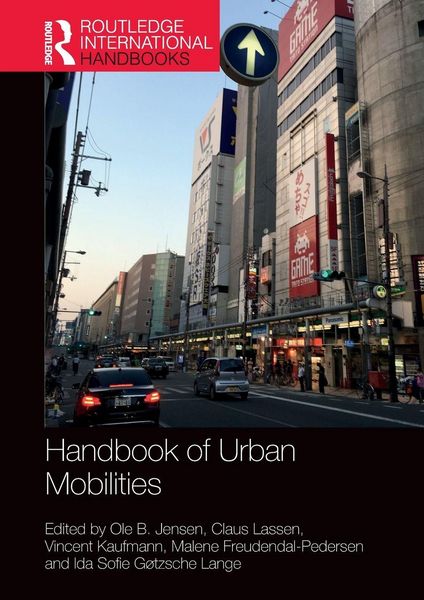
  • Produktbild: Handbook of Urban Mobilities
  • Produktbild: Handbook of Urban Mobilities

Handbook of Urban Mobilities

64,99 €

inkl. gesetzl. MwSt., Versandkostenfrei


Beschreibung

Produktdetails

Einband

Taschenbuch

Erscheinungsdatum

10.06.2020

Abbildungen

schwarz-weiss Illustrationen, Raster, schwarz-weiss, Zeichnungen, schwarz-weiss, Tabellen, schwarz-weiss

Herausgeber

Ole B. Jensen + weitere

Verlag

Taylor & Francis

Seitenzahl

448

Maße (L/B/H)

24,6/17,4/2,5 cm

Gewicht

880 g

Sprache

Englisch

ISBN

978-0-367-49156-7

Beschreibung

Rezension

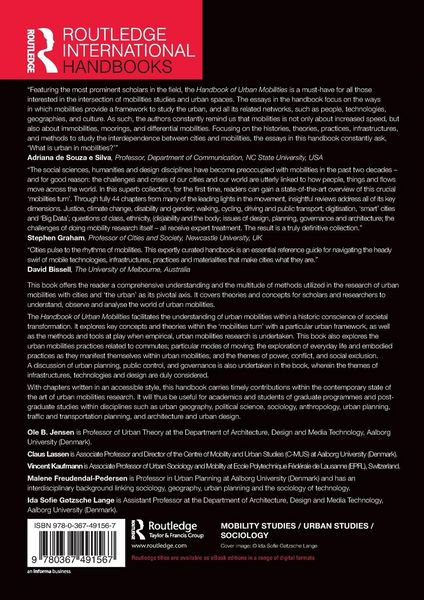
"Featuring the most prominent scholars in the field, the Handbook of Urban Mobilities is a must have for all those interested in the intersection of mobilities studies and urban spaces. The essays in the handbook focus on the ways in which mobilities provides a framework to study the urban, and all its related networks, such as people, technologies, geographies, and culture. As such, the authors constantly remind us that mobilities is not only about increased speed, but also about immobilities, moorings, and differential mobilities. Focusing on the the histories, theories, practices, infrastructures and methods to study the interdependence between cities and mobilities, the essays in this handbook constantly ask, "What is urban in mobilities?"

- Adriana de Souza e Silva, Professor, Department of Communication, NC State University, USA


"The social sciences, humanities and design disciplines have become preoccupied with mobilities in the past two decades - and for good reason: the challenges and crises of our cities and our world are utterly linked to how people, things and flows move across the world.

In this superb collection, for the first time, readers can gain a state-of-the-art overview of this crucial 'mobilities turn'. Through fully 44 chapters from many of the leading lights in the movement, insightful reviews address all of its key dimensions. Justice, climate change, disability and gender; walking, cycling, driving and public transport; digitisation, 'smart' cities and 'Big Data'; questions of class, ethnicity, (dis)ability and the bodym, issues of design, planning, governance and architecture; the challenges of doing mobility research itself -- all receive expert treatment. The result is a truly definitive collection"

- Stephen Graham, Professor of Cities and Society, Newcastle University


"Cities pulse to the rhythms of mobilities. This expertly curated handbook is an essential reference guide for navigating the heady swirl of mobile technologies, infrastructures, practices and materialities that make cities what they are."

- David Bissell, The University of Melbourne


Produktdetails

Einband

Taschenbuch

Erscheinungsdatum

10.06.2020

Abbildungen

schwarz-weiss Illustrationen, Raster, schwarz-weiss, Zeichnungen, schwarz-weiss, Tabellen, schwarz-weiss

Herausgeber

Verlag

Taylor & Francis

Seitenzahl

448

Maße (L/B/H)

24,6/17,4/2,5 cm

Gewicht

880 g

Sprache

Englisch

ISBN

978-0-367-49156-7

Herstelleradresse

Libri GmbH
Europaallee 1
36244 Bad Hersfeld
DE

Email: gpsr@libri.de

Kundinnen und Kunden meinen

0 Bewertungen

Informationen zu Bewertungen

Zur Abgabe einer Bewertung ist eine Anmeldung im Konto notwendig. Die Authentizität der Bewertungen wird von uns nicht überprüft. Wir behalten uns vor, Bewertungstexte, die unseren Richtlinien widersprechen, entsprechend zu kürzen oder zu löschen.

Die Bewertungen sind nach Format, Anzahl Sterne und Datum sortiert.

Verfassen Sie die erste Bewertung zu diesem Artikel

Helfen Sie anderen Kund*innen durch Ihre Meinung

Kundinnen und Kunden meinen

0 Bewertungen filtern

Die Leseprobe wird geladen.
  • Produktbild: Handbook of Urban Mobilities
  • Produktbild: Handbook of Urban Mobilities
  • List of contributors. Introduction. Section I: Histories, concepts and theories. 1 Mobility justice in urban studies. 2 Modern urbanization. 3 Networks, flows and the city of automobilities. 4 Mobility capital and motility. 5 Co-design times and mobilities. Section II: Methods, tools and approaches. 6 Mobile ethnographies of the city. 7 Mobile futures through present behaviours and discourses. 8 Digital approaches and mobilities in the Big Data era. 9 A methodological hybridization to analyze orientation experience in the urban environment. 10 Methodologies for understanding and improving pedestrian mobility. Section III: Commutes, modes and rhythms. 11 The walking commute: gendered and generationed. 12 The future of the car commute. 13 Ups and downs with urban cycling. 14 The train commute. 15 Waiting (for Departure). 16 Moving and pausing. 17 Providing and working in rhythms. Section IV: Everyday life, bodies and practices. 18 Life course and mobility. 19 Urban pram strolling. 20 The video-ethnography of embodied urban mobilities. 21 Routine and revelation: Dis-embodied urban mobilities. 22 Habit as a better way to understand urban mobilities. 23 Residential mobility. 24 Urban mobility and migrations. Section V: Power, conflict and social exclusion. 25 Mobility and social stratification. 26 The conflicted pedestrian: walking and mobility conflict in the city. 27 Transitions: methodology and the marginalisation of experience in transport practice. 28 Social implications of spatial mobilities. Section VI: Urban planning, design and governance. 29 Planning for urban mobilities and everyday life. 30 Mobilities design: cities, movements, and materialities. 31 The movement of public space. 32 Urban tourism. 33 The airport city. 34 Surveillance and urban mobility. Section VII: Infrastructures, technologies and sustainable development. 35 3D printing and the changing logistics of cities. 36 Mobility as a service: moving in the de-synchronized city. 37 Understanding multimodality through rhythm of life: empirical evidence from the Swiss case study. 38 Rethinking the large-scale mobility infrastructure projects in sustainable smart city perspective. 39 Smart cities. 40 Sustainable mobility. 41 Terminal Towns. Index.