• Produktbild: The Critique of Archaeological Economy
  • Produktbild: The Critique of Archaeological Economy

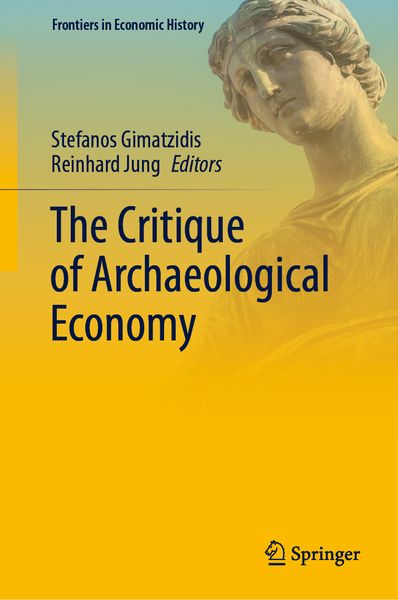
The Critique of Archaeological Economy

169,99 €

inkl. gesetzl. MwSt., Versandkostenfrei


Beschreibung

Produktdetails

Einband

Gebundene Ausgabe

Erscheinungsdatum

15.06.2021

Abbildungen

VI, 234 p. 16 illus., 12 illus. in color.

Herausgeber

Stefanos Gimatzidis + weitere

Verlag

Springer

Seitenzahl

234

Maße (L/B/H)

24,1/16/1,9 cm

Gewicht

530 g

Auflage

21001 Auflage 1st edition 2021

Sprache

Englisch

ISBN

978-3-030-72538-9

Beschreibung

Portrait


Stefanos Gimatzidis
received his B.A. and M.A. degrees in Classical Archaeology from the Aristotle University Thessaloniki, Greece, and his Ph.D. from the Institute for Prehistoric Archaeology of the Freie Universität Berlin, Germany, in 2007. He specializes in the Early Iron Age archaeology of the Mediterranean, Archaic and Classical periods with a focus on the Aegean, Balkans and the Levant. From 2005 to 2011, he was employed at the Ministry of Culture of Greece. Starting in 2011, he has led various international research projects as senior researcher at the Austrian Academy of Sciences in Vienna and worked extensively in Greece, the central Balkans, Italy, Turkey and Lebanon. In 2015, he began lecturing at the University of Vienna’s Institute for Classical Archaeology, and since December 2017, he has been employed as project director at the Austrian Archaeological Institute. 


Reinhard Jung
is an archaeologist and a specialist for the Bronze and Early Iron Age in southern Europe and the Near East. He received his Ph.D. degree from the Institute for Prehistoric Archaeology of the Freie Universität Berlin, Germany, in 1999, and his postdoctoral degree (venia legendi) in pre- and protohistory from the University of Tübingen, Germany, in 2013. From 2002 to 2013, he directed research projects at the Austrian Academy of Sciences, the DAI Athens, Greece, and the University of Salzburg, Austria. From 2013 to 2015, he co-directed excavations at the Bronze Age settlement site of Punta di Zambrone in Calabria, Italy. Since 2013, he has been a senior researcher at the Austrian Academy of Sciences’ Institute for Oriental and European Archaeology, and since 2015 he is head of the research group “Mediterranean Economies.” In addition, he teaches at the University of Tübingen, Germany.


Produktdetails

Einband

Gebundene Ausgabe

Erscheinungsdatum

15.06.2021

Abbildungen

VI, 234 p. 16 illus., 12 illus. in color.

Herausgeber

Verlag

Springer

Seitenzahl

234

Maße (L/B/H)

24,1/16/1,9 cm

Gewicht

530 g

Auflage

21001 Auflage 1st edition 2021

Sprache

Englisch

ISBN

978-3-030-72538-9

Herstelleradresse

Springer-Verlag KG
Sachsenplatz 4-6
1201 Wien
AT

Email: ProductSafety@springernature.com

Noch keine Bewertungen vorhanden

Verfassen Sie die erste Bewertung zu diesem Artikel

Helfen Sie anderen Kundinnen und Kunden durch Ihre Meinung.

Kundinnen und Kunden meinen

Bewertungen (0)

  • Produktbild: The Critique of Archaeological Economy
  • Produktbild: The Critique of Archaeological Economy
  • Chapter 1 - An Introduction to the Critique of Archaeological Economy (Reinhard Jung, Stefanos Gimatzidis).- Chapter 2 - Writing the Deep History of Human Economy (Randall McGuire).- Chapter 3 - Wealth, Women's Labor, and Forms of Value: Thinking From the Study of Ancestral Central America (Rosemary A. Joyce).- Chapter 4 - “The Economy has no surplus”: Harry W. Pearson’s contribution revisited, 60 years later (Svend Hansen).- Chapter 5 - Crafting Values in Chalcolithic Cyprus and Anatolia (Bleda S. Düring).- Chapter 6 - The Bornhöck burial mound and the political economy of an Únětice ruler (Roberto Risch, Harald Meller, Selina Delgado-Raack, and Torsten Schunke).- Chapter 7 - Property and markets: the uses of land in pharaonic Egypt beyond redistributive and neoliberal approaches (Juan Carlos Moreno García).- Chapter 8 - Uneven and Combined: Product Exchange in the Mediterranean 3rd to 2nd Millennium BCE) (Reinhard Jung).- Chapter 9 - Tripod Dedication: Gift and Commodity Exchange inAncient Greece (Stefanos Gimatzidis).- Chapter 10 - Happily connected? The interconnectivity paradigm and the debate about the ancient economy (Jan Paul Crielaard).- Chapter 11 - Aegean Transport Amphoras (6th to 1st centuries BCE): Exploring Social Tension in a Path Dependency Model (Mark L. Lawall).- Chapter 12 - Modelling trade in Athenian pottery in the archaic and classical period (Robin Osborne).