Gutscheinbedingungen

**Gültig bis 06.07.2026 auf fremdsprachige Bücher online auf thalia.at, in der Thalia App ab einem Mindestbestellwert von 30€ und in allen Thalia Buchhandlungen in Österreich. In den Buchhandlungen nur gültig auf lagernde Ware. Einzelne Artikel können ausgeschlossen sein. Ausgenommen sind preisgebundene Artikel & eBooks. Pro Einkauf einmal einlösbar. Nur gültig gegen Vorlage oder im Onlineshop hinterlegter Bonuscard. Infos zur Einlösung in der Buchhandlung sind auf der Bonuscard-Vorteilspreisseite zu finden. Click & Collect nur bei Onlinevorabzahlung möglich. Keine Einlösung bei Scan & Go-Bezahlung. Keine Barauszahlung. Nicht kombinierbar mit anderen Aktionen und Gutscheinen. Gutschein wird auf max. 500€ Bestellwert angerechnet. Nicht gültig für Versandkosten und Services.

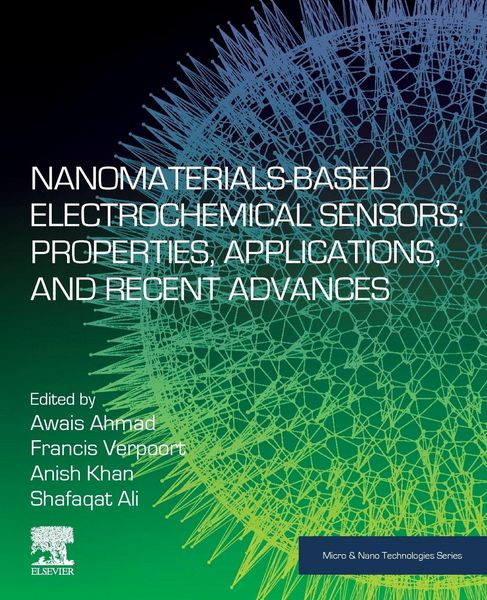
  • Produktbild: Nanomaterials-Based Electrochemical Sensors
  • Produktbild: Nanomaterials-Based Electrochemical Sensors

Nanomaterials-Based Electrochemical Sensors Properties, Applications, and Recent Advances

279,99 €

inkl. gesetzl. MwSt., Versandkostenfrei


Beschreibung

Produktdetails

Einband

Taschenbuch

Erscheinungsdatum

17.11.2023

Herausgeber

Awais Ahmad + weitere

Verlag

Elsevier Science & Technology

Seitenzahl

340

Maße (L/B/H)

23,5/19,1/1,8 cm

Gewicht

450 g

Sprache

Englisch

ISBN

978-0-12-822512-7

Beschreibung

Portrait

Dr. Awais Ahmad is a Researcher at the Department of Organic Chemistry, University of Cordoba in Spain. He completed his graduation from Government College University Faisalabad, Pakistan, and obtained his master's degree from the University of Lahore, Pakistan. Dr. Ahmad's research focuses on various areas including nanomaterials, composite materials, coated materials, heterogeneous catalysis, MOF, self-sacrifice MOF, single atom catalysis, photocatalysis, and electrochemical sensor formulations. He has applied these materials to address challenges in wastewater treatment, heavy metal removal, organic pollutant degradation, CO2 conversion, supercapacitors, dye-sensing solar cells, gel electrolytes, hazardous metal sensing in wastewater, conversion of hazardous gases, nitrogen fixation, catalysis for organic transformation, Li-S batteries, GCE nafion fiber, and water splitting.

For about two decades, Prof. Francis Verpoort has carried out broad and fruitful teaching and research activity at Ghent University in various areas of materials chemistry, including organometallics, catalysis, molecular spectroscopy, related with notable applications in the production of fine chemicals and advanced polymeric materials. He has developed an extensive international scientific cooperation with scientists worldwide, taking part as an active member in different international scientific organizations, as well as in numerous successful bilateral collaboration projects with foreign academic institutions and universities across Europe, China, Russia, India, and in the UAE. In 2011, he was also appointed as Chair Professor at Wuhan University of Technology, China, where he established a research group covering organometallics and materials chemistry. Prof. Verpoort’s main research interests concern the structure and mechanisms of organometallic material chemistry, homogeneous and heterogeneous catalysis, MOFs and MOPs, Porous Organic Polymers (POPs), water splitting, olefin metathesis and its applications in fine chemicals and polymers, CO2 conversion, polymers. A particular specialism is the application of MOFs, POPs for the environment, water purification, and downstream upgrading applications.

Dr. Anish Khan is currently working as Assistant Professor in Chemistry Department, Centre of Excellence for Advanced Materials Research (CEAMR), Faculty of Science, King Abdulaziz University, Jeddah, Saudi Arabia. Completed Ph.D. from Aligarh Muslim University, India in 2010. Completed Postdoctoral from School of Chemical Sciences, University Sains Malaysia (USM) in Electroanalytical chemistry in 2010. Working in the field of synthetic biosensor, polymer composites, organic–inorganic electrically conducting nanocomposites. More than 200 research articles, 70 book chapters 30 books published in referred international publisher and more than 20 international conferences/ workshop. More than 30 research projects completed. Editorial board member of more than 11 international journals. Member of American Nano Society.

Dr Shafaqat Ali is an Associate Professor at GC University in Pakistan. He received his PhD in Crop Science from Zhejiang University, China, in 2010. He was previously the Agricultural Officer for the Government of Pakistan and has been a visiting scientist to the Institute of Soil Science in the Chinese Academy of Sciences since May 2017. He has almost 250 publications and over 6,000 citations.

Produktdetails

Einband

Taschenbuch

Erscheinungsdatum

17.11.2023

Herausgeber

Verlag

Elsevier Science & Technology

Seitenzahl

340

Maße (L/B/H)

23,5/19,1/1,8 cm

Gewicht

450 g

Sprache

Englisch

ISBN

978-0-12-822512-7

Herstelleradresse

Libri GmbH
Europaallee 1
36244 Bad Hersfeld
DE

Email: gpsr@libri.de

Noch keine Bewertungen vorhanden

Verfassen Sie die erste Bewertung zu diesem Artikel

Helfen Sie anderen Kundinnen und Kunden durch Ihre Meinung.

Kundinnen und Kunden meinen

Bewertungen (0)

Die Leseprobe wird geladen.
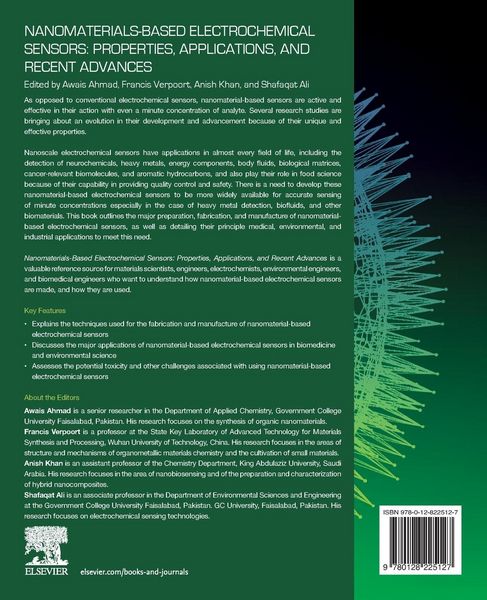
  • Produktbild: Nanomaterials-Based Electrochemical Sensors
  • Produktbild: Nanomaterials-Based Electrochemical Sensors
  • 1. Introduction: Nanomaterials and electrochemical sensors
    2. Process manufacturing techniques for nanomaterials
    3. Biological methods for preparing nanomaterials
    4. Chemical methods for preparing nanomaterials
    5. Toxicity of nanomaterials
    6. Types of electrochemical Sensors
    7. Electrochemical sensors using nanotechnology
    8. Nanotechnology-based sensing methods
    9. Metal oxides and their sensing application
    10. Silicate and its sensing applications
    11. RFID sensors based on nanomaterials
    12. Electrochemical sensors a pure process for environment and energy applications
    13. Biological and biomedical applications of electrochemical sensors
    14. Electrochemical sensors for organic compounds
    15. Electrochemical sensor for heavy metal detection
    16. Electrochemical sensor for detection of nitric oxides
    17. Nanomaterials-based electrochemical sensing of histamine
    18. Nanostructured complexes of gold(I) in sensing
    19. Analyte sensing with self-healing materials