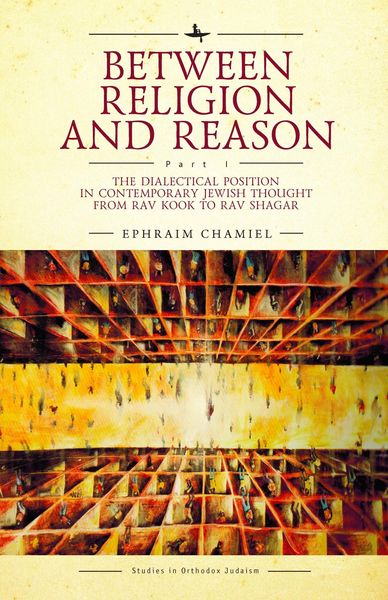
Between Religion and Reason (Part I) The Dialectical Position in Contemporary Jewish Thought from Rav Kook to Rav Shagar
-
Form:Einzelkauf Download
-
Sprache:Englisch
-
eBook Format:PDF
- PDF 130,95 € ausgewählt
- ePUB 112,10 €
130,95 €
inkl. gesetzl. MwSt.Beschreibung
Produktdetails
Format
Kopierschutz
Nein
Family Sharing
Ja
Text-to-Speech
Nein
Erscheinungsdatum
18.05.2020
Verlag
Academic Studies PressSeitenzahl
232 (Printausgabe)
Dateigröße
702 KB
Auflage
1. Auflage
Sprache
Englisch
EAN
9781644690734
The present book is a sequel to Ephraim Chamiel's two previous works The Middle Way and The Dual Truth-studies dedicated to the 'middle' trend in modern Jewish thought, that is, those positions that sought to combine tradition and modernity, and offered a variety of approaches for contending with the tension between science and revelation and between reason and religion. The present book explores contemporary Jewish thinkers who have adopted one of these integrated approaches-namely the dialectical approach. Some of these thinkers maintain that the aforementioned tension-the rift within human consciousness between intellect and emotion, mind and heart-can be mended. Others, however, think that the dialectic between the two poles of this tension is inherently irresolvable, a view reminiscent of the medieval 'dual truth' approach. Som
The present book is a sequel to Ephraim Chamiel's two previous works The Middle Way and The Dual Truth-studies dedicated to the 'middle' trend in modern Jewish thought, that is, those positions that sought to combine tradition and modernity, and offered a variety of approaches for contending with the tension between science and revelation and between reason and religion. The present book explores contemporary Jewish thinkers who have adopted one of these integrated approaches-namely the dialectical approach. Some of these thinkers maintain that the aforementioned tension-the rift within human consciousness between intellect and emotion, mind and heart-can be mended. Others, however, think that the dialectic between the two poles of this tension is inherently irresolvable, a view reminiscent of the medieval 'dual truth' approach. Some thinkers are unclear on this point, and those who study them debate whether or not they successfully resolved the tension and offered a means of reconciliation. The author also offers his views on these debates.
This book explores the dialectical approaches of Rav Kook, Rav Soloveitchik, Rabbi Abraham Joshua Heschel, Samuel Hugo Bergman, Leo Strauss, Ernst Simon, Emil Fackenheim, Rabbi Mordechai Breuer, his uncle Isaac Breuer, Tamar Ross, Rabbi Shagar, Moshe Meir, Micah Goodman and Elchanan Shilo. It also discusses the interpretations of these thinkers offered by scholars such as Michael Rosenak, Avinoam Rosenak, Eliezer Schweid, Aviezer Ravitzky, Avi Sagi, Binyamin Ish-Shalom, Ehud Luz, Dov Schwartz, Rabbi Yuval Cherlow, Lawrence Kaplan, and Haim Rechnitzer. The author questions some of these approaches and offers ideas of his own.
This study concludes that many scholars bore witness to the dialectical tension between reason and revelation; only some believed that a solution was possible. That being said, and despite the paradoxical nature of the dual truth approach (which maintains that two contradictory truths exist and we must live with both of them in this world until a utopian future or the advent of the Messiah), increasing numbers of thinkers today are accepting it. In doing so, they are eschewing delusional and apologetic views such as the identicality and compartmental approaches that maintain that tensions and contradictions are unacceptable.
e thinkers are unclear on this point, and those who study them debate whether or not they successfully resolved the tension and offered a means of reconciliation. The author also offers his views on these debates.
This book explores the dialectical approaches of Rav Kook, Rav Soloveitchik, Rabbi Abraham Joshua Heschel, Samuel Hugo Bergman, Leo Strauss, Ernst Simon, Emil Fackenheim, Rabbi Mordechai Breuer, his uncle Isaac Breuer, Tamar Ross, Rabbi Shagar, Moshe Meir, Micah Goodman and Elchanan Shilo. It also discusses the interpretations of these thinkers offered by scholars such as Michael Rosenak, Avinoam Rosenak, Eliezer Schweid, Aviezer Ravitzky, Avi Sagi, Binyamin Ish-Shalom, Ehud Luz, Dov Schwartz, Rabbi Yuval Cherlow, Lawrence Kaplan, and Haim Rechnitzer. The author questions some of these approaches and offers ideas of his own.
This study concludes that many scholars bore witness to the dialectical tension between reason and revelation; only some believed that a solution was possible. That being said, and despite the paradoxical nature of the dual truth approach (which maintains that two contradictory truths exist and we must live with both of them in this world until a utopian future or the advent of the Messiah), increasing numbers of thinkers today are accepting it. In doing so, they are eschewing delusional and apologetic views such as the identicality and compartmental approaches that maintain that tensions and contradictions are unacceptable.
Dr. Ephraim Chamiel holds a doctorate in Jewish thought from the Hebrew University in Jerusalem. He currently researches Jewish thought in the modern era.
Kundinnen und Kunden meinen
Verfassen Sie die erste Bewertung zu diesem Artikel
Helfen Sie anderen Kund*innen durch Ihre Meinung
Kurze Frage zu unserer Seite
Vielen Dank für Ihr Feedback
Wir nutzen Ihr Feedback, um unsere Produktseiten zu verbessern. Bitte haben Sie Verständnis, dass wir Ihnen keine Rückmeldung geben können. Falls Sie Kontakt mit uns aufnehmen möchten, können Sie sich aber gerne an unseren Kund*innenservice wenden.
zum Kundenservice