KI-Beratung Beta

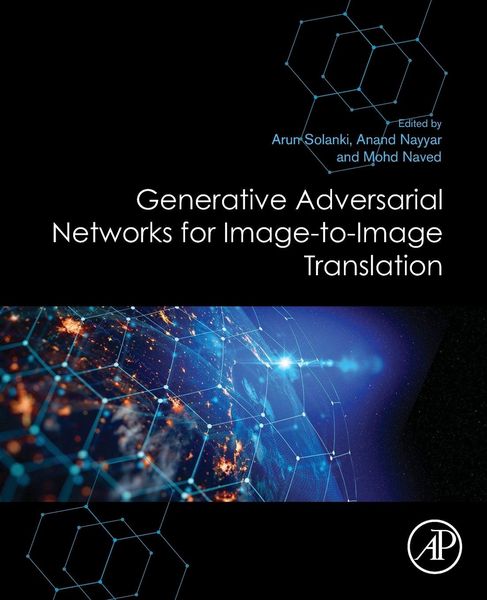
  • Produktbild: Generative Adversarial Networks for Image-to-Image Translati
  • Produktbild: Generative Adversarial Networks for Image-to-Image Translati

Generative Adversarial Networks for Image-to-Image Translati

153,99 €

inkl. gesetzl. MwSt., Versandkostenfrei


Beschreibung

Generative Adversarial Networks (GAN) have started a revolution in Deep Learning, and today GAN is one of the most researched topics in Artificial Intelligence. Generative Adversarial Networks for Image-to-Image Translation provides a comprehensive overview of the GAN (Generative Adversarial Network)...

Beschreibung

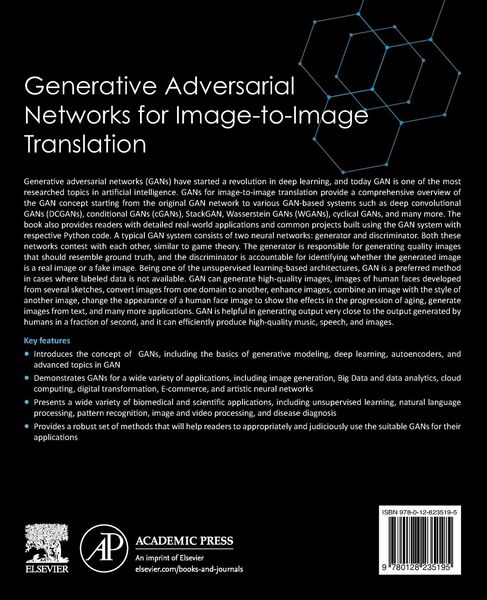
Generative Adversarial Networks (GAN) have started a revolution in Deep Learning, and today GAN is one of the most researched topics in Artificial Intelligence. Generative Adversarial Networks for Image-to-Image Translation provides a comprehensive overview of the GAN (Generative Adversarial Network) concept starting from the original GAN network to various GAN-based systems such as Deep Convolutional GANs (DCGANs), Conditional GANs (cGANs), StackGAN, Wasserstein GANs (WGAN), cyclical GANs, and many more. The book also provides readers with detailed real-world applications and common projects built using the GAN system with respective Python code. A typical GAN system consists of two neural networks, i.e., generator and discriminator. Both of these networks contest with each other, similar to game theory. The generator is responsible for generating quality images that should resemble ground truth, and the discriminator is accountable for identifying whether the generated image is a real image or a fake image generated by the generator. Being one of the unsupervised learning-based architectures, GAN is a preferred method in cases where labeled data is not available. GAN can generate high-quality images, images of human faces developed from several sketches, convert images from one domain to another, enhance images, combine an image with the style of another image, change the appearance of a human face image to show the effects in the progression of aging, generate images from text, and many more applications. GAN is helpful in generating output very close to the output generated by humans in a fraction of second, and it can efficiently produce high-quality music, speech, and images.

Portrait

Dr. Arun Solanki is Assistant Professor in the Department of Computer Science and Engineering, Gautam Buddha University, Greater Noida, India. He received his Ph.D. in Computer Science and Engineering from Gautam Buddha University. He has supervised more than 60 M.Tech. Dissertations under his guidance. His research interests span Expert System, Machine Learning, and Search Engines. Dr. Solanki is an Associate Editor of the
International Journal of Web-Based Learning and Teaching Technologies from IGI Global. He has been a Guest Editor for special issues of Recent Patents on Computer Science, from Bentham Science Publishers. Dr. Solanki is the editor of the books Green Building Management and Smart Automation and Handbook of Emerging Trends and Applications of Machine Learning, both from IGI Global.

Dr. Anand Nayyar is Professor in the School of Computer Science and Artificial Intelligence at Duy Tan University, Vietnam, where he serves as Vice-Chairman (Research) and Director of the IoT and Intelligent Systems Laboratory. His research interests include wireless sensor networks, Internet of Things, artificial intelligence, swarm intelligence, cloud computing, blockchain, cybersecurity, healthcare informatics, big data, drones, and wireless communications. He has published extensively in peer-reviewed journals, conference proceedings, book chapters, and scholarly books, and is an inventor with patents and copyrights in multiple jurisdictions. Dr. Nayyar is actively engaged in international research collaborations, research-funded projects, and postgraduate supervision. He serves on editorial boards and technical committees for international journals and conferences and contributes extensively to peer review and research evaluation activities. He is a Senior Member of IEEE and ACM.

Dr. Mohd Naved is an Associate Professor at Jaipuria Institute of Management in Noida, India, with over a decade of experience in Business Analytics, Data Science, and Artificial Intelligence. His research focuses on the applications of business analytics, data science, and artificial intelligence across various industries.

Produktdetails

Einband

Taschenbuch

Erscheinungsdatum

25.06.2021

Herausgeber Arun Solanki + weitere
Verlag Elsevier Science & Technology

Produktdetails

Einband

Taschenbuch

Erscheinungsdatum

25.06.2021

Herausgeber
Verlag Elsevier Science & Technology
Seitenzahl

444

Maße (L/B/H)

23,5/19,1/2,3 cm

Gewicht

759 g

Sprache

Englisch

ISBN

978-0-12-823519-5

Noch keine Bewertungen vorhanden

Verfassen Sie die erste Bewertung zu diesem Artikel

Helfen Sie anderen Kundinnen und Kunden durch Ihre Meinung.

Kundinnen und Kunden meinen

Bewertungen (0)

Die Leseprobe wird geladen.
  • Produktbild: Generative Adversarial Networks for Image-to-Image Translati
  • Produktbild: Generative Adversarial Networks for Image-to-Image Translati
  • 1. Super-Resolution based GAN for Image Processing: Recent Advances and Future Trends

    2. GAN models in Natural Language Processing and Image Translation

    3. Generative Adversarial Networks and their variants

    4. Comparative Analysis of Filtering Methods in Fuzzy C-Mean Environment for DICOM Image Segmentation

    5. A Review on the Techniques for Generation of Images using GAN

    6. A Review of Techniques to Detect the GAN Generated Fake Images

    7. Synthesis of Respiratory Signals using Conditional Generative Adversarial Networks from Scalogram Representation

    8. Visual Similarity-Based Fashion Recommendation System

    9. Deep learning based vegetation index estimation

    10. Image Generation using Generative Adversarial Networks

    11. Generative Adversarial Networks for Histopathology Staining

    12. ANALYSIS OF FALSE DATA DETECTION RATE IN GENERATIVE ADVERSARIAL NETWORKS USING RECURRENT NEURAL NETWORK

    13. WGGAN: A Wavelet-Guided Generative Adversarial Network for Thermal Image Translation

    14. GENERATIVE ADVERSARIAL NETWORK FOR VIDEO ANALYTICS

    15. Multimodal reconstruction of retinal images over unpaired datasets using cyclical generative adversarial networks

    16. Generative Adversarial Network for Video Anomaly Detection