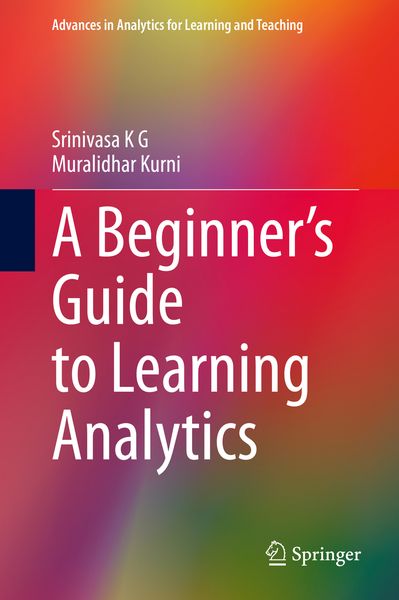
• Produktbild: A Beginner’s Guide to Learning Analytics
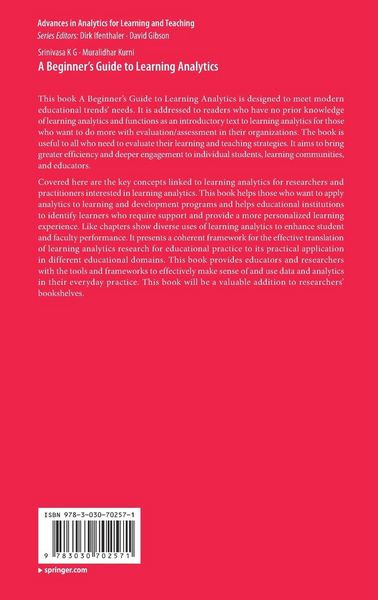
  • Produktbild: A Beginner’s Guide to Learning Analytics
- 10%

A Beginner’s Guide to Learning Analytics

10% sparen

88,99 € UVP 98,99 €

inkl. gesetzl. MwSt., Versandkostenfrei


Beschreibung

Produktdetails

Einband

Gebundene Ausgabe

Erscheinungsdatum

20.04.2021

Verlag

Springer

Seitenzahl

326

Maße (L/B/H)

24,1/16/2,4 cm

Gewicht

676 g

Auflage

1st ed. 2021

Sprache

Englisch

ISBN

978-3-030-70257-1

Beschreibung

Rezension

“This book explores how to bridge these gaps in education, teaching, and learning, with the new knowledge and technology we have today. ... Each chapter includes one or more case studies ... .” (Ernest Hughes, Computing Reviews, February 1, 2022)

Produktdetails

Einband

Gebundene Ausgabe

Erscheinungsdatum

20.04.2021

Verlag

Springer

Seitenzahl

326

Maße (L/B/H)

24,1/16/2,4 cm

Gewicht

676 g

Auflage

1st ed. 2021

Sprache

Englisch

ISBN

978-3-030-70257-1

Herstelleradresse

Springer-Verlag KG
Sachsenplatz 4-6
1201 Wien
AT

Email: GPSR Kontakt

Noch keine Bewertungen vorhanden

Verfassen Sie die erste Bewertung zu diesem Artikel

Helfen Sie anderen Kundinnen und Kunden durch Ihre Meinung.

Kundinnen und Kunden meinen

Bewertungen (0)

Weitere Artikel finden Sie in

  • Produktbild: A Beginner’s Guide to Learning Analytics
  • Produktbild: A Beginner’s Guide to Learning Analytics
  • Chapter 1.- Introduction to Learning Analytics.- 1.1. Introduction to Learning Analytics.- 1.2. Learning analytics: A new and rapidly developing field.- 1.3. Benefits and Challenges of learning analytics.- 1.4. Ethical Concerns with Learning Analytics.- 1.5. Use of Learning analytics.- 1.6. Conclusion.- 1.7. Review Questions.- Chapter 2 Educational Data Mining & Learning Analytics.- 2.1. Introduction.- 2.2. Educational Data Mining (EDM).- 2.3. Educational Data Mining & Learning analytics.- 2.4. Educational Data Mining & Learning analytics Applications.-  2.5. Conclusion.- 2.6. Review Questions.- Chapter 3.-Preparing for Learning Analytics.- 3.1. Introduction.- 3.2. Role of Psychology in Learning analytics.- 3.3. Architecting the learning analytics environment.- 3.4. Major Barriers for adopting Learning Analytics.-3.5. Case Studies.- 3.6. Conclusion.- 3.7. Review Questions.- Chapter 4. Data requirements for Learning analytics.- 4.1. Introduction.- 4.2. Types of data used for Learning Analytics.- 4.3. Data Models used to represent usage data for Learning analytics.- 4.4. Data Privacy maintenance in Learning analytics.- 4.5. Case Studies.- 4.6. Conclusion.- 4.7. Review Questions.- Chapter 5. Tools for Learning Analytics.-  5.1. Introduction.- 5.2. Popular Learning Analytics Tools.- 5.3. Choosing a Tool.- 5.4. Strategies to Successfully Deploy a Tool.- 5.5. Exploring Learning Analytics Tools.- 5.6. Case Studies.- 5.7. Developing a Learning analytics Tool.- 5.8. Conclusion.- 5.9. Review Questions.-Chapter 6.- Other Technology Approaches to Learning Analytics.- 6.1. Introduction.- 6.2. Big Data & Learning Analytics.- 6.3. Data Science & Learning Analytics.- 6.4. AI & Learning Analytics.- 6.5. Machine Learning & Learning Analytics.- 6.6. Deep Learning & Learning Analytics.- 6.7. Case Studies.- 6.8. Conclusion.- 6.9. Review Questions.- Chapter 7.- Learning Analytics in Massive Open Online Courses.- 7.1 Introduction to MOOCs.- 7.2. From MOOCs to Learning analytics.- 7.3. Integrating Learning analytics with MOOCs.- 7.4. Benefits of applying Learning Analytics in MOOCs.- 7.5. Major Concerns of implementing Learning Analytics in MOOCs.- 7.6. Limitation of Applying Learning Analytics in MOOCs.- 7.7. Tools that support Leaning analytics in MOOCs.- 7.8. Case Studies.- 7.9. Conclusion.- 7.10. Review Questions.- Chapter 8.- The Pedagogical perspective of Learning Analytics.- 8.1. Introduction to Pedagogy.- 8.2. Learning Analytics based Pedagogical Framework.- 8.3. Pedagogical Interventions.- 8.4. Learning Analytics based Pedagogical Models.- 8.5. Case studies.- 8.6. Conclusion.- 8.7. Review Questions.- Chapter 9. Moving Forward.- 9.1. Self-Learning and Learning analytics.- 9.2. Lifelong learning and learning analytics.- 9.3. Present and future trend of learning analytics in the world.- 9.4. Measuring 21st Century Skills using Learning analytics.-  9.5. Moving Forward.- 9.6. Smart Learning analytics.- 9.7. Case Studies.- 9.8. Conclusion.- 9.9. Review Questions.-Chapter 10.- Case Studies.- 10.1. Recommender systems using learning analytics.- 10.2. Learning Analytics in Higher Education.- 10.3. Other Evidences on the use of Learning Analytics.- Chapter 11. Problems.