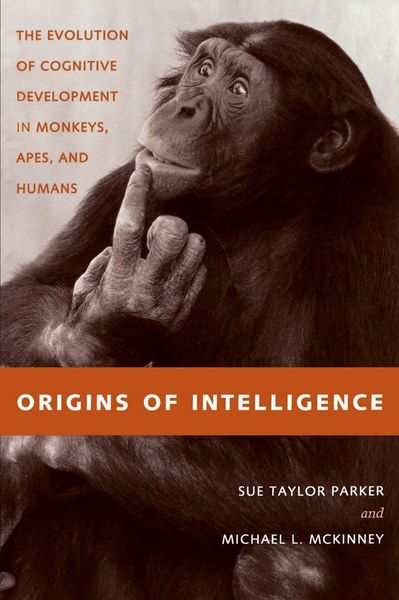
Origins of Intelligence The Evolution of Cognitive Development in Monkeys, Apes, and Humans
-
- Taschenbuch
- eBook ausgewählt
-
Form:Einzelkauf Download
-
Sprache:Englisch
26,20 €
inkl. gesetzl. MwSt.Beschreibung
Produktdetails
Format
ePUB
Kopierschutz
Ja
Family Sharing
Ja
Text-to-Speech
Ja
Verlag
Johns Hopkins University PressSeitenzahl
(Printausgabe)
Dateigröße
10492 KB
Sprache
Englisch
EAN
9781421410418
A look at the origins of cognitive abilities in primate species.
Since Darwin's time, comparative psychologists have searched for a good way to compare cognition in humans and nonhuman primates. In
Origins of Intelligence,Sue Parker and Michael McKinney offer such a framework and make a strong case for using human development theory (both Piagetian and neo-Piagetian) to study the evolution of intelligence across primate species. Their approach is comprehensive, covering a broad range of social, symbolic, physical, and logical domains, which fall under the all-encompassing and much-debated term
intelligence.
A widely held theory among developmental psychologists and social and biological anthropologists is that cognitive evolution in humans has occurred through juvenilization-the gradual accentuation and lengthening of childhood in the evolutionary process. In this work, however, Parker and McKinney argue instead that new stages were added at the end of cognitive development in our hominid ancestors, coining the term
adultification by terminal extensionto explain this process.
Drawing evidence from scores of studies on monkeys, great apes, and human children, this book provides unique insights into ontogenetic constraints that have interacted with selective forces to shape the evolution of cognitive development in our lineage.
"The authors' elegant theory and comprehensive empirical synthesis of how the development of human intelligence and brain evolved opens up cascading heuristic avenues for creatively answering one of the great questions in the human history of ideas." -Jonas Langer,
Human Development
"A handy source of information on comparative cognitive abilities related to life history and brain variables." -James Anderson,
Journal of the Royal Anthropological Institute
Since Darwin's time, comparative psychologists have searched for a good way to compare cognition in humans and nonhuman primates. In
Origins of Intelligence,Sue Parker and Michael McKinney offer such a framework and make a strong case for using human development theory (both Piagetian and neo-Piagetian) to study the evolution of intelligence across primate species. Their approach is comprehensive, covering a broad range of social, symbolic, physical, and logical domains, which fall under the all-encompassing and much-debated term
intelligence.
A widely held theory among developmental psychologists and social and biological anthropologists is that cognitive evolution in humans has occurred through juvenilization-the gradual accentuation and lengthening of childhood in the evolutionary process. In this work, however, Parker and McKinney argue instead that new stages were added at the end of cognitive development in our hominid ancestors, coining the term
adultification by terminal extensionto explain this process.
Drawing evidence from scores of studies on monkeys, great apes, and human children, this book provides unique insights into ontogenetic constraints that have interacted with selective forces to shape the evolution of cognitive development in our lineage.
"The authors' elegant theory and comprehensive empirical synthesis of how the development of human intelligence and brain evolved opens up cascading heuristic avenues for creatively answering one of the great questions in the human history of ideas." -Jonas Langer,
Human Development
"A handy source of information on comparative cognitive abilities related to life history and brain variables." -James Anderson,
Journal of the Royal Anthropological Institute
Noch keine Bewertungen vorhanden
Verfassen Sie die erste Bewertung zu diesem Artikel
Helfen Sie anderen Kundinnen und Kunden durch Ihre Meinung.
Kurze Frage zu unserer Seite
Vielen Dank für Ihr Feedback
Wir nutzen Ihr Feedback, um unsere Produktseiten zu verbessern. Bitte haben Sie Verständnis, dass wir Ihnen keine Rückmeldung geben können. Falls Sie Kontakt mit uns aufnehmen möchten, können Sie sich aber gerne an unseren Kund*innenservice wenden.
zum Kundenservice