Gutscheinbedingungen

**Gültig am 26.09.2026 auf fremdsprachige Mangas (mangas-29438) online auf thalia.at und in der Thalia App. Einzelne Artikel können ausgeschlossen sein. Ausgenommen sind preisgebundene Artikel & eBooks. Pro Einkauf einmal einlösbar. Click & Collect nur bei Onlinevorabzahlung möglich. Keine Barauszahlung. Nicht kombinierbar mit anderen Aktionen und Gutscheinen. Gutschein wird auf max. 500€ Bestellwert angerechnet. Nicht gültig für Geschenkkarten, Versandkosten und Services.

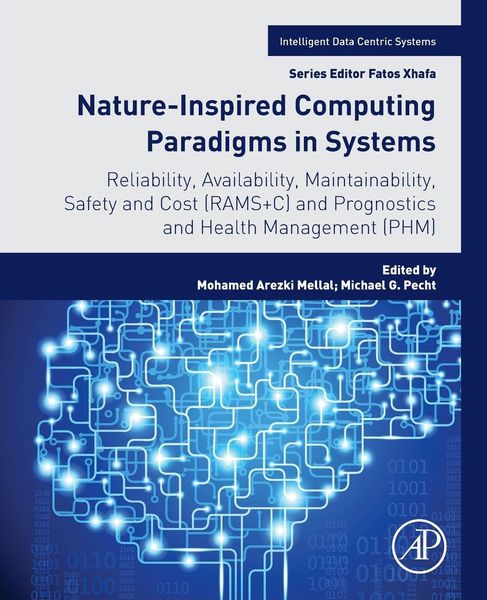
  • Produktbild: Nature-Inspired Computing Paradigms in Systems
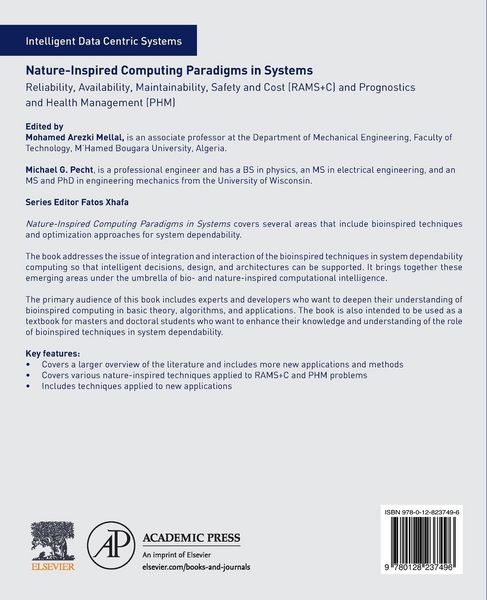
  • Produktbild: Nature-Inspired Computing Paradigms in Systems

Nature-Inspired Computing Paradigms in Systems Reliability, Availability, Maintainability, Safety and Cost (RAMS+C) and Prognostics and Health Management (PHM)

107,99 €

inkl. gesetzl. MwSt., Versandkostenfrei


Beschreibung

Produktdetails

Einband

Taschenbuch

Erscheinungsdatum

01.07.2021

Herausgeber

Mohamed Arezki Mellal + weitere

Verlag

Elsevier Science & Technology

Seitenzahl

144

Maße (L/B/H)

23,5/19,1/0,8 cm

Gewicht

262 g

Sprache

Englisch

ISBN

978-0-12-823749-6

Beschreibung

Portrait

Mohamed Arezki Mellal is a Professor at M'Hamed Bougara University of Boumerdes, Algeria. He was ranked among the top 2% of scientists worldwide by Stanford University (single-year 2022) and placed first by the 47th National University Commission of the MESRS for the professorship in Mechanical Engineering in 2022. He served as a visiting scholar at the University of Maryland, USA, and at other universities. He has been an invited keynote speaker at numerous conferences and is an associate editor of Frontiers in Mechanical Engineering (Topic: Mechatronics) an SCIE-indexed journal. His research interests encompass AI techniques for solving engineering problems, including system design and dependability, control, energy management, robotics, and manufacturing.
He is the founder and director of CALCE (Center for Advanced Life Cycle Engineering) at the University of Maryland, which is funded by over 150 of the world's leading electronics companies at more than US$6M/year. He is a Professional Engineer, an IEEE Fellow, an ASME Fellow, an SAE Fellow, and an IMAPS Fellow. He is currently serving as editor-in-chief of Circuit World. He served as editor-in-chief of IEEE Access for 6 years, as editor-in-chief of IEEE Transactions on Reliability for 9 years, and as editor-in-chief of Microelectronics Reliability for 16 years. He has also served on three U.S. National Academy of Science studies, two U.S. Congressional investigations in automotive safety, and as an expert to the U.S. FDA. He is also a Chair Professor. He consults for 22 major international electronics companies, providing expertise in strategic planning, design, test, prognostics, IP and risk assessment of electronic products and systems.

Produktdetails

Einband

Taschenbuch

Erscheinungsdatum

01.07.2021

Herausgeber

Verlag

Elsevier Science & Technology

Seitenzahl

144

Maße (L/B/H)

23,5/19,1/0,8 cm

Gewicht

262 g

Sprache

Englisch

ISBN

978-0-12-823749-6

Herstelleradresse

Libri GmbH
Europaallee 1
36244 Bad Hersfeld
DE

Email: gpsr@libri.de

Noch keine Bewertungen vorhanden

Verfassen Sie die erste Bewertung zu diesem Artikel

Helfen Sie anderen Kundinnen und Kunden durch Ihre Meinung.

Kundinnen und Kunden meinen

Bewertungen (0)

Die Leseprobe wird geladen.
  • Produktbild: Nature-Inspired Computing Paradigms in Systems
  • Produktbild: Nature-Inspired Computing Paradigms in Systems
  • Optimization
    1. RAMS+C (reliability, availability, maintainability, safety and cost)
    2. Optimal design
    3. Diagnostic
    4. Resilience and vulnerability
    5. Prognostics and Health Management (PHM)
    6. Risk assessment and mitigation
    7. Faults
    8. Obsolescence
    9. Lifetime and lifecycle prediction

    Methods of interest include, but are not limited to
    10. Genetic algorithms
    11. Particle swarm optimization
    12. Differential evolution
    13. Cuckoo algorithms
    14. Artificial bee colony
    15. Ant colony optimization
    16. Artificial neural networks
    17. Brain
    18. Inspired computing
    19. Hybrid techniques