KI-Beratung Beta

  • Produktbild: Nofar, M: Multiphase Polylactide Blends
  • Produktbild: Nofar, M: Multiphase Polylactide Blends

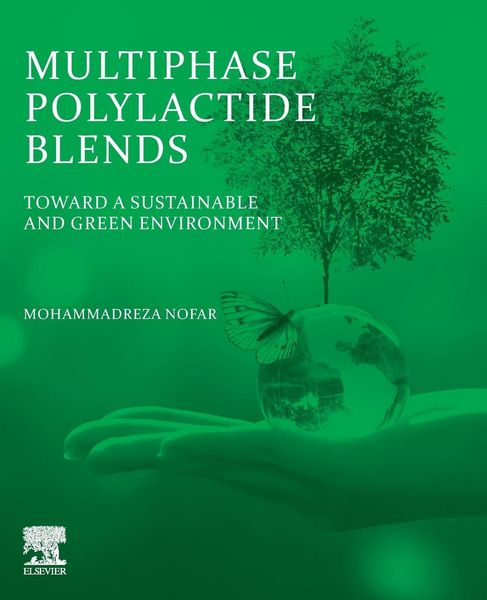
Nofar, M: Multiphase Polylactide Blends Toward a Sustainable and Green Environment

207,99 €

inkl. gesetzl. MwSt., Versandkostenfrei


Beschreibung

Multiphase Polylactide Blends: Toward a Sustainable and Green Environment guides the reader through fundamentals, science, preparation, and key areas of innovation in polylactide (PLA) blends. Bio-based polymers, and notably PLA, have not only gained increasing interest as a more sustainable alternative...

Beschreibung

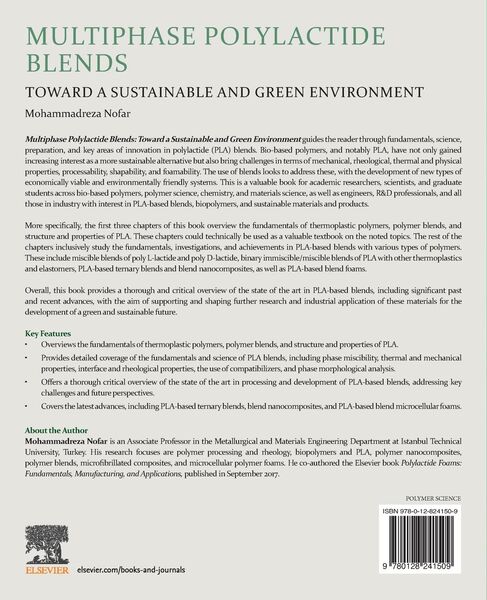
Multiphase Polylactide Blends: Toward a Sustainable and Green Environment guides the reader through fundamentals, science, preparation, and key areas of innovation in polylactide (PLA) blends. Bio-based polymers, and notably PLA, have not only gained increasing interest as a more sustainable alternative but also bring challenges in terms of mechanical, rheological, thermal and physical properties, processability, shapability, and foamability. The use of blends looks to address these, with the development of new types of economically viable and environmentally friendly systems. This is a valuable book for academic researchers, scientists, and graduate students across bio-based polymers, polymer science, chemistry, and materials science, as well as engineers, R&D professionals, and all those in industry with interest in PLA-based blends, biopolymers, and sustainable materials and products.

More specifically, the first three chapters of this book overview the fundamentals of thermoplastic polymers, polymer blends, and structure and properties of PLA. These chapters could technically be used as a valuable textbook on the noted topics. The rest of the chapters inclusively study the fundamentals, investigations, and achievements in PLA-based blends with various types of polymers. These include miscible blends of poly L-lactide and poly D-lactide, binary immiscible/miscible blends of PLA with other thermoplastics and elastomers, PLA-based ternary blends and blend nanocomposites, as well as PLA-based blend foams.

Overall, this book provides a thorough and critical overview of the state of the art in PLA-based blends, including significant past and recent advances, with the aim of supporting and shaping further research and industrial application of these materials for the development of a green and sustainable future.

Produktdetails

Einband

Taschenbuch

Erscheinungsdatum

20.07.2021

Abbildungen

180 illustrations (30 in full color)

Verlag Elsevier Science & Technology

Produktdetails

Einband

Taschenbuch

Erscheinungsdatum

20.07.2021

Abbildungen

180 illustrations (30 in full color)

Verlag Elsevier Science & Technology
Seitenzahl

404

Maße (L/B/H)

23,5/19,1/2,1 cm

Gewicht

693 g

Sprache

Englisch

ISBN

978-0-12-824150-9

Noch keine Bewertungen vorhanden

Verfassen Sie die erste Bewertung zu diesem Artikel

Helfen Sie anderen Kundinnen und Kunden durch Ihre Meinung.

Kundinnen und Kunden meinen

Bewertungen (0)

Weitere Artikel finden Sie in

Die Leseprobe wird geladen.
  • Produktbild: Nofar, M: Multiphase Polylactide Blends
  • Produktbild: Nofar, M: Multiphase Polylactide Blends
  • Chapter 1. Fundamentals of thermoplastic polymers: molecular structure
    1.1 Introduction to natural and synthetic polymers
    1.2 Thermoplastic polymers and crystal structures
    1.3 Thermal and mechanical characteristics of thermoplastics
    1.4 Transition temperatures and crystallization
    References
    Chapter 2. Introduction to polymer blends
    2.1 Introduction
    2.2 Thermodynamics and phase miscibility
    2.3 Immiscible blends: morphologies and properties
    2.4 Compatibilization and interfacial properties
    2.5 Mixing theories and processing
    2.6 Ternary and hybrid polymer blends
    References
    Chapter 3. Polylactide (PLA): molecular structure and properties
    3.1 Introduction to biopolymers and PLA
    3.2 Synthesis and molecular structure
    3.3 Molecular stereochemistry configurations
    3.4 Glass transition temperature
    3.5 Crystallization and melting behaviors
    3.6 Rheological properties
    3.7 Mechanical and physical properties
    3.8 Degradation behavior
    References
    Chapter 4. PLLA/PDLA blends: stereocomplex crystals
    4.1 Crystallization behavior
    4.2 Mechanical properties
    4.3 Rheological properties
    4.4 Barrier and degradation properties
    References
    Chapter 5. PLA binary bioblends with other biopolymers
    5.1 Blends of PLA with biobased and biodegradable polymers
    5.2 Blends of PLA with biodegradable polymers
    5.3 Blends of PLA with biobased polymers
    References
    Chapter 6. PLA binary blends with petroleum-based nondegradable thermoplastics
    6.1 PLA-PE
    6.2 PLA-PP
    6.3 PLA-PS
    6.4 PLA-ABS
    6.5 PLA-PMMA
    6.6 PLA-PET
    6.7 PLA-PBT
    6.8 PLA-PTT
    6.9 PLA-PC
    6.10 PLA-PA
    6.11 PLA-PEG, PEO, or POE
    6.12 PLA-POM
    6.13 PLA-PVPh
    References
    Chapter 7. PLA binary blends with elastomeric polymers
    7.1 PLA-rubber
    7.2 PLA-PU
    7.3 PLA-EVA and EVM
    References
    Chapter 8. Ternary blends of PLA
    8.1 Introduction
    8.2 PLA-TPS-X ternary blends
    8.3 PLA-PBAT-X ternary blends
    8.4 PLA-PBS-X ternary blends
    8.5 PLA-PMMA-X ternary blends
    8.6 PLA-Y-X ternary blends
    References
    Chapter 9. PLA blend nanocomposites
    9.1 Introduction
    9.2 Nanoparticles localization: thermodynamics vs kinetics mechanisms
    9.3 Morphological stabilization
    9.4 Morphological and rheological correlations
    9.5 Induced functionalities
    9.6 Mechanical properties
    9.7 Structure-dependent applications
    9.8 Summary
    Acknowledgement
    References
    Chapter 10. Foaming of PLA blends
    10.1 Introduction
    10.1 Miscible PLA-PLA blend foams
    10.2 PLA bioblend foams
    10.3 PLA blend foams with synthetic/nondegradable polymers
    10.4 PLA blend foams with elastomeric polymers
    References
    Summary and Perspectives