Gutscheinbedingungen

**Gültig bis 14.09.2026 auf Spielzeug, Schreibwaren, Filme, Geschenke & Trends, Musik, tolino eReader & Zubehör, Hörbücher, nicht preisgebundene Bücher und Kalender in der Thalia App. Einzelne Artikel können ausgeschlossen sein. Aufgrund der Buchpreisbindung sind deutschsprachige Bücher und eBooks ausgenommen. Zusätzlich ausgenommen sind Abos & Flatrates, Games, Geschenkkarten/-boxen, Shelfies, Software, Zeitschriften sowie einzelne Artikel von tonies®. Pro Einkauf einmal einlösbar. Nur gültig mit im Onlineshop hinterlegter Bonuscard. Click & Collect nur bei Onlinevorabzahlung möglich. Keine Barauszahlung. Nicht kombinierbar mit anderen Aktionen und Gutscheinen. Gutschein wird auf max. 500€ Bestellwert angerechnet. Nicht gültig für Versandkosten und Services.

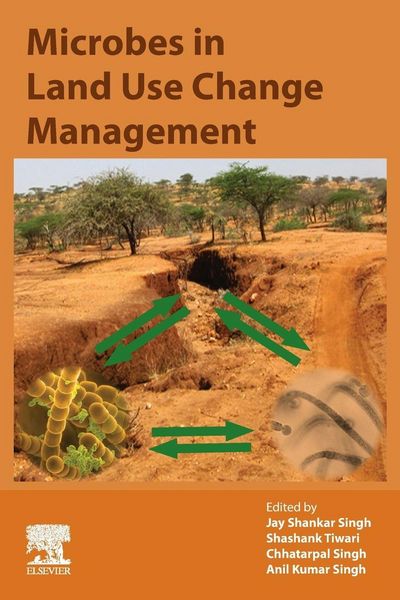
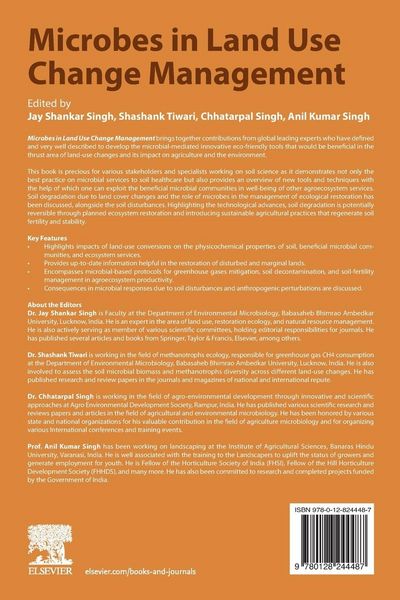
  • Produktbild: Microbes in Land Use Change Management
  • Produktbild: Microbes in Land Use Change Management

Microbes in Land Use Change Management

135,99 €

inkl. gesetzl. MwSt., Versandkostenfrei


Beschreibung

Produktdetails

Einband

Taschenbuch

Erscheinungsdatum

25.08.2021

Herausgeber

Jay Shankar Singh + weitere

Verlag

Elsevier Science & Technology

Seitenzahl

610

Maße (L/B/H)

22,9/15,2/3,1 cm

Gewicht

806 g

Sprache

Englisch

ISBN

978-0-12-824448-7

Beschreibung

Portrait

Dr. Jay Shankar Singh is Faculty at the Department of Environmental Microbiology, Babasaheb Bhimrao Ambedkar University, Lucknow, India. He is an expert in the area of land use, restoration ecology, and natural resource management. He is also actively serving as member of various scientific committees, holding editorial responsibilities for journals. He has published several articles and books from Springer, Taylor & Francis, Elsevier, among others.Dr. Shashank Tiwari is working in the field of methanotrophs ecology, responsible for greenhouse gas CH4 consumption at the Department of Environmental Microbiology, Babasaheb Bhimrao Ambedkar University, Lucknow, India. He is also involved to assess the soil microbial biomass and methanotrophs diversity across different land-use changes. He has published research and review papers in the journals and magazines of national and international repute.Dr. Chhatarpal Singh is working in the field of agro-environmental development through innovative and scientific approaches at Agro Environmental Development Society, Rampur, India. He has published various scientific research and reviews papers and articles in the field of agricultural and environmental microbiology. He has been honored by various state and national organizations for his valuable contribution in the field of agriculture microbiology and for organizing various International conferences and training events.Prof. Anil Kumar Singh has been working on landscaping at the Institute of Agricultural Sciences, Banaras Hindu University, Varanasi, India. He is well associated with the training to the Landscapers to uplift the status of growers and generate employment for youth. He is Fellow of the Horticulture Society of India (FHSI), Fellow of the Hill Horticulture Development Society (FHHDS), and many more. He has also been committed to research and completed projects funded by the Government of India.

Produktdetails

Einband

Taschenbuch

Erscheinungsdatum

25.08.2021

Herausgeber

Verlag

Elsevier Science & Technology

Seitenzahl

610

Maße (L/B/H)

22,9/15,2/3,1 cm

Gewicht

806 g

Sprache

Englisch

ISBN

978-0-12-824448-7

EU-Ansprechpartner

Kolibri 360 GmbH
Ettore-Bugatti-Straße 6-14
51149 Köln
DE
produktsicherheit@kolibri360.de

Herstelleradresse

Elsevier Science & Technology
125 London Wall
EC2Y 5AS London
GB
tradeorders@elsevier.com

Noch keine Bewertungen vorhanden

Verfassen Sie die erste Bewertung zu diesem Artikel

Helfen Sie anderen Kundinnen und Kunden durch Ihre Meinung.

Kundinnen und Kunden meinen

Bewertungen (0)

Die Leseprobe wird geladen.
  • Produktbild: Microbes in Land Use Change Management
  • Produktbild: Microbes in Land Use Change Management
  • 1. Temperature sensitivity of litter and soil organic matter decomposition: perspective of soil microbial community structure and function 
    2. Adaptation of bacterial communities and plant strategies for amelioration and eco-restoration of an organometallic industrial waste polluted site 
    3. Effect of soil biofilms on ecological function and impact on soil properties 
    4. Alteration in microbial population density composition in different land use systems 
    5. Molecular characterization of bacterial community succession and analysis of physiochemical properties in a compost of solid organic waste from Gandhinagar, Gujarat, India 
    6. Molecular technologies for the early detection of fungal phytopathogens associated with cereal crops 
    7. Applicability of fungi in agriculture and environmental sustainability 
    8. Litterfall decomposition of selected plant species and nutrient
    cycling in Madhupur Sal (Shorea robusta Roth) forest of Bangladesh 
    9. Bioactivity of soil microorganisms for agriculture development 
    10. Next generation OMICS: a tool to understand the diversity of soil microbiota and improvement of agricultural sustainability 
    11. Microbial associations in ecological reclamation and restoration of marginal lands 
    12. Assessment of microbial biomass for production of ecofriendly
    single-cell protein, bioenergy, and other useful products 
    13. Participation and understanding of plant microbes' interaction in plant health and growth by combating mercury stress: a sustainable approach towards agricultural practices 
    14. The role of plant growth promoting bacteria in mineralization of endosulfan and its metabolites 
    15. Response of microbial populations to landscape dynamics 
    16. Soil-plant-microbial interactions for soil fertility management and sustainable agriculture 
    17. Endophytic microbial interaction with legume crop for developing resistance against nutrient stress 
    18. Function-driven microbial genomics for ecofriendly agriculture 
    19. Role of microbial communities in restoration disturbed lands 
    20. Impact of microbial biofilm on crop productivity and agricultural sustainability 
    21. Valuing each patch of land: utilizing plant-microbe interactions for the betterment of agriculture 
    22. Tripartite interactions: plant-Pseudomonas putida-microRNAs in agricultural  productivity 
    23. Next-generation omics technologies to explore microbial diversity