Gutscheinbedingungen

**Gültig bis 06.07.2026 auf fremdsprachige Bücher online auf thalia.at, in der Thalia App ab einem Mindestbestellwert von 30€ und in allen Thalia Buchhandlungen in Österreich. In den Buchhandlungen nur gültig auf lagernde Ware. Einzelne Artikel können ausgeschlossen sein. Ausgenommen sind preisgebundene Artikel & eBooks. Pro Einkauf einmal einlösbar. Nur gültig gegen Vorlage oder im Onlineshop hinterlegter Bonuscard. Infos zur Einlösung in der Buchhandlung sind auf der Bonuscard-Vorteilspreisseite zu finden. Click & Collect nur bei Onlinevorabzahlung möglich. Keine Einlösung bei Scan & Go-Bezahlung. Keine Barauszahlung. Nicht kombinierbar mit anderen Aktionen und Gutscheinen. Gutschein wird auf max. 500€ Bestellwert angerechnet. Nicht gültig für Versandkosten und Services.

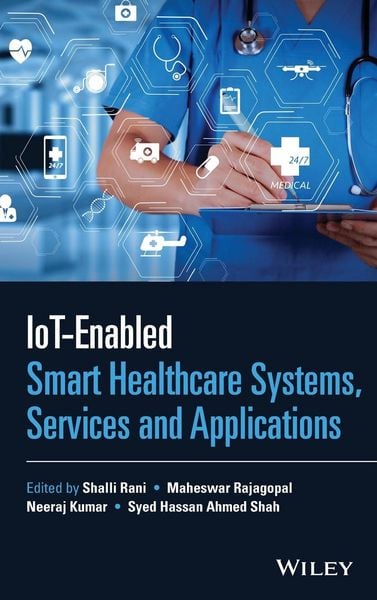
Produktbild: Iot-Enabled Smart Healthcare Systems, Services and Applications

Iot-Enabled Smart Healthcare Systems, Services and Applications

171,99 €

inkl. gesetzl. MwSt., Versandkostenfrei


Beschreibung

Produktdetails

Einband

Gebundene Ausgabe

Erscheinungsdatum

26.01.2022

Herausgeber

Shalli Rani + weitere

Verlag

John Wiley & Sons Inc

Seitenzahl

256

Maße (L/B/H)

23,5/15,7/1,8 cm

Gewicht

528 g

Auflage

1. Auflage

Sprache

Englisch

ISBN

978-1-119-81679-9

Beschreibung

Produktdetails

Einband

Gebundene Ausgabe

Erscheinungsdatum

26.01.2022

Herausgeber

Verlag

John Wiley & Sons Inc

Seitenzahl

256

Maße (L/B/H)

23,5/15,7/1,8 cm

Gewicht

528 g

Auflage

1. Auflage

Sprache

Englisch

ISBN

978-1-119-81679-9

Herstelleradresse

Libri GmbH
Europaallee 1
36244 Bad Hersfeld
DE

Email: gpsr@libri.de

Noch keine Bewertungen vorhanden

Verfassen Sie die erste Bewertung zu diesem Artikel

Helfen Sie anderen Kundinnen und Kunden durch Ihre Meinung.

Kundinnen und Kunden meinen

Bewertungen (0)

Die Leseprobe wird geladen.
  • Produktbild: Iot-Enabled Smart Healthcare Systems, Services and Applications
  • Preface ix

    Acknowledgments xi

    About the Editors xiii

    List of Contributors xvii

    1 The Role of Emerging Technologies in Smart Healthcare 1
    Masooma Zehra Syeda, Dur-e-hassan Syeda, and Himanshi Babbar

    1.1 Introduction 1

    1.2 Emerging Technologies in Smart Healthcare 3

    1.3 Realization of SHC through Emerging Technologies (Applications) 9

    1.4 Conclusion 15

    Author Biography 15

    References 15

    2 ICN-Fog Computing for IoT-Based Healthcare: Architecture and Challenges 19
    Divya Gupta, Shalli Rani, and Syed Hassan Ahmed Shah

    2.1 Introduction 19

    2.2 ICN in IoT 21

    2.3 IoT in Healthcare 24

    2.4 Role of Fog Computing in IoT 26

    2.5 Fog Computing in Healthcare: A Classification Approach 28

    2.6 ICN-Fog Leveraging Healthcare Architecture 30

    2.7 Challenges in the Healthcare System 33

    2.8 Conclusion 35

    References 35

    3 Internet of Things (IoT) Enabled Software Defined Networking (SDN) for Load Balancing, Edge, Cloud Computing in Healthcare 39
    Himanshi Babbar, Shalli Rani, and Neeraj Kumar

    3.1 Overview of Software-Defined Networking 39

    3.2 Overview of Healthcare 40

    3.3 Technologies Used in Software-Defined Networking (SDN) and HealthCare 42

    3.4 Use Cases of Software-Defined Networking in Healthcare 52

    3.5 Research Directions 55

    3.6 Conclusion 55

    Key Points 56

    Author Biography 57

    References 59

    4 Security and Privacy Issues in Smart Healthcare System Using Internet of Things 63
    R. Nidhya, Manish Kumar, R. Maheswar, and D. Pavithra

    4.1 Introduction 63

    4.2 Overview of Internet of Things in Smart Healthcare Systems 64

    4.3 Policies and Legislation Related to Smart Healthcare 66

    4.4 Security and Privacy Issues in Smart Healthcare Based on Internet of Things 69

    4.5 Issues in Location Privacy 77

    4.6 Issues in Privacy of Stored Data and Threats Identity 77

    4.7 Conclusion 77

    Author Biography 78

    References 79

    5 An Overview of Architecture and Applications of IoT-Based Health Care Systems 87
    M. Saravanan, J. Ajayan, R. Maheswar, and E. Parthasarathy

    5.1 Introduction 87

    5.2 Overview of the Healthcare System 88

    5.3 Working Prototype of Healthcare System Using BAN 89

    5.4 On-Body Sensors and Sensor Embodiment 93

    5.5 Vital Signs Monitoring 97

    5.6 Biosensors in M-Health 104

    5.7 IoT-Based Rehabilitation System 109

    5.8 Future Work 115

    5.9 Conclusion 115

    Authors' Biography 115

    References 117

    6 A Review of e-Healthcare System of India and Thailand 123
    Shanu Bhardwaj, S.N. Panda, Priyanka Datta, Rajesh Kumar Kaushal, and Naveen Kumar

    6.1 Introduction 123

    6.2 Literature Review 124

    6.3 Problem Statement 134

    6.4 Methodology 134

    6.5 Discussion 134

    6.6 Conclusion 137

    References 138

    7 WSN-and IoT-Based Smart Surveillance Systems for Patients with Closed-Loop Alarm 143
    Amit Sundas, Sumit Badotra, Shalli Rani, and Chhabildas Madhukar Gajare

    7.1 Introduction 143

    7.2 Literature Review 152

    7.3 Proposed Work : WSN and IoT-Based Smart Surveillance System for Patients with Closed-Loop Alarm 155

    7.4 Implementation and Evaluation of the WSN and IoT-Based Smart Surveillance System for Patients with Closed-Loop Alarm 160

    7.5 Conclusion and Future Work 173

    References 174

    8 An IoMT-Based Smart Remote Monitoring System for Healthcare 177
    Chetna Kaushal, Md Khairul Islam, Anshu Singla, and Md Al Amin

    8.1 Introduction 177

    8.2 Literature Review 181

    8.3 Methodology 183

    8.4 Use Case of Real-Time Remote Monitoring System 191

    8.5 Conclusion 193

    References 194

    9 A Multi-Domain Perspective of Future Directions for VANETs for Emergency Message Dissemination 199
    Ravneet Kaur, Ramkumar Ketti Ramachandran, Robin Doss, and Lei Pan

    9.1 Introduction 199

    9.2 Future Directions of Multi-Domain VANETs Emergency Message Dissemination 200

    9.3 Role of VANETs in Healthcare Systems 203

    9.4 Techniques Used for Fast Delivery of Emergency Message in VANETs to Help the Healthcare System 205

    9.5 Current Facilities and Limitations for Implementing the Real-Time Environment 210

    9.6 Discussion on Upcoming Trends and Possibilities with Future Readings 211

    9.7 Conclusion 214

    Notes 214

    Author Biography 214

    References 216

    Index 219