Gutscheinbedingungen

**Gültig bis 06.07.2026 auf fremdsprachige Bücher online auf thalia.at, in der Thalia App ab einem Mindestbestellwert von 30€ und in allen Thalia Buchhandlungen in Österreich. In den Buchhandlungen nur gültig auf lagernde Ware. Einzelne Artikel können ausgeschlossen sein. Ausgenommen sind preisgebundene Artikel & eBooks. Pro Einkauf einmal einlösbar. Nur gültig gegen Vorlage oder im Onlineshop hinterlegter Bonuscard. Infos zur Einlösung in der Buchhandlung sind auf der Bonuscard-Vorteilspreisseite zu finden. Click & Collect nur bei Onlinevorabzahlung möglich. Keine Einlösung bei Scan & Go-Bezahlung. Keine Barauszahlung. Nicht kombinierbar mit anderen Aktionen und Gutscheinen. Gutschein wird auf max. 500€ Bestellwert angerechnet. Nicht gültig für Versandkosten und Services.

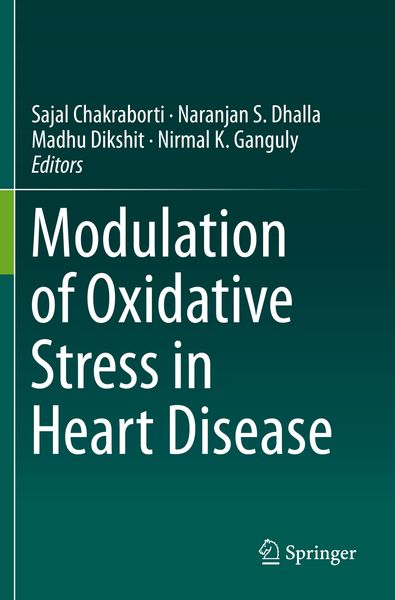
  • Produktbild: Modulation of Oxidative Stress in Heart Disease
  • Produktbild: Modulation of Oxidative Stress in Heart Disease

Modulation of Oxidative Stress in Heart Disease

198,99 €

inkl. gesetzl. MwSt., Versandkostenfrei


Beschreibung

Produktdetails

Einband

Taschenbuch

Erscheinungsdatum

26.08.2021

Herausgeber

Sajal Chakraborti + weitere

Verlag

Springer Singapore

Seitenzahl

686

Maße (L/B/H)

23,5/15,5/3,8 cm

Auflage

1st ed. 2019

Sprache

Englisch

ISBN

978-981-13-8948-1

Beschreibung

Portrait

Dr Sajal Chakraborti is a Professor of Biochemistry at the University of Kalyani, West Bengal, India. He completed his PhD at Calcutta University, Kolkata, India and his DSc at the University of Kalyani. He also pursued postdoctoral research at Johns Hopkins University, Baltimore; University of Utah, Salt Lake City; and New York Medical College, New York as a Fulbright Fellow. He visited the University of Florida, Gainesville, Florida, where he conducted research on f beta-adrenergic receptor activation in heart disease.  His research mainly deals with the role of vasoactive agents in regulating vascular tone under oxidant and calcium signaling phenomena. He has been engaged in biochemistry teaching and research for the past 40 years (email: saj_chakra@rediffmail.com). 

Dr Naranjan S Dhalla is a Distinguished Professor at the University of Manitoba, Winnipeg, Canada. His expertise includes the subcellular and molecular basis of heart function inhealth and disease. He has been engaged in multidisciplinary cardiology research and education for over 50 years. He is currently the Editor-in-chief of Molecular and Cellular Biochemistry (Springer) (email: NSDhalla@sbrc.ca). 

Dr Madhu Dixit is a National Chair Fellow of the Translational Health Science and Technology Institute, Faridabad, Haryana, India. She has contributed to the general area of biochemical pharmacology with a special interest in cardiovascular pharmacology and redox biology. Dr Dixit has been engaged in research, especially on drug discovery and development, for over 40 years (email: rmadhudikshit@gmail.com).

Dr Nirmal K Ganguly , a distinguished biotechnologist and former Director General of the Indian Council of Medical Research (ICMR), is associated with Global Health Strategies, New Delhi, India. One important aspect of his research is the understanding of occupational, environmental and nutritional aspectsof heart disease.  In 2008 he was presented with the Padma Bhushan Award in the field of “Medicine” by the President of India (email: ganguly1nk@gmail.com). 


Produktdetails

Einband

Taschenbuch

Erscheinungsdatum

26.08.2021

Herausgeber

Verlag

Springer Singapore

Seitenzahl

686

Maße (L/B/H)

23,5/15,5/3,8 cm

Auflage

1st ed. 2019

Sprache

Englisch

ISBN

978-981-13-8948-1

Herstelleradresse

Springer-Verlag GmbH
Tiergartenstr. 17
69121 Heidelberg
DE

Email: ProductSafety@springernature.com

Noch keine Bewertungen vorhanden

Verfassen Sie die erste Bewertung zu diesem Artikel

Helfen Sie anderen Kundinnen und Kunden durch Ihre Meinung.

Kundinnen und Kunden meinen

Bewertungen (0)

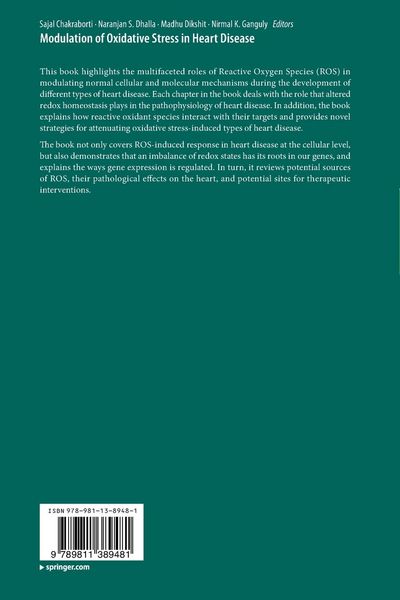
  • Produktbild: Modulation of Oxidative Stress in Heart Disease
  • Produktbild: Modulation of Oxidative Stress in Heart Disease
  • - Part I Regulation of Oxidative Stress. - Modulation of Oxidative Stress in Heart Disease by Uncoupling Proteins. - Oxidant-Dependent and Oxidant-Independent Proangiogenic and Vasomotor Signaling in Coronary Vascular Endothelium. - Modulation of miRNA in Oxidative Stress-Induced Cardiac Remodeling. - Myocardial Oxidative Stress and Metabolic Diseases. - Impact of Genetic and Epigenetic Factors on the Oxidative Stress in Cardiovascular Disease. - Role of Monoamine Oxidases in Heart Diseases. - Key Cellular Effectors in ROS-Mediated Cardiac Diseases. - Reactive Oxygen Species Generation in Neutrophils: Modulation by Nitric Oxide. - Heat Shock Proteins and Their Associated Oxidative Stress-Induced Heart Disease. - Modulation of Oxidative Stress in Cardiovascular Diseases. -  Part II Pathophysiology of Oxidative Stress. - Oxidative Stress and Heart Failure. - Oxidative Stress in Metabolic Syndrome: Experimental Model of Biomarkers. - Oxidative Stress as a Critical Determinant of Adult Cardiac Progenitor Cell-Fate Decisions. Role of Oxidative Stress in Hyperhomocysteinemia-Induced Heart Diseases. - Nitrosative Stress and Cardiogenesis: Cardiac Remodelling Perturbs Embryonic Metabolome. - Oxidative Stress in Pulmonary Artery Hypertension. - Free Radicals and Reactive Oxygen Species in Cardiovascular Pathophysiology: An Overview. - Epigenetic Basis of Oxidative Stress in Diabetic Coronary Atherosclerosis: A Shift in Focus from Genetic Prerogative. - Role of Oxidative Stress, Mitochondrial Dysfunction, and Autophagy in Cardiovascular Disease: Its Pathogenesis and Amelioration by Different Small Natural Molecules. - Parkin Protein: The Missing Link Between Cardiovascular and Parkinson’s Disease. -  Part III Prevention and Therapeutics. - New Technologies in Drug Development Provide New Hope in Targeting of Dysregulated Redox Signalling in Cardiovascular Disease. - An Exercise Mimetic That Targets Nitroso-Redox Balance as a Therapeutic for Heart Disease. - Myocardial Injury Secondary to Intestinal Ischemia/Reperfusion or Microbiota Disturbance: Preventive and Therapeutic Concerns. - Multi-target Approach for Oxidative Stress Modulation by Aspirin, Salicylates and Other NSAIDs: Clinical Implications in Atherosclerosis. - The Evolving Concept of Mitochondrial Dynamics in Heart: Interventional Opportunities. - Pharmacogenetic Implications of Statin Therapy on Oxidative Stress in Coronary Artery Disease. - Basic Mechanisms of Ischemia/Reperfusion Injury Leading to Cellular and Tissue Damage: Therapeutic Implications. - Targeting Mitochondria for Therapy of Cardiovascular Disease.