• Produktbild: Handbook of Astrobiology
  • Produktbild: Handbook of Astrobiology

Handbook of Astrobiology

Aus der Reihe Series in Astrobiology

69,99 €

inkl. gesetzl. MwSt., Versandkostenfrei


Beschreibung

Produktdetails

Einband

Taschenbuch

Erscheinungsdatum

31.03.2021

Herausgeber

Vera M. Kolb

Verlag

Taylor and Francis

Seitenzahl

868

Maße (L/B/H)

28/21/4,6 cm

Gewicht

2077 g

Sprache

Englisch

ISBN

978-0-367-78048-7

Beschreibung

Produktdetails

Einband

Taschenbuch

Erscheinungsdatum

31.03.2021

Herausgeber

Vera M. Kolb

Verlag

Taylor and Francis

Seitenzahl

868

Maße (L/B/H)

28/21/4,6 cm

Gewicht

2077 g

Sprache

Englisch

ISBN

978-0-367-78048-7

Herstelleradresse

Libri GmbH
Europaallee 1
36244 Bad Hersfeld
DE

Email: gpsr@libri.de

Kundinnen und Kunden meinen

0 Bewertungen

Informationen zu Bewertungen

Zur Abgabe einer Bewertung ist eine Anmeldung im Konto notwendig. Die Authentizität der Bewertungen wird von uns nicht überprüft. Wir behalten uns vor, Bewertungstexte, die unseren Richtlinien widersprechen, entsprechend zu kürzen oder zu löschen.

Die Bewertungen sind nach Format, Anzahl Sterne und Datum sortiert.

Verfassen Sie die erste Bewertung zu diesem Artikel

Helfen Sie anderen Kund*innen durch Ihre Meinung

Kundinnen und Kunden meinen

0 Bewertungen filtern

Die Leseprobe wird geladen.
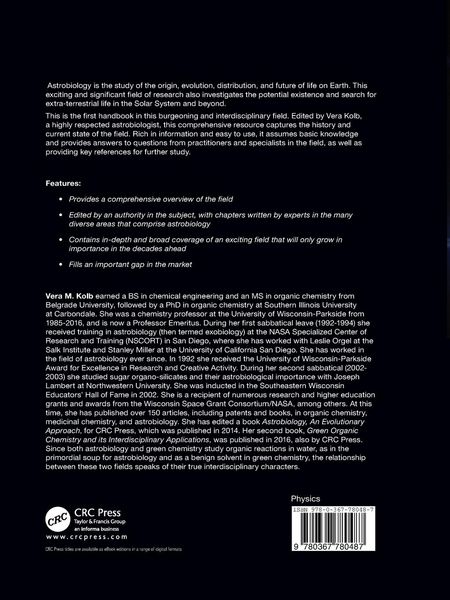
  • Produktbild: Handbook of Astrobiology
  • Produktbild: Handbook of Astrobiology
  • Part 1. Astrobiology: Definition, scope, and education 1.1 Astrobiology: Definition and scope 1.2 Astrobiology goals: NASA Strategy and European roadmap1.3. Online, classroom and wilderness teaching environments: Reaching astrobiology learners of all ages around the world 1.4 Astrobiology as a medium for science education1.5?Astrobiology as Origins Story: Education and inspiration across cultures Part 2. Definition and nature of life 2.1 Definition of life: Multiple perspectives 2.2 A generalized and universalized definition of life applicable to extraterrestrial environments2.3 Synthetic life and minimal cell2.4 Communication as the main characteristic of life Part 3. Origin of life: History, philosophical aspects, and major developments 3.1 Philosophical aspects of the origin-of-life question: Neither by chance nor by design3.2 Charles Darwin and the Plurality of Worlds: Are we Alone?3.3 Origins of life: Early history, from Buffon to Oparin 3.4 Think life by studying its origins. A look on the second part of the 20th century Part 4. Chemical origins of life: Chemicals in the universe and their delivery on the early Earth. Geology and atmosphere on the early Earth. 4.1 Interstellar molecules and their prebiotic potential4.2 Formation and delivery of complex organic molecules to the Solar System and early Earth4.3 Organic molecules in meteorites and their astrobiological significance4.4 Ancient life and crust and mantle evolution4.5 Atmosphere on early Earth and its evolution as it impacted life Part 5. Chemical origin of life: Prebiotic chemistry. 5.1 Prebiotic chemistry that led to life5.2 Prebiotic chemical pathways to RNA and the importance of its compartmentation5.3 The hydrothermal impact crater-lakes: The c