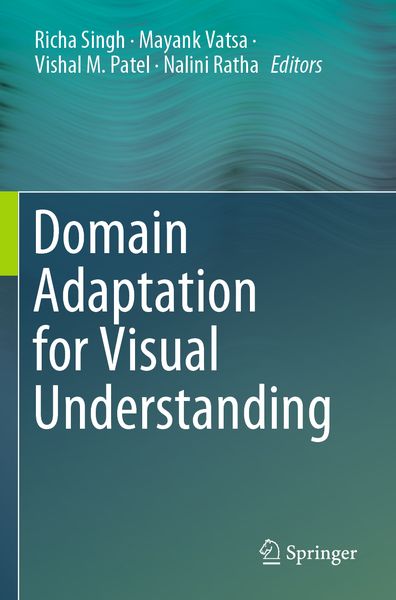

Domain Adaptation for Visual Understanding
-
- Hardcover
- Taschenbuch ausgewählt
- eBook
-
Sprache:Englisch
99,99 €
inkl. gesetzl. MwSt.,
Beschreibung
Produktdetails
Einband
Taschenbuch
Erscheinungsdatum
26.08.2021
Abbildungen
X, 144 p. 62 illus., 56 illus. in color.
Herausgeber
Richa Singh + weitereVerlag
SpringerSeitenzahl
144
Maße (L/B/H)
23,5/15,5/0,9 cm
Gewicht
248 g
Auflage
1st ed. 2020
Sprache
Englisch
ISBN
978-3-030-30673-1
This unique volume reviews the latest advances in domain adaptation in the training of machine learning algorithms for visual understanding, offering valuable insights from an international selection of experts in the field. The text presents a diverse selection of novel techniques, covering applications of object recognition, face recognition, and action and event recognition.
Topics and features: reviews the domain adaptation-based machine learning algorithms available for visual understanding, and provides a deep metric learning approach; introduces a novel unsupervised method for image-to-image translation, and a video segment retrieval model that utilizes ensemble learning; proposes a unique way to determine which dataset is most useful in the base training, in order to improve the transferability of deep neural networks; describes a quantitative method for estimating the discrepancy between the source and target data to enhance image classification performance; presentsa technique for multi-modal fusion that enhances facial action recognition, and a framework for intuition learning in domain adaptation; examines an original interpolation-based approach to address the issue of tracking model degradation in correlation filter-based methods.
This authoritative work will serve as an invaluable reference for researchers and practitioners interested in machine learning-based visual recognition and understanding.
Noch keine Bewertungen vorhanden
Verfassen Sie die erste Bewertung zu diesem Artikel
Helfen Sie anderen Kundinnen und Kunden durch Ihre Meinung.
Kurze Frage zu unserer Seite
Vielen Dank für Ihr Feedback
Wir nutzen Ihr Feedback, um unsere Produktseiten zu verbessern. Bitte haben Sie Verständnis, dass wir Ihnen keine Rückmeldung geben können. Falls Sie Kontakt mit uns aufnehmen möchten, können Sie sich aber gerne an unseren Kund*innenservice wenden.
zum Kundenservice