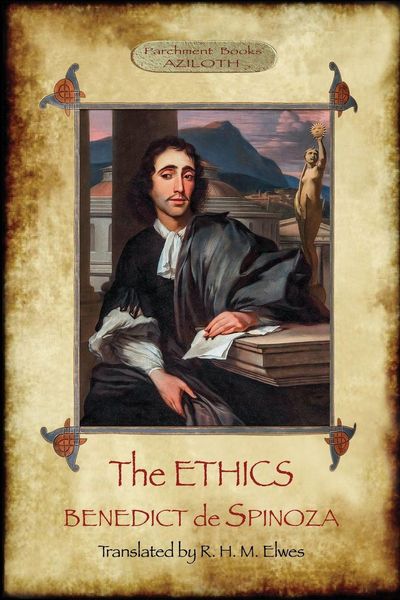
The Ethics Translated by R. H. M. Elwes, with Commentary & Biography of Spinoza by J. Ratner (Aziloth Books).
-
- Hardcover
- Taschenbuch ausgewählt
- eBook
-
Sprache:Englisch
-
Verlag:Aziloth Books
- Globe Pequot Publishing Group Inc 19,99 €
- Lector House 17,99 €
- Level 4 Press, Inc. 7,99 €
- True Sign Publishing House 22,99 €
- Bibliotech Pr 21,99 €
- Dover Publications Inc 11,99 €
- A & D Publishing 19,99 €
- Digireads.com 16,99 €
- Moonrise Press 19,99 €
- Wordsworth Editions Ltd 9,99 €
- Simon & Brown 15,99 €
- Aziloth Books 17,99 € ausgewählt
- Double 9 Books 18,99 €
17,99 €
inkl. gesetzl. MwSt.,
- Kostenlose Lieferung ab 30 € Einkaufswert
- Versandkostenfrei für Bonuscard-Kund*innen
Beschreibung
Produktdetails
Einband
Taschenbuch
Erscheinungsdatum
10.12.2020
Verlag
Aziloth BooksSeitenzahl
196
Maße (L/B/H)
22,9/15,2/1,1 cm
Gewicht
293 g
Sprache
Englisch
ISBN
978-1-913751-05-0
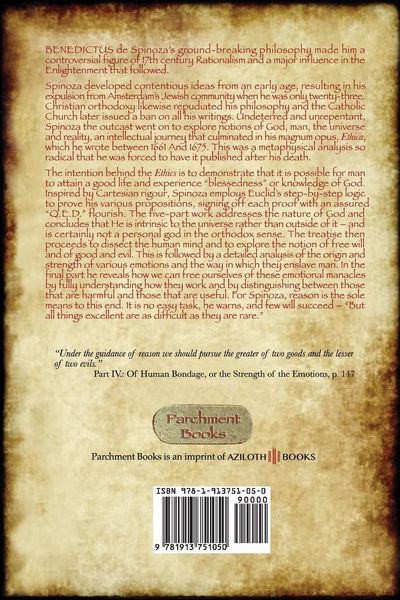
Benedictus de Spinoza's ground-breaking philosophy made him a controversial figure of 17th century Rationalism and a major influence in the Enlightenment that followed. Spinoza developed contentious ideas from an early age, resulting in his expulsion from Amsterdam's Jewish community when he was only twenty-three. Christian orthodoxy likewise repudiated his philosophy and the Catholic Church later issued a ban on all his writings. Undeterred and unrepentant, Spinoza the outcast went on to explore notions of God, man, the universe and reality, an intellectual journey that culminated in his magnum opus, Ethica, which he wrote between 1661 And 1675. This was a metaphysical analysis so radical that he was forced to have it published after his death. The intention behind the Ethics is to demonstrate that it is possible for man to attain a good life and experience "blessedness" or knowledge of God. Inspired by Cartesian rigour, Spinoza employs Euclid's step-by-step logic to prove his various propositions, signing off each proof with an assured "Q.E.D." flourish. The five-part work addresses the nature of God and concludes that He is intrinsic to the universe rather than outside of it - and is certainly not a personal god in the orthodox sense. The treatise then proceeds to dissect the human mind and to explore the notion of free will and of good and evil. This is followed by a detailed analysis of the origin and strength of various emotions and the way in which they enslave man. In the final part he reveals how we can free ourselves of these emotional manacles by fully understanding how they work and by distinguishing between those that are harmful and those that are useful. For Spinoza, reason is the sole means to this end. It is no easy task, he warns, and few will succeed - "But all things excellent are as difficult as they are rare."
Noch keine Bewertungen vorhanden
Verfassen Sie die erste Bewertung zu diesem Artikel
Helfen Sie anderen Kundinnen und Kunden durch Ihre Meinung.
Kurze Frage zu unserer Seite
Vielen Dank für Ihr Feedback
Wir nutzen Ihr Feedback, um unsere Produktseiten zu verbessern. Bitte haben Sie Verständnis, dass wir Ihnen keine Rückmeldung geben können. Falls Sie Kontakt mit uns aufnehmen möchten, können Sie sich aber gerne an unseren Kund*innenservice wenden.
zum Kundenservice