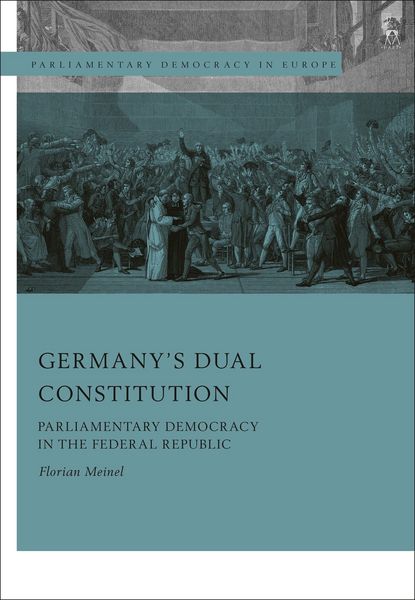
Produktbild: Germany's Dual Constitution

Germany's Dual Constitution Parliamentary Democracy in the Federal Republic

84,99 €

inkl. gesetzl. MwSt., Versandkostenfrei


Beschreibung

Produktdetails

Einband

Gebundene Ausgabe

Erscheinungsdatum

15.07.2021

Verlag

Hart Publishing

Seitenzahl

152

Maße (L/B/H)

17,7/25,2/1,5 cm

Gewicht

444 g

Sprache

Englisch

ISBN

978-1-5099-4339-5

Beschreibung

Produktdetails

Einband

Gebundene Ausgabe

Erscheinungsdatum

15.07.2021

Verlag

Hart Publishing

Seitenzahl

152

Maße (L/B/H)

17,7/25,2/1,5 cm

Gewicht

444 g

Sprache

Englisch

ISBN

978-1-5099-4339-5

Herstelleradresse

Libri GmbH
Europaallee 1
36244 Bad Hersfeld
DE

Email: gpsr@libri.de

Kundinnen und Kunden meinen

0 Bewertungen

Informationen zu Bewertungen

Zur Abgabe einer Bewertung ist eine Anmeldung im Konto notwendig. Die Authentizität der Bewertungen wird von uns nicht überprüft. Wir behalten uns vor, Bewertungstexte, die unseren Richtlinien widersprechen, entsprechend zu kürzen oder zu löschen.

Die Bewertungen sind nach Format, Anzahl Sterne und Datum sortiert.

Verfassen Sie die erste Bewertung zu diesem Artikel

Helfen Sie anderen Kund*innen durch Ihre Meinung

Kundinnen und Kunden meinen

0 Bewertungen filtern

Die Leseprobe wird geladen.
  • Produktbild: Germany's Dual Constitution
  • 1. Introduction: The Two Crises of Parliamentary Government
    I. Brexit and the Europeanisation of Westminster Parliamentarianism
    II. Master Narratives of the German Democracy - and Recent Doubts
    III. Realities of Mass and Social Media
    IV. Outline

    2. The Two Worlds of German Constitutionalism
    I. What is Parliamentary Government?
    A. The Monism of Powers
    B. Reservations about Parliamentary Rule
    C. Confidence, Power and Control
    D. The Asymmetric Juridification of the System of Government
    II. The Dual Structure of the German Constitution
    A. The Administration's Uncoupling from the Political System
    B. Continuity as Principle
    C. The Constitution as an Achievement
    III. The Outsider's Republic: Parliamentary Government and the Political Culture of the Merkel Era
    A. Technocracy or Morality?
    B. The Weakness of Parliamentary Instruments of Power
    C. The Drama of the Social Democrats
    IV. Merkel's Legacy and the Cautionary Tale of the Grand Coalition
    A. The Supermajority as Working Principle
    B. The Democratic Costs of the Multi-Party System
    C. The Future of the Constitution
    V. Parliamentarianism and Anti-Parliamentarianism

    3. Transformations of Parliamentary Government in Germany Since World War I
    I. The Written and the Real Constitution
    A. A Constitution without a Theory
    B. The Link between Parliament and Government
    II. 1919: Weimar - A Semi-Parliamentary Bureaucracy
    A. The Very Different Example of England
    B. The German Problem
    C. Organising Responsibility
    D. Distorted Images in Parliamentary Theory: A Weimar Legacy
    III. 1949: Parliamentarianism and the Basic Law
    A. The Point of Departure
    B. A Turn Away from the Parliamentary System of Government?
    C. The House that Adenauer Built (With a Little Help from the SPD)
    D. The Federal Chancellery as Parliamentary Government Headquarters
    E. The Chancellor's De Facto Right to Dissolve Parliament
    IV. 1969: The Normality of Parliamentary Changes of Power and the 'Popular Parties' as Mediating Institutions
    A. Parliamentary State Secretaries: Their Uses and Abuses
    B. In Praise of Party Patronage
    V. The Legal Connection between Parliament and Government Forged by the Constitutional Court
    A. Limits of Constitutional Review in Parliamentary Democracies
    B. A Political Court
    C. The Constitutional Enabling of Parliamentary Minorities and of the Parties
    D. The Reservation of Statutory Powers and its Democratic Reinterpretation
    E. Parliament as an Agency of Legalisation and a Machine of Legislation

    4. What is the Bundestag? Political Representation in a Working Legislature
    I. What is Parliamentary Representation?
    A. Representation without Decision?
    B. Constitutional Problems of Representation
    II. The Constitutional Importance of the Electoral System
    A. Is there a Democratic Precedence of Proportional Representation?
    B. The Political Consequences
    C. The Eternal Question of Electoral Reform
    III. The Tasks of Political Theory

    5. The Crisis of the Mediating Institutions
    I. The Abiding Peculiarity of Parliamentary Government in the Federal Republic
    II. The Creeping Decline of the Popular Parties as a Constitutional Factor
    A. The Limits of Culturalist Explanations
    B. In Praise of Lobbyism, or: The End of West German Corporatism
    C. There are No Small Parties Any More
    D. At the Borders of Government and Opposition
    E. Forming Governments I: Why do Coalition Talks Take Longer and Longer
    F. Forming Governments II: Intervals of the Political System
    G. Forming Governments III: The Latency of the Presidential Factor
    III. The Dilemma of the Federal Constitutional Court
    A. The Temptations of the Grand Coalition
    B. Europe and the Difficulties of Bringing Back in Parliament
    C. Formalising the Informal: A Juridical Dilemma IV. The Chancellery Unchained
    A. What Matters when it's a Matter for the Boss
    B. The Creeping Unitarisation of the Executive

    6. Potentials and Weaknesses of Parliamentary Control
    I. What is Parliamentary Scrutiny?
    A. Trust and Scrutiny
    B. The Dialectic of Ministerial Responsibility
    C. Who is the Federal Government? or: The Object of Scrutiny
    II. Functions and Limits of Plenary Control
    A. Questions of Style, Rules of Procedure
    B. The Lack of Rhetorical Culture
    C. The Complicity of the Opposition
    III. In the Engine Room of Responsibility: The Committees
    A. The Masterstroke of the 1969 Parliamentary Reform
    B. Politics and Bureaucracy in the Committees
    IV. The Multi-Level System, Information Overkill and New
    Administrative Models - Aspects of Unbounded Control Tasks
    A. How to Control 'Europe'?
    B. Scrutiny or Executive Self-Control? A Passive Parliament
    C. The Rise of Agencies and the Limits of Inquiry Rights
    D. Government Scrutiny by Corporate Governance: An Unconstitutional Fallacy

    7. The Future of Parliamentarianism and the German Constitution
    I. What Chances for Minority Governments?
    II. A New Chance for a Bargaining Democracy?
    III. A Renaissance of Parliamentarianism?
    IV. Constitutional Implications
    V. Institutional Alternatives