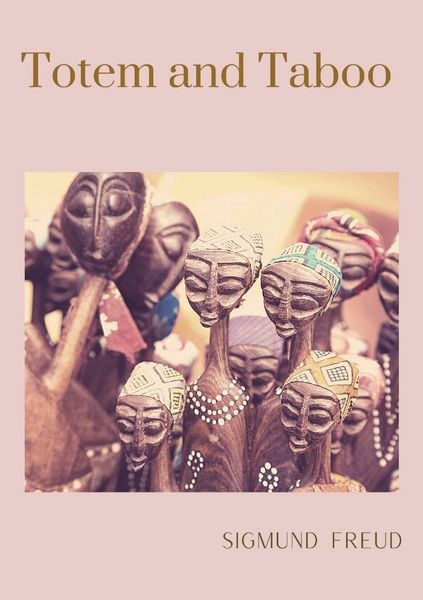

Totem and Taboo A 1913 book by Sigmund Freud, the founder of psychoanalysis, in which the author applies his work to the fields of archaeology, anthropology of religion. It is a collection of 4 essays inspired by the work of Wilhelm Wundt and Carl Jung.
-
- Hardcover
- Taschenbuch ausgewählt
- eBook
- Hörbuch
-
Sprache:Englisch
-
Verlag:Les Prairies Numeriques
- Lector House 17,99 €
- Les Prairies Numeriques 19,99 € ausgewählt
- W. W. Norton & Company 14,99 €
- Outlook 19,99 €
- Vintage USA 25,99 €
- Hatala Geroproducts 9,99 €
- Dover Publications Inc. 9,99 €
- Lushena Books 31,99 €
- Random House N.Y. 22,99 €
- Martino Fine Books 18,99 €
- Alpha Edition 21,99 €
- Cosimo 18,99 €
- Digireads.com 14,99 €
- Creative Media Partners, LLC 22,99 €
- Routledge Academic 36,99 €
- Union Square Kids 13,99 €
- Aziloth Books 15,99 €
19,99 €
inkl. gesetzl. MwSt.,
- Kostenlose Lieferung ab 30 € Einkaufswert
- Versandkostenfrei für Bonuscard-Kund*innen
Beschreibung
Produktdetails
Einband
Taschenbuch
Erscheinungsdatum
14.10.2020
Verlag
Les Prairies NumeriquesSeitenzahl
122
Maße (L/B/H)
21/14,8/0,8 cm
Gewicht
141 g
Übersetzt von
James Strachey
Sprache
Englisch
ISBN
978-2-38274-343-0
Totem and Taboo by Sigmund Freud
- Totem and Taboo: Resemblances Between the Mental Lives of Savages and Neurotics, or Totem and Taboo: Some Points of Agreement between the Mental Lives of Savages and Neurotics, (German: Totem und Tabu: Einige Übereinstimmungen im Seelenleben der Wilden und der Neurotiker) is a 1913 book by Sigmund Freud, the founder of psychoanalysis, in which the author applies his work to the fields of archaeology, anthropology, and the study of religion. It is a collection of four essays inspired by the work of Wilhelm Wundt and Carl Jung and first published in the journal Imago (1912-13): "The Horror of Incest", "Taboo and Emotional Ambivalence", "Animism, Magic and the Omnipotence of Thoughts", and "The Return of Totemism in Childhood".
- Though Totem and Taboo has been seen as one of the classics of anthropology, comparable to Edward Burnett Tylor's Primitive Culture (1871) and Sir James George Frazer's The Golden Bough (1890), the work is now considered discredited by anthropologists. The cultural anthropologist Alfred L. Kroeber was an early critic of Totem and Taboo, publishing a critique of the work in 1920. Some authors have seen redeeming value in the work.Freud, who had a longstanding interest in social anthropology and was devoted to the study of archaeology and prehistory, wrote that the work of Wilhelm Wundt and Carl Jung provided him with his "first stimulus" to write the essays included in Totem and Taboo. The work was translated twice into English, first by Abraham Brill and later by James Strachey. Freud was influenced by the work of James George Frazer, including The Golden Bough (1890)."The Horror of Incest" concerns incest taboos adopted by societies believing in totemism.Freud examines the system of Totemism among the Australian Aborigines. Every clan has a totem (usually an animal, sometimes a plant or force of nature) and people are not allowed to marry those with the same totem as themselves. Freud examines this practice as preventing against incest. The totem is passed down hereditarily, either through the father or the mother. The relationship of father is also not just his father, but every man in the clan that, hypothetically, could have been his father. He relates this to the idea of young children calling all of their parents' friends as aunts and uncles. There are also further marriage classes, sometimes as many as eight, that group the totems together, and therefore limit a man's choice of partners. He also talks about the widespread practices amongst the cultures of the Pacific Islands and Africa of avoidance.
Noch keine Bewertungen vorhanden
Verfassen Sie die erste Bewertung zu diesem Artikel
Helfen Sie anderen Kundinnen und Kunden durch Ihre Meinung.
Kurze Frage zu unserer Seite
Vielen Dank für Ihr Feedback
Wir nutzen Ihr Feedback, um unsere Produktseiten zu verbessern. Bitte haben Sie Verständnis, dass wir Ihnen keine Rückmeldung geben können. Falls Sie Kontakt mit uns aufnehmen möchten, können Sie sich aber gerne an unseren Kund*innenservice wenden.
zum Kundenservice